

Walk-In Tub vs Walk-In Shower for Seniors — Which One Is Actually Right for Your Parent
In the spring of 2024, a woman named Dorothy, 74, from Phoenix, Arizona sat in a walk-in tub showroom for three hours with her daughter, weighing the decision. She was style-conscious, active, and had recently had knee surgery that made stepping over her standard tub edge feel risky. The salesperson showed her gleaming jets, heated backrests, and chromotherapy lighting. Dorothy was impressed. She nearly signed.
What the salesperson never mentioned — what almost no salesperson in this industry mentions — is that Dorothy would need to sit in a cooling tub for 10 to 15 minutes every single time, waiting for it to drain before she could open the door and stand up. Dorothy has arthritis. Sitting in cooling water is the last thing her joints need. She left without signing, and after consulting an occupational therapist, chose a walk-in shower instead. This guide exists so the next Dorothy does not need three hours in a showroom to get to that answer.
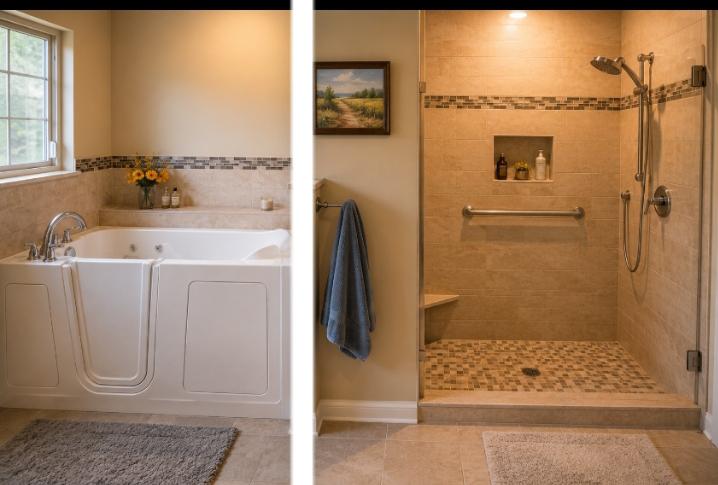
⚡ Before You Read Further
- Walk-in shower wins for most seniors — daily independence, no wait time, zero-threshold entry option, wheelchair compatible, easier caregiver assistance
- Walk-in tub wins specifically when therapeutic soaking (for arthritis, fibromyalgia, muscle pain) is a genuine priority and the senior can tolerate the fill-and-drain process
- Neither may be necessary if grab bars, a shower seat, and a handheld showerhead in the existing tub area solve the safety concern — always the cheapest first step
The Problem Nobody Mentions in the Showroom
A walk-in tub has a door built into its side. The process works like this: you open the door, step in, sit on the built-in seat, close the door, and then fill the tub. The door must remain closed while the tub fills and while you soak, because it is at the tub’s bottom edge — opening it with water inside means water on the floor.
When you are finished bathing, you drain the tub — and then you wait. Standard residential drains process 2–4 gallons per minute. A walk-in tub holds 50–80 gallons. At average drain speed, that is 12–40 minutes of sitting in a tub that is rapidly cooling before you can safely open the door and stand.
For a senior with arthritis, circulation issues, or simply a low tolerance for cold — which describes the majority of the walk-in tub’s target market — this is genuinely uncomfortable and sometimes genuinely problematic. Fast-drain kits reduce this time significantly, but they add $150–$300 to the project cost and are rarely included in the base quote.
What Dorothy’s occupational therapist told her: “A walk-in shower removes the hazard entirely. A walk-in tub manages the hazard while introducing a new one most people do not anticipate until they are already inside it.”
Full Comparison — Every Factor That Actually Matters
| Factor | Walk-In Tub | Walk-In Shower | Winner |
|---|---|---|---|
| Installation cost | $5,000–$10,000 | $4,000–$9,000 | ⚖️ Similar |
| Daily ease of use | Moderate — fill/drain wait | High — step in, shower, done | 🚿 Shower |
| Entry threshold | 3–5 inch step over | Zero threshold possible | 🚿 Shower |
| Wheelchair accessible | No | Yes — roll-in design | 🚿 Shower |
| Therapeutic soaking | Yes — jets available | No | 🛁 Tub |
| Time per bathing session | 45–90 minutes total | 10–20 minutes typical | 🚿 Shower |
| Grant fundability | Most states | All states | 🚿 Shower |
| Caregiver-assisted bathing | Difficult — enclosed space | Easier — open design | 🚿 Shower |
| Cold tolerance required | High — drain wait is cold | None | 🚿 Shower |
| Water heater requirement | Often needs upgrade (50+ gal) | No change needed | 🚿 Shower |
| Resale impact | Neutral to negative | Neutral to positive | 🚿 Shower |
When a Walk-In Tub Is Actually the Right Answer
There is a genuine population of seniors for whom a walk-in tub is the correct choice — and I want to describe that person accurately rather than dismiss the product entirely. Harold, 78, from Columbus, Ohio is a good example. Harold has Parkinson’s and significant lower-body muscle stiffness that responds well to warm water hydrotherapy. He takes a walk-in tub soak four times a week. He has a fast-drain kit installed and his wife stays nearby. For Harold, the walk-in tub was the right answer.
The ideal walk-in tub candidate shares most of Harold’s profile: takes baths (not showers) as their primary bathing method; has a genuine therapeutic need for soaking — arthritis, fibromyalgia, or post-surgical muscle pain — that a shower cannot address; can tolerate sitting during the drain period, ideally with a fast-drain kit installed; is not reliant on a wheelchair for mobility; and has someone nearby during bathing for safety.
If that describes your parent, a walk-in tub deserves serious consideration. If only some of it applies, consider whether a standard walk-in shower with a built-in bench and handheld showerhead might meet the same practical needs without the drain-wait issue. Use the Walk-In Tub Cost Calculator and the Bathroom Modification Cost Calculator side by side to compare full project costs before making any final decision.
Dorothy’s Decision — Phoenix, Arizona, April 2024
📋 Case Study — Dorothy, 74, Phoenix, Arizona — April–June 2024
Dorothy, 74, retired accountant, Phoenix, Arizona. Following knee replacement surgery in January 2024, her surgeon recommended avoiding stepping over her standard tub edge for at least six months. She and her daughter spent three hours in a walk-in tub showroom in April before leaving without buying anything.
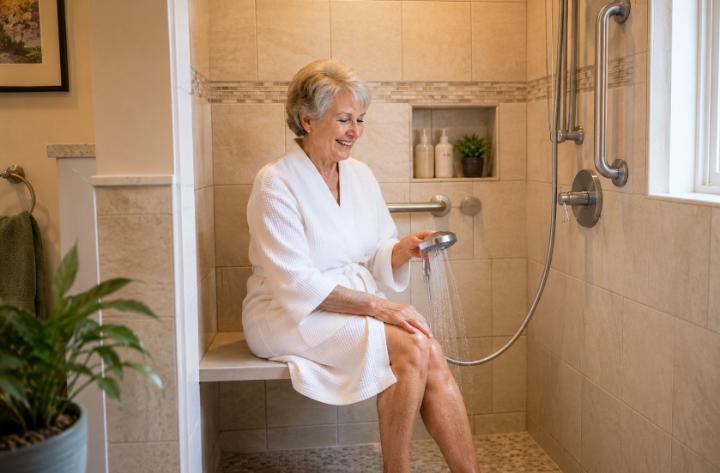
At her daughter’s insistence, Dorothy consulted an occupational therapist in May 2024. The OT walked through Dorothy’s bathroom, observed how she moved, and asked specifically whether Dorothy’s primary bathing preference was soaking or showering. Dorothy showered daily. She had not taken a bath in over seven years. The OT’s recommendation was immediate: a walk-in shower conversion.
The walk-in shower conversion was completed in June 2024, including a built-in teak bench, a handheld showerhead on a sliding bar, and three grab bars positioned where the OT had recommended. Total cost: $6,200. The equivalent walk-in tub from the showroom would have cost $9,400 plus a water heater upgrade. Dorothy reports using the shower daily without any of the drain-wait anxiety the tub would have required.
“The salesperson never asked me whether I actually took baths. Nobody asked. That one question would have saved me three hours in that showroom.”
Harold’s Decision — Columbus, Ohio, September 2023
Harold, 78, from Columbus, Ohio had lived with Parkinson’s for four years when his neurologist specifically recommended warm water hydrotherapy as a complement to his physical therapy. Harold had always been a bath person — his wife described him as someone who considered a shower “a way to get clean quickly” rather than an actual bathing experience.
His situation was the mirror image of Dorothy’s. He had a genuine therapeutic need. He preferred baths. His mobility was managed well enough that the low step-over threshold on a walk-in tub was manageable. His wife was present during bathing. He researched fast-drain kits before installation and had one specified in his contractor quote.
Harold’s walk-in tub with air jets and a fast-drain kit was installed in September 2023 for $8,100, partially offset by a grant through Ohio’s OHFA home repair program that covered $4,500 of the cost. He used it three to four times per week consistently. His physical therapist noted measurable improvement in lower-body muscle tension after six months of regular hydrotherapy use.
The distinction between Harold’s situation and Dorothy’s is the key variable in this entire comparison: does the senior actually take baths, and is there a therapeutic reason specific to soaking that a shower cannot replicate? If both answers are yes, a walk-in tub deserves serious consideration. If either answer is no, a walk-in shower is almost certainly the better fit.
Cost Reality — What Each Option Actually Runs in 2026
🛁 Walk-In Tub — Total Realistic Cost
- Unit: $2,000–$6,000
- Installation labor: $1,200–$3,000
- Plumbing modifications: $300–$1,200
- Water heater upgrade (often needed): $800–$1,800
- Fast-drain kit: $150–$300
- Electrical (jets/heater): $200–$800
- Realistic total: $5,000–$13,000
🚿 Walk-In Shower — Total Realistic Cost
- Conversion (basic): $3,500–$6,000
- Zero-threshold upgrade: $500–$1,500
- Bench/seat: $200–$800
- Grab bars (3–4): $300–$800
- Handheld showerhead: $40–$150
- No water heater upgrade needed
- Realistic total: $4,500–$9,500
Questions Worth Answering Before Any Decision
Can you get grants for both options? Yes — both qualify under bathroom accessibility modification programs in most states. Walk-in showers tend to be funded more readily because they serve a broader population including wheelchair users. Use the Walk-In Tub Cost Calculator to understand the grant-relevant cost range for the tub option.
Which is faster to install? A walk-in shower conversion from an existing tub space typically takes 1–3 days. A walk-in tub installation runs 1–2 days for the unit but frequently requires additional plumbing and electrical work that adds 1–2 more days in older homes.
What if my parent insists on a tub? A transfer bench placed across the existing tub edge, paired with a handheld showerhead, is a $60–$150 interim solution worth trying first. It allows showering while seated, eliminates the step-over risk, and costs a fraction of either permanent option. If it works, you have saved thousands. If it doesn’t, the permanent decision becomes clearer.
Does a walk-in tub require a bigger water heater? Almost always, yes. A walk-in tub holds 50–80 gallons. Most residential water heaters hold 40–50 gallons. Without an upgrade, the tub will run cold before it fills. Factor this cost — $800–$1,800 — into any walk-in tub budget before comparing it to a shower conversion price.
What does an occupational therapist recommend? Every OT I have discussed this with leads with the same question Dorothy’s did: “Does your parent currently take baths or showers?” The answer almost always determines the recommendation. OT consultations for home bathroom safety typically cost $150–$300 and are worth it for any project over $5,000.
🔗 Walk-In Tub Resource Cluster
What Family Caregivers Need to Know Before Choosing
Most of the conversation around this comparison focuses on the senior’s experience. But if a caregiver — whether a spouse, adult child, or professional home health aide — is regularly assisting with bathing, the choice between a walk-in tub and a walk-in shower has a very different calculus from the caregiver’s side.
Assisting someone inside a walk-in tub is physically awkward. The caregiver must reach over or around the door opening, work within a confined and slippery space, and manage the fill and drain process while keeping the senior safe and comfortable. For a senior who needs regular physical assistance during bathing — rather than just the safety backup of having someone nearby — a walk-in shower is almost always the more practical option for the caregiver as well.
A roll-in shower — the widest, most accessible walk-in shower configuration — allows a caregiver to stand alongside the senior or even bring a shower wheelchair inside. This design, which costs perhaps $1,000–$2,000 more than a standard walk-in shower conversion, is the gold standard for seniors who need close physical assistance during bathing. No walk-in tub design offers anything comparable.
Planning for Changing Needs Over Time
One of the most important questions in this decision — and one that almost never gets asked in a showroom — is not “what does my parent need now?” but “what will they need in three to five years?”
A senior with mild balance concerns at 72 may be using a walker by 77 and a wheelchair by 82. A walk-in tub installed at 72 becomes increasingly difficult to use as mobility declines, because it still requires stepping over a threshold — even a low one — and managing the entry door while seated. A zero-threshold walk-in shower, by contrast, accommodates walkers, shower wheelchairs, and caregiver assistance with no modification as needs change.
According to the CDC’s Older Adult Falls Prevention program, bathroom modifications can help reduce fall risks and support older adults in remaining independent at home.
This forward-looking lens is one of the reasons occupational therapists almost universally lean toward walk-in showers over walk-in tubs for most seniors — not because tubs are worse products, but because showers remain useful across a wider range of future mobility scenarios than tubs do.
What to Actually Do This Week Before Spending Anything
Dorothy spent three hours in a showroom before getting an occupational therapy consultation that took 45 minutes and gave her the answer the showroom never did. I would reverse that sequence entirely.
- Try the $60 test first: A bath transfer bench and a handheld showerhead is a $60–$150 interim solution. If it solves the safety problem for six to twelve months, it buys time to make a careful permanent decision without pressure.
- Ask the one question the showroom won’t: Does your parent currently take baths or showers? The answer almost determines the right option on its own. If they shower, a walk-in tub is almost never the right answer. If they bathe and have a therapeutic reason for soaking, the tub deserves consideration.
- Consult an occupational therapist before a contractor: An OT assessment costs $150–$300 and will tell you specifically what your parent’s bathroom needs based on how they actually move — not based on what a commission-motivated salesperson wants to sell them.
- Get cost estimates for both options before deciding: Use the Bathroom Modification Cost Calculator for a walk-in shower estimate and the Walk-In Tub Cost Calculator for the tub option — including the water heater upgrade cost — before speaking to any contractor.
- Check grant eligibility before committing to a budget: Both options are funded in most states. Knowing what grants are available in your state before finalizing a project budget can change the entire financial picture. Call 211 or check the state-by-state grant guide for your specific location.
For additional guidance on adapting a home for safer aging, the
National Institute on Aging’s Aging in Place guide
provides practical recommendations for planning home modifications before mobility needs become more significant.
The Decision Comes Down to One Honest Question
Dorothy walked out of that showroom without buying anything because nobody asked her the one question that would have saved everyone’s time: does she take baths? Harold’s walk-in tub was the right choice because he answered yes — and had a specific therapeutic reason behind it.
Strip away the marketing, the jets, the chromotherapy lighting, and the TV commercials. The honest comparison between a walk-in tub and a walk-in shower comes down to one question and one honest answer about whether the person you are making this decision for actually soaks in a bath — and whether there is a genuine therapeutic reason that soaking serves better than a shower seat ever could.
If the answer is yes on both counts: explore the walk-in tub, specify a fast-drain kit upfront, verify the water heater capacity, and check grant eligibility in your state. If the answer is no on either count: a zero-threshold walk-in shower with a built-in bench and three well-placed grab bars will serve your parent better, cost less, and remain useful as their mobility changes over the coming years.