

CAREGIVER GUIDE
Struggling to Get Your Parent into the Bathtub? Discover Wheelchair-Accessible Walk-In Tubs
7:40 p.m. Bathroom doorway.
Daughter: “Okay, Dad. Hand on the wall. Lift your foot.”
Dad: “I know how to take a bath, honey. I have been doing it since Eisenhower.”
Daughter: “I know. Lift anyway.”
Silence. A towel falls. Somebody sighs. If that scene feels familiar, keep reading.
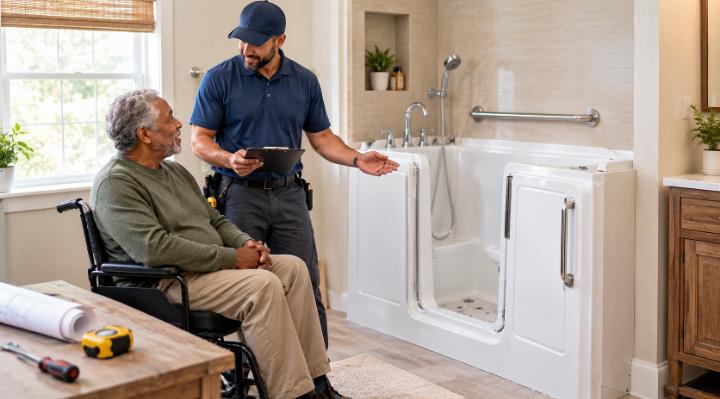
“An ounce of prevention is worth a pound of cure.”
Benjamin Franklin
Bath-night trouble is easier to fix early than late. That is the whole reason I wrote this guide.
I spent a few evenings reading caregiver stories and comparing bath setups. One thing stood out. Almost nobody is bad at helping. The tub is just built for a different body. Check this article to understand more about wheelchair-accessible walk-in tubs for elderly parents and why they need it.
The fast answer: If you are struggling to get your parent into the bathtub, wheelchair-accessible walk-in tubs can make the move much simpler.
They have a low side door, a built-in seat, and, on transfer models, an outswing door with room to slide over from a chair.
Before you buy, check the seat width, the tub length, and the floor space in your bathroom. Then get every number in writing.
Heads up: I may earn a commission if you buy through my Ella’s Bubbles links. You pay the same price, and I only recommend what I would double check for my own family.
00Skim This First
- ✓Bath time gets hard because tub walls are high, floors are wet, and bodies change.
- ✓Wheelchair-accessible walk-in tubs swap the high step for a side door and a seat.
- ✓An outswing door gives a parent and a helper more room to move over.
- ✓Seat width and tub length matter more than most people expect.
- ✓Measure the bathroom and the path to it before you shop.
- ✓Ask about water heaters, plumbing, and power. They are the hidden costs.
01Why Getting a Parent Into the Bathtub Gets So Hard
Families tell me they only start looking at wheelchair-accessible walk-in tubs after a hard night. I would rather you look before.
Nobody warns you about this part of caregiving. One day your parent is fine. A few months later, a bath feels like a small mountain climb.
Here is what I see over and over when families describe bath time. It is rarely one big problem. It is five small ones stacked on top of each other.
The tub-edge pile-up
- ✓The step is high. Lifting a leg over a tub wall takes hip strength and balance.
- ✓The floor is slick. Water and soap turn a safe floor into a skating rink.
- ✓The lowering is scary. Sitting down into a deep tub needs strong legs and a steady grip.
- ✓The getting out is worse. Wet skin, tired muscles, and a deep tub make standing up a fight.
- ✓Nothing to grab. Towel bars were never built to hold a person.
- ✓Pride gets in the way. Parents hide how hard it feels because they hate being helped.
The CDC runs a program called STEADI to help older adults and families look at fall risk. It is worth a read. See the CDC STEADI page.
None of this means your parent is weak. It means a standard tub asks for a lot, and a lot gets harder every year.

02Quick Quiz: Is the Bathtub the Real Problem?
Tap each question. No score, no judgment. It just helps you see what you are dealing with.
Does your parent hold the wall or sink to get in?
That is a sign the tub wall is asking for more balance than they have on a wet day.
Do they only bathe when someone is home?
Waiting for a helper is a quiet sign of worry. It also makes baths feel like a favor, which hurts pride.
Have baths turned into sponge washes?
Skipping real baths is one of the most common signs I see families describe. Do not wave it off.
Do you or a sibling lift or steady them?
If you are doing the lifting, your back is part of this problem too.
Do they look wiped out afterward?
Tired and shaky after a bath is a signal to talk to their doctor and look at the setup.
A couple of yes answers? Take the Senivly aging-in-place readiness quiz. It takes a few minutes and shows which rooms to look at first.
03How Wheelchair-Accessible Walk-In Tubs Make the Move Easier
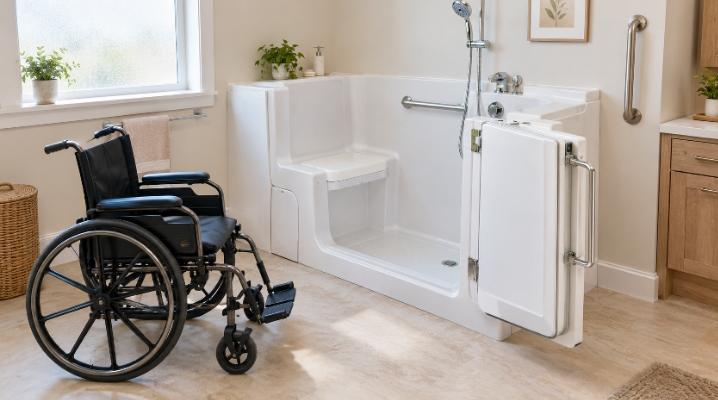
A walk-in tub swaps the high step for a low door in the side. Your parent sits on a built-in seat, the door closes, and then the tub fills.
That already removes the scariest part: lifting a leg over a tall wall. But for wheelchair users and helpers, the real magic is the door and the layout.
Why the outswing door matters
An outswing door opens away from the seat. That leaves an open path, so a wheelchair can park close and your parent can slide across.
With an inswing door, the door sweeps into the same space your parent needs. Picture two people trying to pass in a narrow hallway. Same idea.
There is a catch. The door needs floor space to swing. So you must draw that arc on a floor plan before you buy. A tape measure is the cheapest therapist you will ever hire.
Why the L-shaped design helps
In an L-shaped transfer tub, the seat sits in a shorter section with room around it. That gives your parent a clear spot to sit down, turn, and settle in.
It also gives the helper a place to stand. No leaning over the wall, no twisting your back, no awkward grip on a wet arm.
📍 Milwaukee, Wisconsin, January 2026
The Door That Changed Bath Night
Picture a Tuesday night in Milwaukee. Ruth, 55, is helping her mother Evelyn, 83, who uses a wheelchair after a stroke. The bathroom is small. The tub wall comes up past Evelyn’s knee.
Every bath is a two-person production with a lot of whispering. Evelyn starts saying she’s “just not that dirty.” Ruth laughs, but she lies awake that night.
A friend mentions a transfer tub with an outswing door. Ruth does not buy anything yet. She just measures: the room, the door, and her mom’s chair.
The measurements show the door swing fits if the little vanity moves six inches. That is a one-afternoon fix, not a remodel.
Months later, Ruth says the biggest change is not the tub. It is that Evelyn picks her own radio station and shuts the door.
04Seat Width and Entry Space: Why a Few Inches Matter So Much
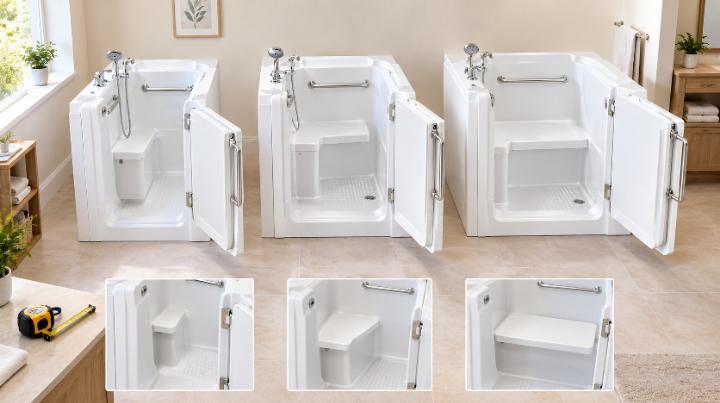
Here is where I see families trip up. They look at tub size and forget about seat size. But your parent sits on the seat, not the outer shell.
A seat that is too tight pinches hips and makes sliding in a chore. A seat that is too roomy can leave a parent feeling unsteady.
The five Ella’s Bubbles transfer sizes below show how much the numbers can differ. Confirm all specs with the maker before you buy.
| Model | Tub size (W × L) | Seat width | Where it may fit |
|---|---|---|---|
| Transfer26 | 26" × 52" | 19" | Narrow bathrooms, smaller frames |
| Transfer30 | 30" × 52" | 22" | Standard tub alcoves |
| Transfer32 | 32" × 52" | 24" | Parents wanting more seat room |
| Transfer60 | 30" × 60" | 22" | Taller parents, longer bathing space |
| TransferXXL | 36" × 55" | 29" | Larger frames needing a wide seat |
How to measure your parent for the seat
- Have your parent sit on a hard, flat chair.
- Measure across the widest point of the hips, from side to side.
- Write down the number, then add a little breathing room.
- Measure the wheelchair width too. Footrests and armrests count.
- Show both numbers to the seller and ask what they recommend.
I would also ask a physical or occupational therapist to look at the plan. They know how your parent moves, and that matters more than any chart.
📍 Greenville, South Carolina, March 2026
Three Inches and a Lot of Coffee
Picture Marcus, 47, at his kitchen table with a measuring tape and a legal pad. His dad, Walter, 79, is a big man with a bad knee and a great sense of humor.
Marcus first looks at the smallest tub because the bathroom is tight. Then he measures Walter’s hips. The seat would have been about an inch too snug. Walter would never complain, which is the problem.
He moves to a wider seat and checks the floor space again. It takes another hour with the tape measure and a lot of muttering.
Walter’s review of the plan: “Finally, someone built a seat for a human being.” Marcus writes that on the legal pad and underlines it twice.
05Measure Your Bathroom Before You Shop for Wheelchair-Accessible Walk-In Tubs
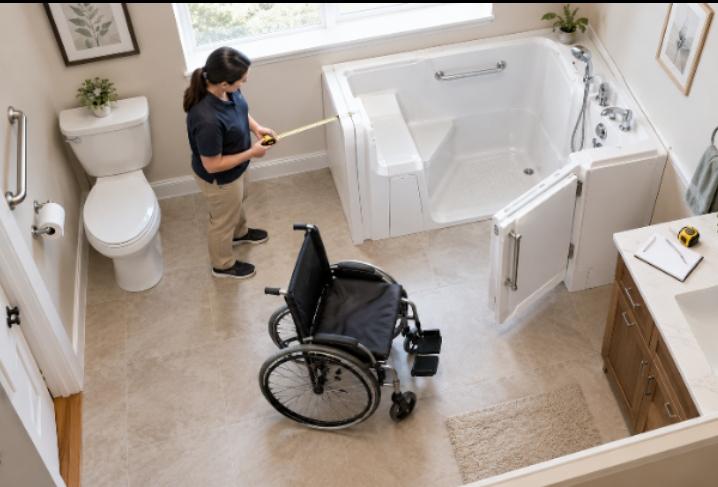
This is the boring part that saves the most money. Fifteen minutes with a tape measure can keep you from buying a tub that will not fit.
The ADA standards use a 60 inch turning space as a common wheelchair reference. They apply to public buildings, not homes, but the numbers are handy. Browse the ADA standards.
| What to measure | Why it matters |
|---|---|
| Current tub space (W × L) | Sets the size of tub that can drop in. |
| Bathroom door width | The tub and wheelchair both need to pass. |
| Hallway width to the bathroom | A tight turn can block a chair. |
| Floor space beside the tub | Where the wheelchair will park. |
| Door swing zone | The outswing door needs open floor. |
| Toilet and sink distance | Fixtures can block the swing. |
| Wheelchair width and seat height | Helps compare to the tub seat. |
Jot each number on your phone or a sticky note as you go. Take a photo of every spot too. When you call a seller, those photos answer half their questions before they ask.
Not sure what the whole project might cost? The Senivly home modification cost calculator gives you a rough range for the tub, the install, and extras you may not have thought about.
06Installation Requirements: What the Brochure Does Not Mention
A tub is not a plug-and-play gadget. Somebody has to remove the old one, hook up the new one, and make sure the floor can handle it.
The usual checklist
- ✓Plumbing: The drain and valves may need to move.
- ✓Power: Some models need a dedicated circuit with a GFCI.
- ✓Water heater: A small tank can run out of hot water before the tub fills.
- ✓Floor and walls: They may need extra support or new tile.
- ✓Access: The old tub has to get out, and the new one has to get in.
- ✓Permits: Ask who handles permits and inspections.
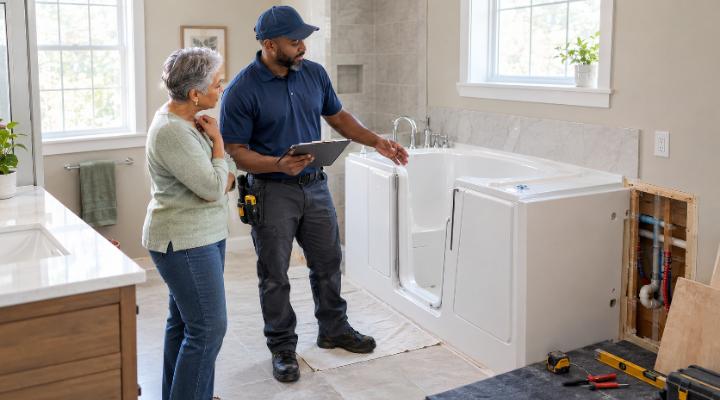
Many suppliers quote walk-in tubs from a few thousand dollars to well over ten thousand, with install often extra. Get everything itemized in writing.
📍 Albuquerque, New Mexico, September 2025
The Cold Bath Nobody Mentioned
Picture Donna, 61, who just had a lovely tub installed for her husband Ray, 74. The first bath is a big moment. She fills it, Ray gets in, and everyone smiles.
By the time the tub is full, the water is lukewarm. Ray, polite as ever, says it’s “fine.” Donna can tell it is not fine.
The old water heater was too small. Nobody had asked about that on the sales call. A bigger heater fixes it, but it adds to the bill.
Her advice to friends now is short: “Ask how much hot water it takes before you sign anything.”
Renting? You have extra questions, starting with your landlord. I wrote a guide on making a rental safer for an elderly parent without renovations that covers what to try first.
07Walk-In Tub, Walk-In Shower, or Something Simpler?
I will be honest: a walk-in tub is not the answer for every parent. If your parent never soaks, a shower may be a better fit. Run the numbers on both.
| Option | What I like | What to watch |
|---|---|---|
| Wheelchair-accessible walk-in tub | Seated soak, low entry, room to transfer. | Cost, fill and drain time, floor space. |
| Walk-in or roll-in shower | Fast, simple, no tub wall at all. | No soaking, may need a remodel. |
| Tub transfer bench | Low cost, keeps your current tub. | Still means lifting legs over the rim. |
| Grab bars | Cheap and quick to add. | Do not remove the high step. |
| Bath lift | Raises and lowers a parent in the tub. | Needs a usable tub and a battery or power. |
Thinking about the shower route? Compare the price with the Senivly walk-in shower cost calculator. Seeing both numbers makes the choice much less stressful.
08The Room Around the Tub Matters Too
A tub only works as well as the room it sits in. I have seen families spend big on a tub and forget the floor, the light, and the path to the toilet.
- ✓Floors: Slick tile is a problem even with the best tub.
- ✓Lighting: Older eyes need more light and less glare, especially at night.
- ✓Clutter: A laundry basket in the wrong spot can block a wheelchair.
- ✓Towels and soap: Keep them within arm’s reach of the seat.
Slippery floors? The non-slip flooring cost calculator shows what better traction might cost. It is often cheaper than people guess.
Light matters more than people think. My guide on the best lighting height for aging eyes explains where to put bulbs so hallways and bathrooms feel clear.
Want a full walk-through of the house? Use the 20 ways to make your home safer list. It covers more than the bathroom.
09Where Ella’s Bubbles Fits for Wheelchair-Accessible Walk-In Tubs
Ella’s Bubbles makes a transfer-focused range of wheelchair-accessible walk-in tubs. I include it because the five sizes let you match a tub to a real person and a real bathroom.
Not every family needs the same thing. A 26 inch tub and a 36 inch tub solve very different problems. Having both on one menu makes comparing easier.
Ella’s Bubbles may suit you if…
- ✓ You want an outswing-door transfer design.
- ✓ You need a wide seat option, up to 29 inches.
- ✓ You want to compare several sizes before choosing.
Verify before you buy
- ✓ Exact door opening, seat height, and transfer room.
- ✓ Weight rating and who each model suits.
- ✓ Warranty terms, including labor and the door seal.
- ✓ Install needs, lead times, and local rules.
Still, get at least two other quotes. A company that likes its product will not mind questions or comparisons.
10Questions to Ask Before You Buy
Print these and keep them near the phone. I split them in two lists, because some answers come from the seller and some come from you.
Ask the seller
- What are the exact tub size, seat width, seat height, and door opening?
- Is the door an outswing design, and how much floor does it need?
- What is the weight capacity?
- How fast does the tub fill and drain?
- How much hot water does it use?
- What plumbing and electrical work is needed?
- Do you install, or do I hire my own installer?
- What is the warranty on the shell, door seal, and pumps?
- What is the lead time, and what is the return policy?
Ask yourself and your parent
- Does my parent want to soak, or just get clean?
- Can they sit comfortably and move over from their chair?
- Is the route from the bedroom to the bathroom clear?
- Who will help, and are they comfortable doing it?
- What does the budget look like once install is added?
11Six Mistakes That Cost Families Time and Money
- Shopping before measuring. Door swings and doorways can end a plan fast.
- Ignoring the wheelchair. Footrests, armrests, and seat height all count.
- Skipping the therapist. They know how your parent moves.
- Forgetting hot water. Ask Donna and Ray about that lukewarm bath.
- Buying on looks. Comfort and easy controls come first.
- Leaving your parent out. It is their bathroom. Treat it that way.
12Before and After: One Bath Night, Two Setups
Numbers and measurements are useful, but I find a side-by-side story makes the change feel real. Here is a typical evening, before and after a transfer tub.
| Moment | With a standard tub | With a transfer-style walk-in tub |
|---|---|---|
| Getting to the bathroom | Walker or chair, tight turn, a pause at the door. | Same path, but cleared and measured first. |
| Getting in | Hand on wall, lift a leg, hold breath. | Open the door, move over, sit. |
| During the bath | Helper hovers, leaning over the wall. | Helper waits close, with room to stand. |
| Getting out | Wet skin, deep tub, a long push to stand. | Drain, open the door, move back to the chair. |
| How everyone feels | Tense, tired, a little embarrassed. | Calmer, more private, less rushed. |
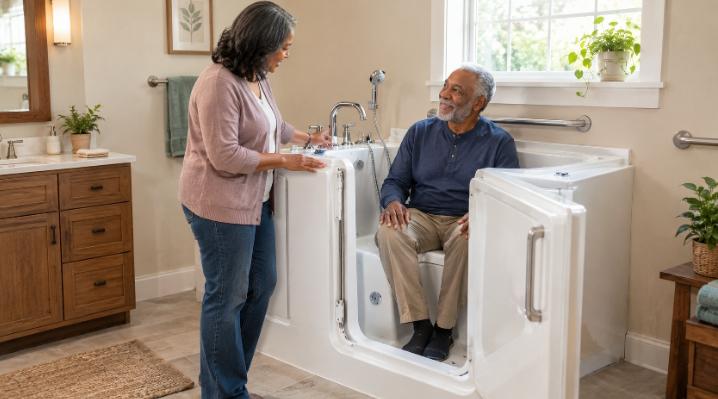
I am not promising a magic fix. A tub still needs good habits and a helper who knows the plan. But the mood shift is what families mention most.
📍 Sacramento, California, April 2026
Watching the Demo Video Twice
Picture Priya, 44, who lives across town from her father, Raj, 80. She works long hours and visits on weekends. Her brother helps on weekdays.
They both watch a demo video of a transfer tub. Priya pauses it at the door and says, “Wait, how far does that swing?” Her brother pulls out a tape measure.
They mark the swing on the bathroom floor with painter’s tape. It takes five minutes. The tape shows the door would hit the toilet by about four inches.
That tiny strip of blue tape saves them a very expensive mistake. They pick a different layout and ask the seller to confirm the swing in writing.
Raj, watching from the doorway, says only, “You two are spending my money like it’s yours.” Then he asks which color is cheapest.
Painter’s tape is my favorite trick for wheelchair-accessible walk-in tubs. Mark the tub footprint and the door swing on the floor. Then roll a chair through. You will see problems in seconds.
13What a Good Demo Should Show You
Whether you visit a showroom or watch a video, a demo tells you more than a brochure. Here is what I would want to see before I paid a deposit.
- ✓The door opening and closing, from the inside and the outside.
- ✓How the latch works for someone with weak or arthritic hands.
- ✓The seat height, and how a person actually slides onto it.
- ✓How fast the tub fills and drains, ideally on camera.
- ✓Where the grab bars and controls sit, and whether a seated person can reach them.
- ✓What the floor feels like, and whether it looks slippery.
If a company will not show these things, I would ask why. Good products usually look good on camera, and a confident seller likes to show them off.
Questions to ask during the demo
- ✓“How would my parent move from a chair to this seat?”
- ✓“What happens if the door seal gets worn?”
- ✓“How loud is the pump?”
- ✓“What would you change if you were buying this for your own mom?”
That last question is my favorite. People tell the truth when you ask what they would do for their own family.
14Long-Distance Helpers: What to Do When You Live Far Away
Plenty of readers live in a different city from their parents. If that is you, bath-night worries can keep you up at 2 a.m. I understand that.
📍 Tulsa, Oklahoma, February 2026
The Son Who Helped by Phone
Picture Andre, 52, who lives in Tulsa. His mother, Loretta, 81, lives in Memphis, Tennessee. She has told him a dozen times that she is “doing just fine.”
On a video call, Andre notices she keeps one hand on the sink the whole time she talks. He asks her to show him the bathroom. She sighs, then carries her tablet down the hall.
He sees the tub, the wet mat, and a towel over the faucet. He says nothing that night. He just asks, “Mom, what’s the hardest part of getting in there?”
She tells him. It takes twenty minutes. A local home safety pro visits the next week, and Andre starts comparing options on his phone.
Six ways to help from far away
- Do a video walk-through of the bathroom with your parent.
- Ask a trusted neighbor or relative to take photos and measurements.
- Book a visit from an occupational therapist if you can.
- Set up a regular check-in call around bath time.
- Research quotes and options, then share them with your parent.
- Offer to pay for part of the work, if you can, and say so kindly.
Phone and video are not perfect, but they work. The point is to listen, ask good questions, and let your parent make the final call.
15Three Signs It Is Time to Look at Wheelchair-Accessible Walk-In Tubs
You do not need a crisis to start shopping. I watch for three quiet signs, and any one of them is a good reason to begin looking.
Sign one: bath time has turned into a negotiation
When baths need bargaining, reminding, or a pep talk, something about the setup is off. Parents rarely dodge a bath for no reason.
Sign two: the helper is getting hurt or worn down
If the person helping has a sore back, a pulled shoulder, or a knot in their stomach every bath night, that matters just as much as the parent’s comfort.
Sign three: the tub is being avoided
A dry tub, a pile of unused towels, or a switch to sponge baths all say the same thing. The tub has become something to dodge instead of something to enjoy.
Spot one or more? That is your cue to measure, ask questions, and look at options. Wheelchair-accessible walk-in tubs are one of them, not the only one, and your parent deserves a real choice.
16What Parents Say vs. What They Mean
I love this one, because every family has heard these lines. Parents are not lying. They are protecting their pride, and that is a very human thing.
| What they say | What it might mean | What helps |
|---|---|---|
| “I’m fine, I don’t need help.” | “I hate needing help.” | Ask what part feels hardest, not whether they need help. |
| “I’ll take a bath later.” | “I’m scared of the tub.” | Offer a calm plan, not a lecture. |
| “That thing costs too much.” | “I don’t want to be a burden.” | Show the numbers and share the cost plan. |
| “I don’t like those hospital-looking things.” | “I don’t want to feel old.” | Show colors, finishes, and nice bathroom photos. |
| “Your mother never needed that.” | “Change is hard.” | Ask them to help pick, so it feels like their idea. |
Notice a pattern? Almost every line is about pride. Treat the conversation like a negotiation about their home, not a verdict on their body.
A few lines I like to use
- ✓“I’m not trying to take over. I just want baths to feel easier for you.”
- ✓“Want to look at a few options together? You pick.”
- ✓“If something goes wrong, I’d rather know the tub helped than wonder.”
📍 Dayton, Ohio, October 2025
The Argument About a Tub
Picture Carol, 63, trying to talk her father Frank, 86, into looking at accessible tubs. Frank is a retired machinist who fixed cars until last year.
Her first try goes badly. “I’m not a patient,” Frank says. Carol drops it and goes to the kitchen to bang pots around.
A week later she tries something new. She brings brochures and says, “Dad, you know tools. Tell me if this door design makes sense.”
Frank spends an hour on the hinge and the seal. He has opinions. Many opinions. By the end, he is the one saying, “Well, if I had to pick one, I’d want that one.”
Carol says the trick was making him the expert. He had been the fixer his whole life. She gave him a problem to fix.
17Who Might Help Pay for Wheelchair-Accessible Walk-In Tubs?
Cost is the big worry for most families, so let me be straight. I cannot promise any program will pay. But there are places worth a phone call.
- ✓Your Area Agency on Aging: They know local repair and modification programs. Use the Eldercare Locator to find yours.
- ✓The VA: Veterans may qualify for home modification help. Ask a VA benefits counselor.
- ✓State and local programs: Some states fund home changes for seniors. I cover several in the reading list below.
- ✓Medical expense rules: Some medically needed changes may count for tax purposes. Ask a tax pro.
- ✓Family: Siblings can split costs. Write down who pays what and when.
Rules change often, and approval is never guaranteed. Always check current details with the program itself before you plan around it.
Ask early. Some programs have waiting lists, and a few months can pass between a call and a decision. Starting the paperwork before a crisis saves a lot of stress.
18The Caregiver Side: Your Back Counts Too
I want to say something directly to the person reading this. If you have been lifting, steadying, and worrying, you are tired. That is not weakness. That is math.
The Family Caregiver Alliance has solid tips for people in your spot. Visit the Family Caregiver Alliance. Please look. You deserve support too.
📍 Phoenix, Arizona, June 2026
The Back That Said Enough
Picture Teresa, 49, helping her mother, 82, with baths three times a week. Teresa works full time and picks up her kids after school.
One Thursday she bends over the tub wall and feels something tweak in her lower back. She finishes the bath. She does not tell anyone.
The next morning she can barely stand up straight. That is when she realizes the bath routine is not just her mom’s problem. It is hers too.
She calls her mother’s doctor, asks about a therapist visit, and starts reading about transfer tubs. Her message to other caregivers is simple: “Do not wait until your back makes the decision for you.”
- ✓Ask a therapist to show safe ways to help someone move.
- ✓Wear shoes with grip, even inside the house.
- ✓Set out towels, soap, and a robe before the bath starts.
- ✓Never lift more than your training and body allow.
- ✓Share the routine. A sibling or aide can take a day or two.
19Safety Net: What If Something Goes Wrong in the Bathroom?
A good tub helps. It does not replace a plan. I like families to have a simple safety net, especially when a parent bathes alone.
- ✓Keep a phone or call button within reach of the tub area.
- ✓Agree on a check-in signal, like a knock and a spoken reply.
- ✓Post emergency numbers and medication details near the bathroom.
- ✓Ask how quickly the tub drains and how the door opens from outside.
- ✓Skip hot, long baths if the doctor has raised heart or dizziness concerns.
Worried about falls when you are not around? Read about medical alert systems with fall detection. A wearable button near the bathroom can add peace of mind.
A note from me
No tub, button, or bar can promise to stop every fall. They are tools. Your parent’s doctor and care team should have the final say on how and when to bathe.
20A Simple Plan for Struggling Families
If you are overwhelmed, do not try to fix everything at once. Here is the order I would follow, one small step at a time.
- Talk with your parent about the hardest part of bathing.
- Call the doctor or therapist and ask about transfers and hot water.
- Measure the bathroom, the doorway, and the wheelchair.
- Set a rough budget with a calculator.
- Request written quotes from two or three companies.
- Ask for a video or showroom demo of the door and seat.
- Choose together, then hire a licensed installer.
Do this today, even if you do nothing else
Grab a tape measure. Measure the bathroom door. Write the number on a sticky note and put it on the fridge. That is step one, and it takes thirty seconds.
The first-week plan once the tub is in
Do a dry run first. Practice the move with the door open and no water. Let your parent sit, wiggle, and ask questions.
Then try a short, shallow bath with the care team’s blessing. Check the water with a thermometer, since older skin can be sensitive to heat.
Write down anything that feels awkward. Tiny changes, like where the towel hangs, can make bath time smoother within days.
21Jokes, Because You Have Earned One
Caregiving is serious. But humor keeps people sane, and I have collected a few bathroom groaners that make my own family laugh.
- ✓Why did the bathtub go to therapy? Too many drain issues.
- ✓What do you call a tub that always listens? A good soaker.
- ✓Why do parents love walk-in tubs? Finally, a tub that lets them sit down before the water shows up.
Bad? Sure. But next time bath night gets tense, try one. Even a groan counts as a win.
22Frequently Asked Questions About Wheelchair-Accessible Walk-In Tubs
How do I get an elderly parent into the bathtub safely?
Ask their doctor or therapist to teach a safe method for your parent. Helpers, grab bars, and tub design can all play a part. A walk-in tub removes the high step.
What makes wheelchair-accessible walk-in tubs different?
They add transfer-friendly details, like an outswing door, a seat of fitting width, and room for a chair to park. Features vary, so confirm with the maker.
Do wheelchair-accessible walk-in tubs fit in a small bathroom?
Some sizes fit tight spaces, but the door needs room to swing. Measure the room, the door arc, and the path in before you buy.
How wide should the seat be?
It should fit your parent without squeezing or leaving too much gap. Measure hips while seated and ask a therapist or supplier to check the match.
Can a walk-in tub stop falls?
No product can promise that. A low-entry tub removes the need to step over a high wall, but safe habits and help still matter.
What does installation involve?
It can include removing the old tub, moving plumbing, adding power, and checking the floor. Ask for an itemized quote and a written timeline.
Is a walk-in shower better?
It depends on your parent. If they never soak and want quick baths, a shower may work better. If they love soaking, a tub may suit them.
Can I add a walk-in tub if I rent?
You will need your landlord’s permission, and many rentals will say no. Ask first, and look at simpler fixes if the answer is no.
23Final Thoughts: Make Bath Time Less Stressful
If getting your parent into the bathtub feels like a daily fight, it is not a failure. It is a signal that the setup no longer fits.
Wheelchair-accessible walk-in tubs exist because plenty of families have been there.
Wheelchair-accessible walk-in tubs will not fix every bathing problem. But for many families, an outswing door, the right seat, and a clear plan can turn bath night from a standoff into a routine.
Measure first. Include your parent. Ask hard questions. Compare more than one company. Then choose from a calm place, not a worried one.
“A journey of a thousand miles begins with a single step.”
Lao Tzu
Your single step can be small. Grab a tape measure and measure the bathroom door today.
Make bathing less stressful for your family.
Discover accessible bathing solutions that can help make transfers easier and more comfortable.
Your turn
What is the funniest or hardest thing that has happened during bath time with your parent? Tell me in the comments. Your story might help another family feel less alone tonight.
And if you have a tip that worked, share that too. I read every comment.
24Keep Reading
- ➜Texas home modification grants for seniors in 2026
- ➜Florida home modification grants for seniors in 2026
- ➜California home modification grants for seniors in 2026
- ➜New York home modification grants for seniors in 2026
- ➜Medical alert watch vs pendant: which is right for you in 2026
This article is general information, not medical, legal, or financial advice. Talk with your parent’s healthcare team and a licensed installer before making changes.