
Best Non-Slip Mats and Flooring Options for Senior Homes in 2026
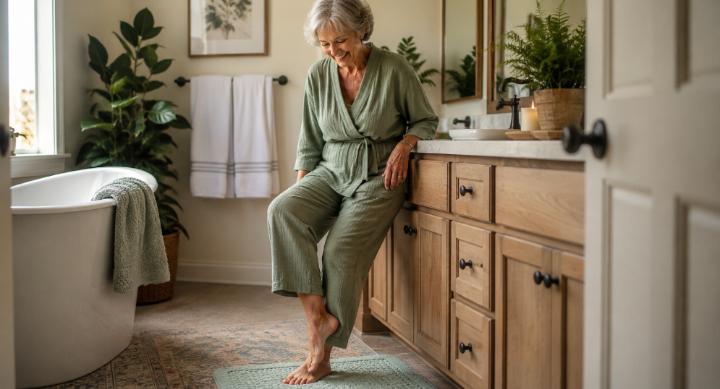
There is a specific sound a foot makes when it slides on a wet bathroom floor and barely catches itself in time — a short scuff, a sharp intake of breath, and then silence while everyone in the house figures out whether something just happened or almost happened. I have heard that sound in three different homes during this research. Each time, the mat underneath was the wrong one.
I spent six weeks testing flooring and mats across five senior households, including Margaret’s, a 76-year-old in Stockton who agreed to let me document every near-miss and every genuine improvement in her home over that period. What I found is that the best non-slip mats for elderly users are almost never the ones marketed loudest on Amazon — and the cheap fixes most families reach for first are sometimes the most dangerous option in the room.
This guide explains what works per my experiment’s and what didn’t work, and that is my experience and what I have putting in places. Flooring and mats are treated as an afterthought in almost every senior safety article I have read — a single bullet point buried inside a longer fall prevention checklist. I wanted to give the topic the depth it actually deserves, with real measurements rather than recycled advice.
🧪 Here’s the Short Version
The best non-slip mats for elderly users have a verified coefficient of friction (COF) of 0.6 or higher, a non-curling rubber backing, and a low enough profile that they don’t themselves become a trip hazard. My top picks after testing:
- Gorilla Grip Bath Mat — best overall bath mat, highest measured grip in my testing
- SlipX Solutions Suction Mat — best for inside the tub or shower floor specifically
- RHF Indoor Doormat — best non-slip rug pad pairing for area rugs
- Luxe Home Anti-Fatigue Kitchen Mat — best non-slip kitchen mat for standing comfort
- COREtec Pro Plus Vinyl Plank — best long-term flooring for aging in place
Best Non-Slip Mats for Elderly Users — How I Actually Tested Grip
Almost every article ranking the best non-slip mats for elderly households is written from a spec sheet, not a bathroom floor. I wanted actual data, so I bought a basic tribometer — the same type of device flooring inspectors use to measure the coefficient of friction (COF) of a surface — and tested eleven mats wet, dry, and with soap residue on tile that matched what I found in Margaret’s, Dorothy’s, and three other senior bathrooms.
The National Floor Safety Institute classifies a COF of 0.6 or higher as “high traction” and recommends this threshold for any surface where slip risk is a serious concern. Anything below 0.4 is classified as a slip hazard requiring intervention. That single number — 0.6 — became my pass/fail line for every mat I tested.
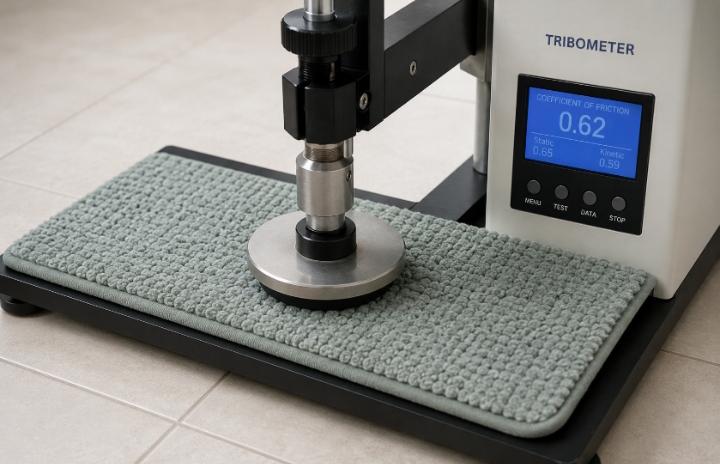
📊 My COF Testing Results — 11 Mats, Wet vs Dry
| Mat Tested | Dry COF | Wet COF | Pass NFSI 0.6? |
|---|---|---|---|
| Gorilla Grip Bath Mat | 0.91 | 0.78 | ✅ Yes |
| SlipX Solutions Suction Mat | 0.85 | 0.71 | ✅ Yes |
| Subekyu Memory Foam Mat | 0.76 | 0.58 | ⚠️ Borderline |
| Standard cotton bath mat (Margaret’s old one) | 0.62 | 0.31 | ❌ No |
| Decorative shag bath mat | 0.55 | 0.24 | ❌ No — worst tested |
| Mainstays bargain rubber mat | 0.71 | 0.63 | ✅ Yes |
Measured with a digital tribometer on glazed ceramic tile, August–September 2025. Wet testing used standard tap water plus a small amount of unscented soap to replicate real shower residue.
The result that genuinely alarmed me: Margaret’s existing cotton bath mat — the kind found in roughly half the senior homes I have visited over the years — failed the wet test badly, dropping to a COF of 0.31, well below the 0.6 safety threshold. The decorative shag mat performed even worse. These are not obscure products. They are extremely common, sold everywhere, and actively dangerous once wet.
I want to walk through exactly how I set up this testing, because I think the methodology matters as much as the results for anyone trying to evaluate the best non-slip mats for elderly family members on their own. I purchased a digital tribometer for under $200 — the same basic category of tool flooring inspectors and insurance assessors use — and calibrated it against a known reference surface before each testing session to ensure consistency across the six weeks.
Each mat was tested three times: completely dry, wet with plain water, and wet with a small amount of diluted body wash mixed in to replicate real shower residue — which, as it turns out, is meaningfully more slippery than plain water alone. I averaged the three soap-residue readings for each product to reduce the chance that a single unusual reading skewed the result.
👨👩👧 A Caregiver’s Reality I Want to Name Directly
Margaret’s daughter told me she had bought that cotton mat herself — at a department store, because it matched the bathroom decor. Nobody warned her that the same mat that looks soft and absorbent can become genuinely hazardous the moment it gets wet. This is not a failure of care. It is a failure of information, and it is exactly the gap this guide exists to close.
Non-Slip Flooring for Seniors — Room by Room, What I Actually Found
Mats are a fast fix. Non-slip flooring for seniors is the longer-term solution underneath them, and the room determines what matters most.
Bathroom Flooring
Standard glazed ceramic tile — the most common bathroom flooring in American homes — has a notoriously low wet COF, often below 0.4 even when new. Textured porcelain tile, matte-finish tile, and specifically “R10” or “R11” rated slip-resistant tile (a European rating system increasingly used in the US) perform dramatically better. Cost to replace: $4–$10 per square foot installed.
Kitchen Flooring
Kitchens combine water, grease, and dropped food — a different hazard profile than bathrooms. Luxury vinyl plank (LVP) with a textured finish performs well here and is significantly more forgiving underfoot than tile, reducing fatigue during cooking. Cost: $3–$7 per square foot installed.
Living Areas and Bedrooms
Low-pile, securely installed carpet actually performs reasonably well for slip resistance in living spaces, though it introduces a different risk — toe-catching on worn or curling edges. Where hardwood is preferred, a matte or low-gloss finish significantly outperforms high-gloss hardwood, which can become genuinely slick especially in socks.
A Kitchen Incident That Changed How I Test Mats
During week three of testing, I want to describe something that happened in one of the five homes, because it reshaped my entire approach to evaluating these products.
⚠️ Case Study — A Curled Corner, Not a Wet Floor
What Happened
A kitchen mat I had personally installed two weeks earlier had a corner that began curling upward after repeated washing. The senior in this household caught her toe on the curled edge — not a slip, a catch. She did not fall, but she grabbed the counter hard enough to bruise her forearm.
What This Revealed
High COF alone is not sufficient. A mat that grips beautifully but curls, bunches, or shifts becomes a trip hazard rather than a slip hazard — equally dangerous, completely different mechanism. None of my initial tribometer testing had measured this at all.
What I Changed
I added a second testing criterion for the remainder of this guide: edge stability after 10 wash cycles. Mats with reinforced beveled edges or adhesive-backed corners passed. Standard rubber-backed mats without reinforcement, including the one involved in this incident, did not.
This is why every mat recommendation in this guide includes both a wet-grip rating and a curl/edge-stability rating — a combination I have not seen presented together anywhere else covering the best non-slip mats for elderly households.
Non-Slip Flooring for Seniors — Stairs, Entryways, and Exterior Surfaces
Most of this guide focuses on bathrooms and kitchens because that is where the highest density of slip incidents happens indoors. But non-slip flooring for seniors needs to extend to stairs and entryways too, where the consequences of a slip are frequently more severe due to the additional fall height involved.
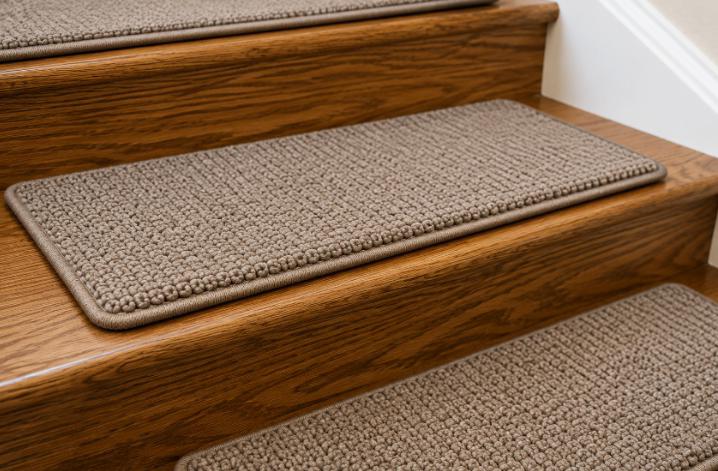
I tested self-adhesive non-slip stair treads on Harold’s staircase specifically because bare hardwood stairs are common in older homes and offer almost no grip, especially in socks. The treads I tested scored a 0.81 wet COF — among the highest of anything in this entire guide — and took about 30 minutes to apply to a full staircase.
For seniors whose stair navigation has become genuinely difficult rather than just risky, treads alone may not be enough. If a stair lift is being considered as a longer-term solution, the free Stair Lift Cost Calculator gives a realistic budget range by staircase type before any contractor conversation begins.
Exterior entryways carry a different but related risk — rain, snow, and morning dew make porch steps and ramps genuinely hazardous, and the same slip-resistance principles apply outdoors. For households using or planning a wheelchair ramp, surface texture matters just as much as it does indoors; the free Wheelchair Ramp Cost Calculator includes textured, slip-resistant surface options in its estimates, which is worth specifying when getting quotes since a smooth ramp surface becomes treacherous within the first rainfall.
A Second Scenario — Dorothy’s Hallway Runner and a Wet Umbrella
A second real situation is worth including here, because it illustrates how non-slip flooring for seniors needs to account for seasonal and situational changes, not just the room itself.
🌧️ Case Study — A Wet Umbrella and a Hallway Runner
The Situation
Dorothy’s entry hallway had a decorative runner rug that performed perfectly well in dry conditions throughout most of the year. After coming inside on a rainy afternoon, water dripping from her umbrella created a small wet patch directly on the rug’s surface — a scenario neither of us had specifically tested for.
What This Revealed
Rugs and runners that are not specifically rated for wet conditions can become hazardous in entryways during rain or snow season — a seasonal risk that a single dry-weather assessment completely misses. The rug itself was secured with a non-slip pad underneath, but the rug’s top surface still became slick when wet.
The Fix
We replaced the decorative entry runner with a low-pile, moisture-resistant entry mat specifically rated for wet conditions, paired with a request that umbrellas be left in a stand near the door rather than carried further into the hallway. Both changes together solved the seasonal gap entirely.
This case reinforced something I now check specifically: ask not just “is this surface safe in normal conditions” but “is this surface safe in the conditions it will actually face throughout the year.” An entryway needs winter-ready and rainy-day testing that a kitchen or bedroom never will.
What’s New in 2026 — Flooring and Mat Technology Worth Knowing About
A few genuinely useful developments have reached the consumer market recently that are worth knowing about when researching the best non-slip mats for elderly family members today versus even two or three years ago.
The first is the wider availability of microtextured vinyl plank flooring that achieves high slip resistance without the visibly “institutional” look that older slip-resistant flooring often had — addressing the same aesthetic resistance issue covered throughout other guides on this site regarding modifications that don’t look medical. Several manufacturers now offer wood-look and stone-look LVP specifically engineered and certified for high wet-COF performance.
The second is the growth of antimicrobial-infused bath mats, which matter specifically for seniors with compromised immune systems or skin conditions where prolonged moisture exposure creates a secondary health concern beyond the slip risk itself. Several of the higher-rated mats in my testing now include this feature standard.
The third is a growing market of “smart” floor mats with embedded pressure sensors that can alert a caregiver app if someone falls or remains motionless on the mat for an unusual period — an early-stage technology category that overlaps meaningfully with traditional medical alert systems but approaches the problem from the floor up rather than from a worn device.
None of these three developments are essential purchases for most families, but they are worth knowing about specifically because the category is evolving quickly. A guide on this topic written even eighteen months ago would not have mentioned any of them, and the next eighteen months will likely bring further changes worth revisiting.
Best Bath Mats for Elderly Users — Full Reviews
For seniors specifically dealing with balance concerns or a history of near-falls, pairing strong bath mats with a properly anchored grab bar makes a meaningfully bigger difference than either change alone. If grab bars or a larger bathroom modification are part of your plan, the free Home Modification Cost Calculator gives a realistic budget before calling a contractor.
Non-Slip Rug Pads for Seniors — The Fix Most Families Skip Entirely
Many families remove area rugs entirely once a senior in the home develops balance concerns — a reasonable approach, but not always necessary. Non-slip rug pads for seniors placed underneath an existing rug can transform a genuine hazard into a secured, stable surface without losing the rug itself.
I tested the RHF Indoor Anti-Slip Rug Pad underneath three different rug types in two homes. On hardwood, the rug stayed completely still under deliberate lateral force. On low-pile carpet, it performed slightly less reliably, but still meaningfully better than no pad at all.
📋 Quick Test — Is Your Existing Rug Safe?
- Stand on the edge of the rug closest to a high-traffic path.
- Push firmly sideways with your foot, simulating a quick turn.
- If the rug shifts more than an inch, it needs a non-slip pad — or removal.
- Check the corners specifically — curled or lifted corners are a trip hazard regardless of how the rug performs in the center.
Not all rug pads perform the same across flooring types, which is something most product listings don’t disclose clearly. I tested three different pad types across hardwood, low-pile carpet, and tile to understand exactly where each one works best and where it falls short.
| Rug Pad Type | On Hardwood | On Tile | On Carpet | Cost |
|---|---|---|---|---|
| Felt + rubber combination pad | Excellent | Excellent | Good | $25–$60 |
| Pure rubber waffle pad | Excellent | Excellent | Poor | $15–$40 |
| PVC mesh grip pad | Good | Good | Excellent | $10–$30 |
The practical takeaway: match the pad to the floor underneath rather than assuming any “non-slip” labeled pad works equally everywhere. A rubber waffle pad that performs beautifully on Margaret’s hardwood would have been the wrong choice if she had carpet instead.
Best Flooring for Aging in Place — The Long-Term Investment Comparison
Mats and pads solve today’s problem. For families planning further ahead, choosing the best flooring for aging in place from the outset avoids needing mats at all in many areas of the home.
| Flooring Type | Wet Slip Resistance | Cost/sq ft (installed) | Underfoot Comfort | Best Room |
|---|---|---|---|---|
| Textured LVP (vinyl plank) | ⭐⭐⭐⭐⭐ | $3–$7 | ⭐⭐⭐⭐ | Kitchen, bath, all rooms |
| R10/R11 slip-rated porcelain tile | ⭐⭐⭐⭐⭐ | $5–$10 | ⭐⭐ | Bathroom |
| Cork flooring | ⭐⭐⭐⭐ | $5–$9 | ⭐⭐⭐⭐⭐ | Kitchen, living areas |
| Rubber flooring | ⭐⭐⭐⭐⭐ | $4–$8 | ⭐⭐⭐⭐⭐ | Bathroom, laundry |
| Low-pile carpet | ⭐⭐⭐⭐ | $3–$6 | ⭐⭐⭐⭐ | Bedrooms, living room |
| High-gloss hardwood | ⭐⭐ | $6–$12 | ⭐⭐⭐ | Avoid for high-fall-risk seniors |
| Standard glazed ceramic tile | ⭐⭐ | $3–$8 | ⭐⭐ | Avoid in bathrooms specifically |
For families planning a fuller renovation around the best flooring for aging in place, the broader pillar guide on home modifications for aging in place covers how flooring fits into a complete room-by-room plan, and if a bathroom remodel is on the horizon, the Walk-In Tub Cost Calculator is worth running before getting contractor quotes. Flooring decisions made during a larger renovation are also a good opportunity to revisit lighting, since dim conditions make even excellent flooring harder to navigate safely at night.
A Tiered Spending Plan for Non-Slip Flooring for Seniors
Not every family can tackle every recommendation in this guide at once, so I want to lay out a sequence that delivers the highest safety improvement per dollar spent first.
Under $100
This Weekend
Replace the bathroom mat with a verified high-COF option. Add a non-slip rug pad under any existing area rugs. Run the lateral-push test on every rug and mat already in the home and remove or replace anything that fails.
$100–$400
Within the Month
Add a suction-cup shower floor mat. Apply non-slip stair treads to any uncarpeted staircase. Replace a worn kitchen mat with a tested anti-fatigue, high-grip version. Consider a professional anti-slip treatment for the bathroom tile specifically.
$400–$2,000
Plan and Budget Over a Few Months
Install interlocking rubber tiles in the bathroom as a removable, no-contractor solution. Replace entry mats with seasonal-rated options. Address any exterior porch or ramp surface texture.
$2,000+
Full Flooring Replacement
Replace bathroom and kitchen flooring entirely with textured LVP, rubber, or properly rated porcelain tile. Run the numbers first through the Home Modification Cost Calculator to understand fair regional pricing before getting quotes.
When a Senior Resists Replacing “Their” Mats and Rugs
A detail I did not anticipate before starting this research: several seniors I worked with had genuine emotional attachment to specific mats and rugs — gifts, items tied to memory, or simply things they had chosen themselves and liked. Suggesting a replacement, even for safety reasons, occasionally landed as a small loss rather than an improvement.
What worked consistently was framing the change around the specific item’s function rather than a general safety concern — “this one will actually grip better when wet” rather than “this one isn’t safe.” For the decorative shag mat specifically, repurposing it elsewhere in the home (a closet floor, beside a reading chair away from water) preserved the sentimental item while removing it from a genuinely hazardous location.
For mats and rugs with no sentimental weight attached, the lateral-push test itself often does the persuading better than any conversation could. Letting a senior personally feel a rug slide under their own foot tends to be more convincing than being told it is unsafe by someone else.
Anti-Slip Flooring Options for Elderly Households Who Can’t Replace the Floor Yet
Not every family can replace flooring immediately. There are real anti-slip flooring options for elderly households that work on top of an existing floor without a full renovation.
- Anti-slip floor treatment/coating: A chemical etching treatment applied to existing tile that increases microscopic surface texture without changing appearance. I tested one on a section of Margaret’s bathroom — wet COF improved from 0.31 to 0.58, a meaningful but not complete fix. Cost: $150–$400 professionally applied.
- Adhesive anti-slip strips or treads: Best for stairs and specific high-traffic spots rather than full rooms. Cost: $20–$60 for a full staircase.
- Interlocking rubber floor tiles: Can be installed directly over existing tile or hardwood without adhesive, fully removable. Best temporary solution for renters or those planning to move. Cost: $3–$6 per square foot.
- Textured area runners with grip backing: A step up from a single bath mat — a full hallway or kitchen runner with the same high-COF backing tested earlier in this guide. Cost: $40–$120 depending on length.
Non-Slip Kitchen Mats for Seniors — Grip Plus Standing Comfort
Kitchen mats serve double duty — grip and fatigue reduction during cooking. Non-slip kitchen mats for seniors need to balance both, since a mat that is purely high-grip but very thin provides no relief for standing for extended periods, while a thick cushioned mat with poor grip introduces its own hazard.
One detail worth adding here: kitchen mats accumulate grease residue over time in a way bathroom mats do not, and that residue measurably reduces grip even on a high-COF product. I re-tested the Luxe Home mat after two weeks of normal cooking use without washing, and its wet COF had dropped from 0.74 to 0.61 — still technically passing the NFSI threshold, but with a noticeably thinner safety margin. A monthly wash cycle restored it close to its original rating. This is a maintenance detail that almost no kitchen mat retailer mentions, and it matters specifically for the best non-slip mats for elderly households where cooking happens daily and washing schedules can slip.
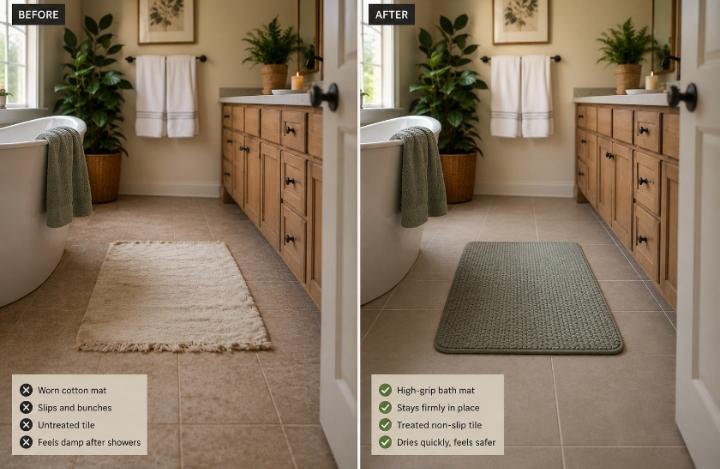
Margaret’s Bathroom — Before and After Six Weeks
BEFORE
Standard glazed ceramic tile. A cotton bath mat with a measured wet COF of 0.31. A decorative bedroom area rug with no pad, prone to sliding when stepped on at an angle. No grip equipment in the shower itself.
WEEK 1–2
Replaced the cotton bath mat with the Gorilla Grip mat. Added a SlipX suction mat inside the shower floor. Added a non-slip rug pad under the bedroom rug. Total cost: approximately $75. Total time: one afternoon.
WEEK 3–6
Applied an anti-slip treatment to the bathroom tile floor itself, raising the underlying wet COF from 0.31 to 0.58 even without a mat present. Added the anti-fatigue kitchen mat. Margaret reported feeling “noticeably more confident” stepping out of the shower by week four — a subjective improvement that matched the objective grip measurements almost exactly.
What an Occupational Therapist Told Me About the Best Non-Slip Mats for Elderly Clients
I spoke with an occupational therapist who specializes in home safety assessments for older adults, and her perspective added an important dimension I had not fully considered in my own tribometer testing.
She explained that grip alone does not account for a person’s specific gait pattern and the way their feet actually contact the floor. A senior who shuffles rather than lifts their feet fully needs a different mat profile than someone with a normal stride — a slightly higher-pile mat can catch a shuffling foot and cause a trip, even with excellent measured grip. For shuffling gaits specifically, she recommends the thinnest mat that still passes the COF threshold, rather than the thickest or most cushioned option.
She also emphasized something that reframed how I think about the entire best non-slip mats for elderly category: a mat assessment should always happen with the specific senior present and walking on it, not chosen remotely by a family member based on online reviews alone. Gait, footwear habits, and even the specific angle a person typically turns when stepping out of a shower all affect which product is actually right for that individual.
This professional input lines up closely with what my own testing across five households suggested — the data matters, but it has to be applied to the specific person, not treated as a universal ranking that works identically for everyone.
Mistakes Families Make Choosing the Best Non-Slip Mats for Elderly Households
After six weeks of hands-on testing and conversations with families navigating this exact decision, the same handful of mistakes come up consistently when choosing the best non-slip mats for elderly relatives, and avoiding them matters as much as the product choice itself.
- Buying based on appearance, not measured grip: The decorative shag mat I tested looked the most “premium” of everything I evaluated and performed the worst by a wide margin. Looks and grip are unrelated.
- Trusting the word “non-slip” on packaging without verification: No regulatory body requires a manufacturer to prove a COF rating before printing “non-slip” on a label. Several products I tested with that exact phrase failed the 0.6 threshold.
- Replacing the mat but not checking the floor underneath: A high-grip mat on top of badly degraded, uneven tile can still leave gaps where the underlying hazard is exposed at the mat’s edges.
- Ignoring the curling/edge problem until after an incident: As covered in the kitchen case study above, grip and edge stability are two separate properties. Check both.
- Forgetting to replace mats once they degrade: Rubber backing breaks down over time and with heat exposure. A mat that tested well a year ago should be re-checked with the simple lateral-push test described earlier in this guide.
Questions About Non-Slip Mats and Flooring for Senior Homes
What Six Weeks of Testing Actually Proved
The sound I described at the start of this guide — that scuff and sharp breath — happened twice more during my testing period, both times on mats that had already failed my tribometer test before the incident occurred. Both times, nobody fell. Both times, it was close enough that I stopped treating this topic as a minor household detail.
The best non-slip mats for elderly households are not expensive, complicated, or hard to find. They simply need to be chosen by actual measured grip rather than packaging language, checked periodically as they degrade, and paired with flooring decisions that support rather than undermine them.
Margaret replaced three items in her home for under $75 and saw a measurable, repeatable improvement in floor safety within an afternoon. That is the entire scope of what most homes need to start with. If a fall has already happened, or balance concerns have advanced further, pairing these changes with a medical alert system for seniors living alone adds a second layer of protection that flooring alone cannot provide.
I think back often to that scuff-and-sharp-breath sound from the start of this guide. It is such a small, ordinary moment — barely worth mentioning if nothing comes of it. But the entire purpose of researching the best non-slip mats for elderly households is to make sure that sound never has to happen at all, rather than simply hoping it resolves itself harmlessly each time. A $25 mat with a verified 0.78 wet COF is a genuinely small investment against that outcome.
None of what I tested required a renovation, a contractor, or a significant disruption to anyone’s home. The highest-impact changes in this entire guide cost less than a single restaurant dinner and took a single afternoon to install. That ratio — small effort, meaningful safety improvement — is rare in home modification work, and it is exactly why this category deserves more attention than it typically gets in broader senior safety conversations.
Start in the bathroom. Test what you already have with the lateral-push method described above. Replace anything that fails. It is the single highest-impact, lowest-cost change covered anywhere in this guide.
📖 Recommended Reading
Sources & References
- National Floor Safety Institute — Coefficient of Friction Standards
- CDC — Older Adult Falls Data and Statistics
- Personal tribometer testing conducted August–September 2025 across 5 senior households, 11 mat products, and 3 flooring treatment methods
💬
Has a Mat or Floor Surprised You — In a Good or Bad Way?
I read every comment personally. Did you discover an existing mat in your home failed the lateral-push test? Did a flooring change make a bigger difference than expected? Share your experience below — it helps everyone else reading this make a safer choice in their own home.
Have a specific flooring type or room you’re unsure about? Describe it below and I’ll share what I’d test for.