

Bathroom Grab Bar Placement for Seniors with Shoulder Arthritis
Shoulder arthritis can completely change how someone uses a grab bar. A bar that’s perfectly placed for someone with strong, pain-free shoulders becomes useless or even harmful when reaching up or twisting causes sharp joint pain. Many bathroom grab bar placement for seniors with shoulder arthritis guides focus mainly on installation measurements and don’t spend much time explaining how shoulder pain can affect safe placement.
This one is different. If your parent has shoulder arthritis and you’ve been wondering whether the grab bar you installed is actually helping or just sitting there looking like it might help someday, this guide will tell you exactly what to look for and what to change.
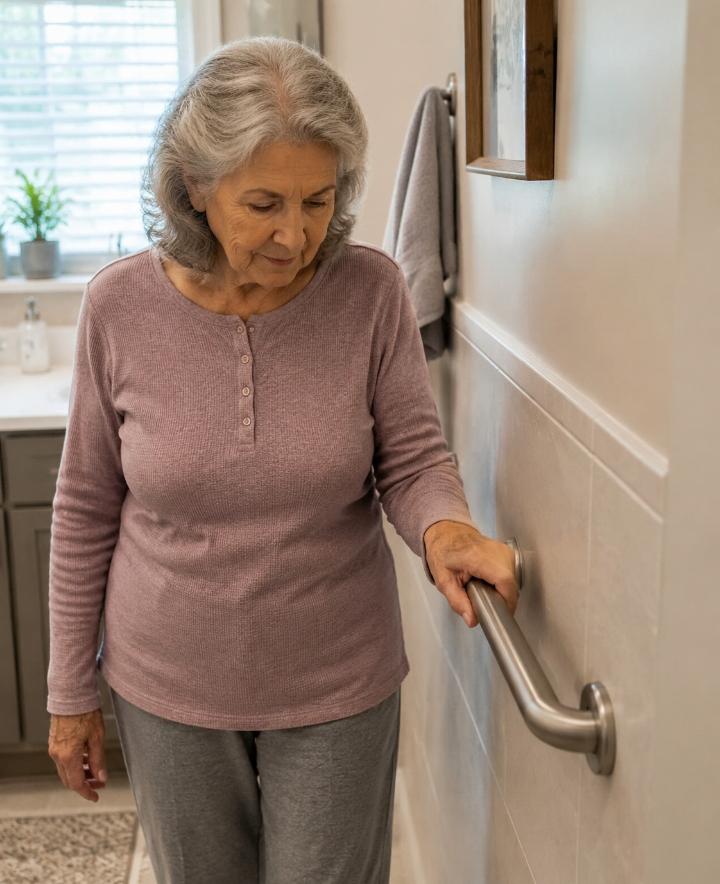
This guide provides general home safety information and isn’t a substitute for medical advice or an in-home assessment by a qualified healthcare professional or occupational therapist. Individual mobility needs vary.
Why Shoulder Arthritis Makes Standard Grab Bar Advice Wrong
Standard grab bar placement guides are written for the average senior. Shoulder height from the floor. Diagonal bars for the shower. Horizontal bar by the toilet. These measurements work for someone who can raise their arm freely, rotate their shoulder without pain, and grip at various angles.
Shoulder arthritis often reduces comfortable range of motion, especially external rotation and reaching overhead. The amount of limitation varies from one person to another. Reaching above shoulder height becomes painful or impossible on bad days. Gripping a bar at an uncomfortable angle may increase stress on the shoulder joint and make movement more painful for some people.
My grandmother dealt with this exact problem in her Kissimmee, Florida home. She had a grab bar on the wall beside her toilet that was installed too high, so every time she reached for it she had to raise her arm past the point that hurt. She stopped using it. The bar was there, but it wasn’t helping her at all.
I’ve seen many families run into this problem. A grab bar may be installed correctly according to general recommendations, yet still go unused because reaching it causes shoulder pain.
She always said she didn’t need a doctor telling her what to do. She needed someone to explain things in plain English. So that’s what this guide tries to be.
The core rule for shoulder arthritis: Every grab bar must be reachable without raising the hand above shoulder height, and grippable without requiring the arm to twist outward at the shoulder. That’s the standard everything else in this guide builds on.
Which Shoulder Movements Are Actually Painful
Before you can place a bar correctly, you need to understand what hurts. Shoulder arthritis pain in the bathroom usually comes from four specific movements. Not everyone has trouble with all four, but knowing which ones apply to your parent makes bar placement much more specific.
- Reaching overhead: Anything above shoulder height. Common culprit for pain when using a bar mounted too high on a wall.
- External rotation: Turning the arm outward so the elbow points away from the body. Triggered by bars mounted too far to the side or at the wrong angle.
- Reaching across the body: Grabbing something on the opposite side. A bar mounted directly across a tub from a weak shoulder causes this.
- Sustained gripping under load: Holding a bar while bearing weight. Even when placement is right, grip fatigue sets in faster with arthritis. Bar diameter matters here.
Write down which of these apply to your parent before anything is installed or moved. The placement decisions below connect directly to this list.
Grab Bar Placement by Location
Beside the Toilet
The standard recommendation is a horizontal bar on the side wall, 33 to 36 inches from the floor. For a senior with shoulder arthritis, that height works as a starting point but it isn’t fixed. The real test is whether your parent can reach the bar from a seated position without raising their elbow above shoulder level. If the bar is too high, they’re straining the shoulder every single time they push up off the toilet.
A better approach for many people with shoulder arthritis: drop the bar slightly, to around 30 to 32 inches, and confirm it’s on the side of the stronger shoulder, not the painful one. The goal is for the arm to push downward as the person rises, not reach outward or upward.
If shoulder arthritis affects both sides, a flip-down bar mounted directly in front of the toilet is worth considering. It allows both arms to push straight down, which is the shoulder-friendliest movement possible for transfers.
Inside the Shower or Tub
This is where standard placement goes wrong most often for shoulder arthritis patients. A diagonal bar mounted from low near the faucet to high near the showerhead requires the arm to reach up and across at the same time. That combination hits two of the four painful movements at once.
For someone with shoulder pain, two shorter horizontal bars placed at different heights serve better than one long diagonal. The lower bar, at around 24 inches, is for entering and exiting while crouching or stepping. The upper bar, at around 36 inches, is for steadying while standing. Neither one requires overhead reaching.
The bar diameter also matters more than people realize. Bars that are 1.5 inches in diameter require the fingers to wrap further, which increases the rotational load on the shoulder when gripping under weight. A 1.25 inch diameter bar is easier on arthritic shoulders for most people.
At the Shower Entry
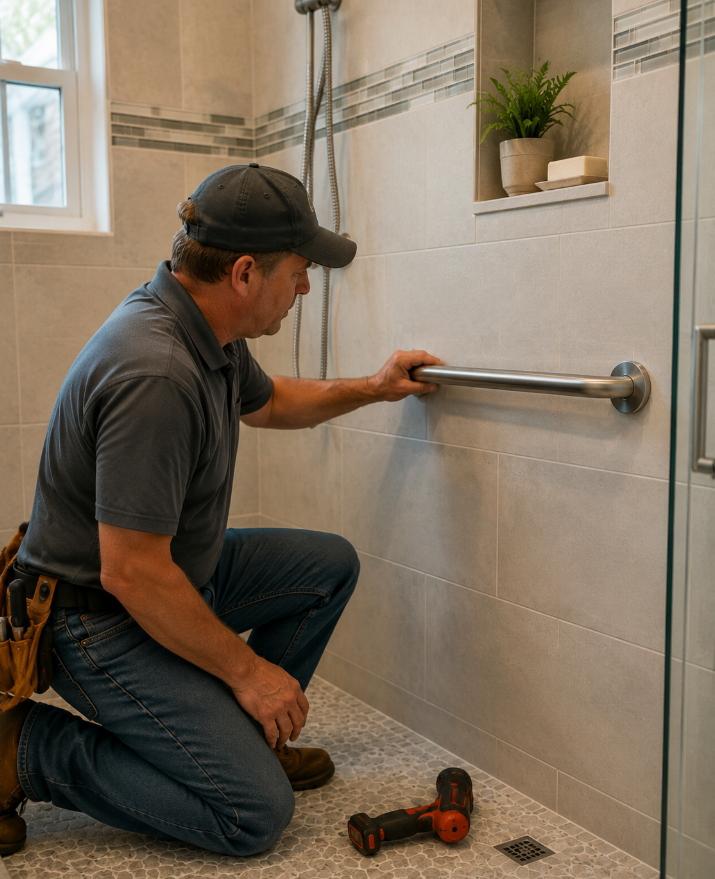
The entry grab bar is the one that sees the most weight-bearing stress and the most shoulder rotation risk. Stepping over a tub edge while holding a bar involves leaning, weight shifting, and sometimes a quick twist to balance. If the bar is positioned so the shoulder has to externally rotate during that step, that’s when people get hurt.
The ideal entry bar for shoulder arthritis is a vertical bar mounted on the wall just outside the shower opening, at a height where the hand naturally rests with the elbow slightly bent and the shoulder neutral. Not raised, not reaching forward. Just a natural hand position from a standing posture.
For most adults that position is somewhere between 32 and 40 inches depending on height. It needs to be measured for the individual, not taken from a chart.
The Test That Tells You If a Bar Is Placed Right
Here’s a simple test I’d recommend doing before any bar is permanently anchored. Ask your parent to stand in the position they’d be in when using the bar. Without reaching, ask them to let their arm hang naturally. Then ask them to raise it only until they feel resistance or mild discomfort, and note where their hand is at that point.
The bar needs to be reachable below that height. Not at it. Below it. Because in real use, they won’t be standing still and calm the way they are during this test. They’ll be stepping over a tub edge or standing from a toilet, which adds physical stress and usually reduces the range they can move comfortably.
Have the senior physically touch a mark on the wall at the proposed bar height before installation. If reaching that mark causes any shoulder discomfort, the bar is too high. This test takes two minutes and prevents a costly reinstall.
A Real Example: What Changed in Linda’s Bathroom in Savannah, Georgia
Linda Harmon, 71, from Savannah, Georgia had two grab bars installed in her shower in August 2025. Both were placed at standard heights by a contractor who wasn’t aware of her rotator cuff arthritis. Linda used neither bar after the first week because reaching them sent a shooting pain through her right shoulder.
Her occupational therapist visited on the November and immediately identified the problem. The upper bar was at 42 inches, which required Linda to raise her arm past the painful range just to grip it. The lower bar was angled diagonally in a way that required external shoulder rotation when bearing weight on it.
Both bars were reinstalled. The upper bar came down to 34 inches. The diagonal became two horizontal bars. A 1.25 inch diameter bar replaced the standard 1.5 inch. Linda began using both bars within three days of the changes. She told her therapist the difference was “like finally having something that was actually made for me.”
The reinstallation cost $180 in additional labor. The original installation cost $320. The right placement from the start would have saved Linda $180 and two months of a bathroom that made her nervous every single morning.
Bar Types That Work Better for Shoulder Arthritis
| Bar Type | Best For | Shoulder Arthritis Notes |
|---|---|---|
| Horizontal bar | Toilet transfers, shower standing | Best option. Allows push-down movement that doesn’t stress the shoulder joint. |
| Vertical bar | Shower entry, standing balance | Good when mounted at natural hand height. Avoids overhead reaching. |
| Diagonal bar | Tub entry, multi-purpose | Use with caution. The upper end often sits too high and the grip angle creates shoulder rotation pain. |
| Flip-down bar | Bilateral shoulder issues, toilet | Excellent. Allows both arms to push straight down. Shoulder-friendliest transfer movement available. |
| Clamp-on toilet bar | Renters, temporary situations | Acceptable short term but doesn’t bear the same weight as anchored bars. Not a permanent solution. |
Should You Hire an Occupational Therapist?
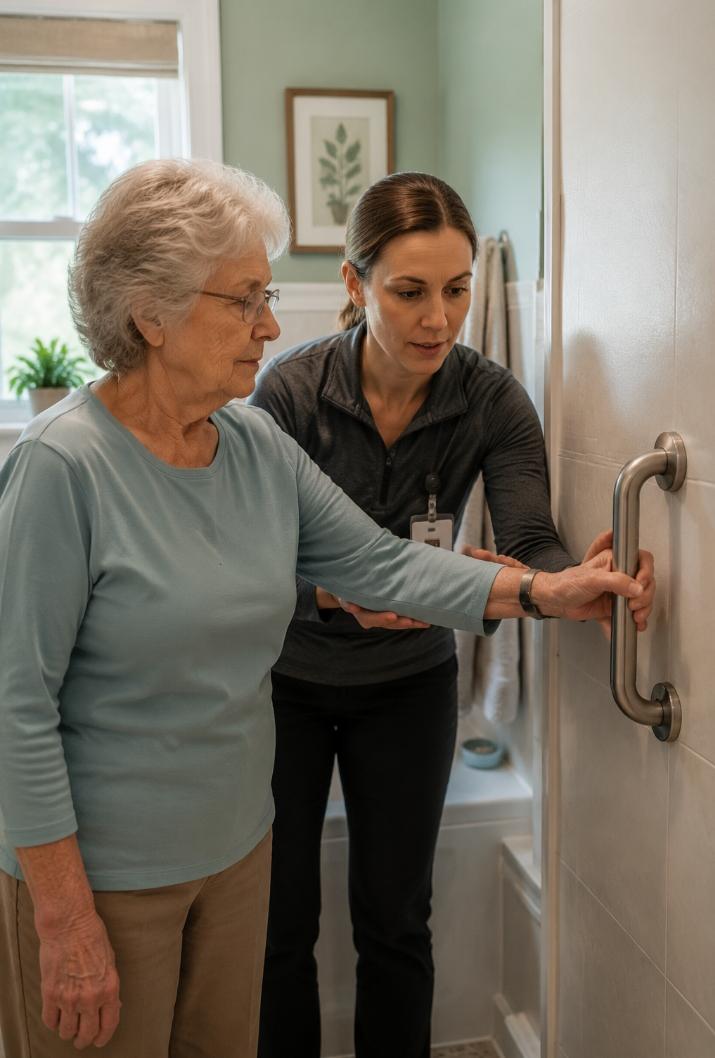
Yes, if the shoulder issue is significant. An occupational therapist trained in home safety assessments can evaluate your parent’s specific range of motion, watch how they actually move through their bathroom routine, and mark the exact placement for every bar before a single hole is drilled.
The cost is usually $150 to $300 for a home assessment. On a project where incorrect placement might mean $200 in reinstallation labor, the math is obvious. And on a project where incorrect placement means the bars simply don’t get used, it’s even more obvious.
Not everyone needs this. If the arthritis is mild, if the mobility issues are straightforward, and if someone in the family can do the two-minute reach test described earlier and make reasonable adjustments, a professional assessment isn’t mandatory. But if the shoulder limitation is significant, don’t skip it.
Questions Worth Asking Before Installation
Does the bar have to be anchored into a stud?
Yes. Suction cup bars aren’t safe for weight-bearing use, and grab bars in general need to be anchored into wall studs or blocking. A bar that pulls out of the wall when someone leans on it is more dangerous than no bar at all.
What if the stud isn’t where the bar needs to go?
A carpenter can add backing or blocking inside the wall at the correct position. This is a common and straightforward modification. It adds cost but it’s the right solution when stud location doesn’t match what the shoulder arthritis placement requires.
Can grab bar installation be done as a DIY project?
Technically yes, but it’s one of the few home modifications where a professional is genuinely worth the cost. The combination of finding studs correctly, drilling into tile without cracking it, and verifying load-bearing capacity makes this a job where errors are common and consequences are serious. Hire someone who’s done it before.
How much does installation typically cost?
A professionally installed grab bar costs between $100 and $300 per bar, depending on location, whether blocking is needed, and local labor rates. Most bathroom setups benefit from two to three bars. The full cost of a proper installation is usually $300 to $800 total.
Sources
-
Centers for Disease Control and Prevention (CDC).
Older Adult Falls
-
National Institute on Aging (NIA).
Falls and Falls Prevention
-
American Occupational Therapy Association (AOTA).
Occupational Therapy Resources
These resources provide evidence-based guidance on fall prevention, safe home modifications, occupational therapy, and strategies to help older adults maintain independence at home.
One Last Thing Worth Knowing
A grab bar that doesn’t get used isn’t a safety upgrade. It’s just a bar on the wall.
The only measure of success for any grab bar installation is whether the person it was installed for actually reaches for it every time they need it. If your parent is avoiding the bar, that’s information. It usually means the placement is wrong, not that they’re being stubborn. Ask where it hurts when they use it and work backward from that answer.
The broader picture of what makes a bathroom safe for aging at home is covered in the full guide to home modifications for aging in place, and the home safety checklist tool walks through every room including the bathroom with specific items to review.
Helpful Resources
If you’re planning a safer bathroom for yourself or a loved one, these guides and tools can help you compare products, estimate costs, and learn more about aging safely at home.