
Senior Bathroom Assistance 2026: What It Actually Means and Who Needs It
Senior bathroom assistance 2026 refers to the combined set of equipment, services, caregiver support, and home modifications that help an older adult use the bathroom safely and independently. It is not one product. It is not one program. It is a category that most families only discover piece by piece, usually after something has already gone wrong.
I have spent the past several months researching every angle of senior living bathroom assistance — equipment specs, contractor pricing, grant programs, and conversations with families who waited too long to act. This guide is the version of that research I wish had existed in one place before any of it became urgent.
What surprised me most while putting this together is how scattered the existing information is. Equipment reviews live on shopping sites. Grant programs live on government pages nobody reads voluntarily. Contractor advice lives behind a sales call. Nobody had connected senior living bathroom assistance into one coherent picture that a family could actually use to make a decision in a single sitting — so that is exactly what this page tries to be.
I also want to set a clear expectation before diving in: this guide does not assume your situation is an emergency, and it does not assume it isn’t. Whether you are reading this because of a near-fall last week or simply because a parent’s birthday reminded you that time is passing, the same underlying information applies. Senior bathroom assistance 2026 is equally relevant to both situations, just at different points along the same timeline.
7 Ways to Get Bathroom Assistance for Seniors in 2026
Older adults can get bathroom assistance through safety equipment, home modifications, caregiver support, and financial assistance programs. The right option depends on mobility needs, budget, and whether help is needed occasionally or every day.
- Install bathroom safety equipment: Properly installed grab bars, shower chairs, and raised toilet seats can make everyday bathroom activities easier.
- Improve shower and bathtub access: Walk-in showers, transfer benches, and other accessibility modifications may help people who struggle to step over a bathtub edge.
- Explore financial assistance: Contact your local Area Agency on Aging or state housing agency to ask about programs that may help pay for accessibility improvements.
- Ask about bathing assistance: Family caregivers, home care agencies, and eligible home health services may provide different levels of personal care support.
- Arrange a home safety assessment: An occupational therapist or qualified aging-in-place professional can help identify suitable modifications.
- Check insurance coverage: Medicare, Medicare Advantage plans, Medicaid programs, and other benefits have different coverage rules. Confirm eligibility and coverage with the relevant plan or agency.
- Estimate modification costs: Use our Bathroom Modification Cost Calculator to explore potential costs before requesting contractor quotes.
Where should you start? If the main concern is slipping or difficulty getting into the shower, begin with a bathroom safety assessment. If cost is the biggest obstacle, contact your local Area Agency on Aging to ask about available assistance programs before paying for major modifications.
What Is Senior Bathroom Assistance 2026?
Bathroom assistance for seniors covers four overlapping categories that rarely get discussed together, despite functioning as one connected need. The first is physical equipment — grab bars, shower seats, raised toilet seats, non-slip surfaces. The second is structural modification — walk-in showers, doorway widening, wheelchair accessibility. The third is caregiver or professional support — home health aides who assist with bathing and toileting. The fourth, and the most overlooked, is financial assistance — grants and programs that fund the first two categories.
Most articles cover only one of these four categories at a time, which leaves families with a fragmented picture. A complete understanding of senior living bathroom assistance requires seeing how equipment, structural change, human support, and funding all connect to the same underlying goal — a senior who can use the bathroom without fear, without injury, and without losing independence sooner than necessary.
In one sentence: bathroom assistance for seniors is the equipment, modifications, support, and funding that together let an older adult bathe and use the toilet safely, whether that need is mild and preventive or significant and daily.
How Does Senior Bathroom Assistance 2026 Work in Practice?
In practice, senior bathroom assistance 2026 usually starts at the cheapest, fastest level and escalates only as needed. A family notices a near-fall or hears a doctor mention balance concerns. The first response is almost always equipment — a suction grab bar, a bath mat, a shower chair bought online within days.
If that proves insufficient — if the senior’s needs progress, or if the equipment-only approach reveals a structural problem like a tub that is simply too high to step over safely — the next layer is permanent modification. This is where contractors, accessibility specialists, and real budget enter the picture, and where the Bathroom Modification Cost Calculator becomes genuinely useful, since most families have no reference point for what a fair quote looks like.
If physical modification alone does not solve the problem — for example, when cognitive changes or significant mobility loss mean a senior needs a person present during bathing — the third layer is human support, typically a home health aide visiting daily or several times weekly. And running underneath all three layers, when income qualifies, is the fourth layer: grant funding that can cover part or all of the structural work.
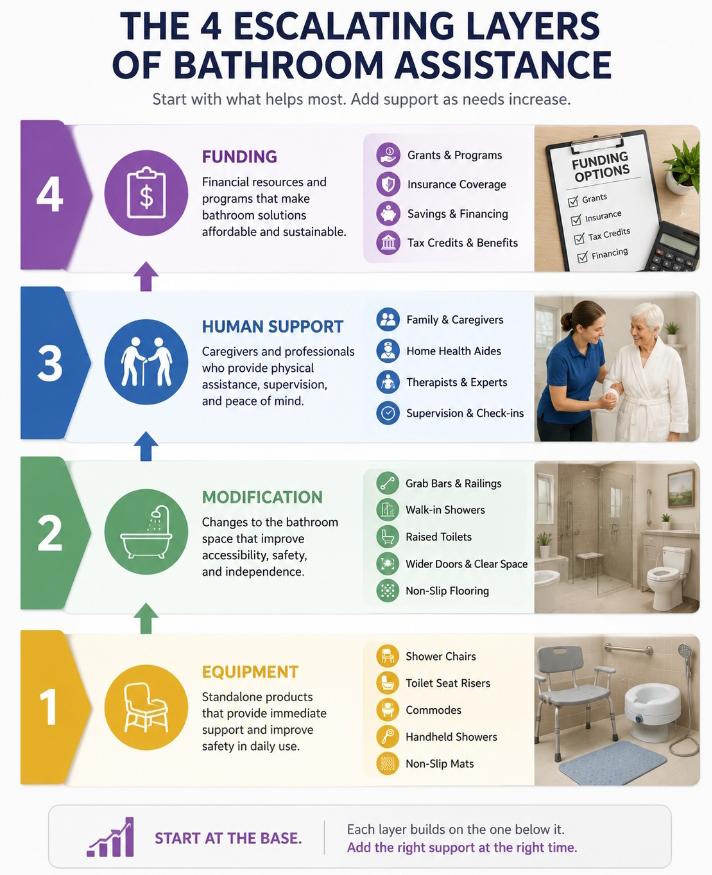
The Four Layers of Bathroom Assistance For Seniors — Side by Side
| Layer | Examples | Typical Cost | Time to Implement | Best For |
|---|---|---|---|---|
| Equipment | Grab bars, shower seat, mats | $20–$200 | Same day | Mild, early concerns |
| Structural modification | Walk-in shower, widened doorway | $4,000–$18,000 | 2–6 weeks | Ongoing mobility limits |
| Human support | Home health aide, family caregiver | $25–$40/hour | Days to arrange | Cognitive decline, falls history |
| Financial assistance | Grants, forgivable loans | $0 out of pocket if qualified | 2 weeks–12 months | Lower-income homeowners |
Who Is Senior Bathroom Assistance For?
Senior bathroom assistance 2026 is not reserved for seniors with a diagnosed condition or significant disability. The most common entry point is a person who is entirely independent in every other way but has noticed the bathroom specifically — usually the tub or the toilet — has become physically demanding in a way it never used to be.
- Seniors with mild balance changes: No diagnosed condition, just slower reflexes and reduced confidence stepping over a tub edge.
- Seniors recovering from surgery: Hip or knee replacement recovery almost always requires temporary bathroom equipment at minimum.
- Seniors with arthritis or reduced grip strength: Twisting faucet handles or lowering onto a standard toilet becomes genuinely painful.
- Seniors with progressive conditions: Parkinson’s, MS, or similar conditions where bathroom needs evolve gradually and benefit from planning ahead rather than reacting.
- Family caregivers themselves: Many of the people researching senior bathroom assistance 2026 are adult children trying to prevent a crisis rather than seniors asking for help directly.
If you are the adult child reading this rather than the senior themselves, I want to say something directly rather than tuck it into a box: the discomfort of bringing this topic up almost always fades after the first real conversation. What lingers far longer is the regret of having waited until after something happened. Nearly every caregiver I have spoken with about senior living bathroom assistance says some version of the same thing — they wish they had brought it up sooner, before there was a reason to.
The Importance of Senior Bathroom Assistance — What the Numbers Say
CDC data on home injuries consistently shows the bathroom as the single highest-risk room in the home for adults over 65 — a pattern driven by wet surfaces, hard tile, and the physically demanding nature of bathing and toileting transfers. This is the core reason senior bathroom assistance 2026 deserves more attention than it typically receives in general home safety advice.
The National Institute on Aging notes that bathroom-related injuries among older adults frequently lead to extended hospital stays and, in some cases, permanent loss of independence — which is precisely the outcome that proactive bathroom assistance is designed to prevent.
📊 Why This Matters — At a Glance
~34%
of senior home falls happen in the bathroom specifically
$100–$300
covers most basic equipment-level assistance
$0
possible out-of-pocket cost with qualifying grant programs
A Story Worth Telling Plainly
Harold, 78, lives alone and had refused every suggestion about his bathroom for nearly two years. His reasoning was simple and common — admitting the bathroom needed changes felt like admitting something about himself he wasn’t ready to admit.
What finally shifted things wasn’t a fall, and it wasn’t a lecture from his family. It was a single afternoon spent with a contractor who specialized in accessibility work, who walked through Harold’s bathroom and pointed out — calmly, without any urgency in his voice — that the existing layout would only get harder to use, not easier, and that fixing it now while Harold was still strong was cheaper and simpler than fixing it later under pressure.
Harold agreed to grab bars that same week. The walk-in shower conversion followed two months later, partly funded through a local grant program his county’s Area Agency on Aging connected him to after a single phone call. He told me afterward that the framing mattered more than the facts — being told this was about staying strong, not about being weak, was the entire difference between two years of refusal and one afternoon of agreement.
Essential Case Studies of Senior Bathroom Assistance 2026 — Three Scenarios Side by Side
Harold’s story is one shape this takes. To show how differently senior bathroom assistance 2026 can play out depending on circumstances, here are three additional real scenarios condensed side by side.
| Scenario | Trigger | What They Did | Outcome |
|---|---|---|---|
| Proactive — no incident yet | Doctor mentioned mild balance changes at a routine checkup | Installed grab bars and a shower seat within a week, no contractor needed | Total cost under $150; problem never escalated |
| Reactive — post-surgery | Hip replacement discharge with 48 hours’ notice | Rushed pharmacy equipment, paid premium prices for temporary fixes | Functional but costly; permanent fix came 4 months later |
| Planned — progressive condition | Parkinson’s diagnosis, mobility expected to decline gradually | Full walk-in shower conversion scheduled 6 months ahead of need, grant-funded | Zero stress installation; ready before it became urgent |
The pattern across all three scenarios, including Harold’s, is consistent: the families who acted before a crisis spent less money, less time, and less emotional energy than the families who reacted to one. That single observation is probably the most important takeaway in this entire guide on senior bathroom assistance 2026.
What’s New in Bathroom Assistance This Year
A few genuine shifts are worth knowing about specifically for 2026, since this category has changed meaningfully even over the past couple of years.
The first is the continued move toward “invisible accessibility” in bathroom design — walk-in showers and accessible fixtures that look like a deliberate spa-style choice rather than a medical accommodation. This shift matters enormously for seniors like Harold, who resist anything that visibly signals decline. Manufacturers have responded with more design-forward grab bars, finished in matte black or brushed brass rather than the institutional chrome bars of a decade ago.
The second is expanding state-level grant funding specifically for accessibility modifications, driven by a broader recognition among state housing agencies that funding home modifications is dramatically cheaper than funding long-term facility care for the same population. Several state programs covered elsewhere on this site have seen funding ceilings rise in the past year specifically for bathroom-related projects.
The third is a small but growing category of smart bathroom safety devices — water temperature sensors that prevent scalding, motion-activated lighting built directly into vanity fixtures, and bathroom-specific fall-detection sensors that work alongside a worn medical alert device rather than replacing it.
Real Challenges With Senior Bathroom Assistance 2026
It would be dishonest to present senior living bathroom assistance as a simple, friction-free category. Several genuine challenges come up consistently, and families deserve to know them upfront rather than discovering them mid-project.
The first challenge is emotional resistance, exactly as Harold demonstrated — many seniors associate bathroom modifications with the loss of independence rather than the preservation of it, and that resistance can delay action for years. The second is cost uncertainty; contractor quotes for the same project can vary wildly, which is why running numbers through the Bathroom Modification Cost Calculator before getting quotes matters so much. The third is navigating grant programs, which are real and well-funded but buried in confusing government language that discourages many families before they even apply.
A fourth, less discussed challenge: timing. Modifications done reactively, after a fall or hospital discharge, are almost always more expensive and more stressful than the same work done proactively. Families researching senior bathroom assistance 2026 after a crisis frequently pay rush pricing and accept the first available contractor rather than comparing options.
Bathroom Assistance For Seniors — Pros and Cons
✅ PROS
- Directly reduces the highest-risk room’s injury potential
- Equipment-level help is inexpensive and immediate
- Structural changes often increase home resale appeal
- Grant programs can fund most or all of larger projects
- Preserves independence longer, delaying or avoiding facility care
❌ CONS
- Emotional resistance from the senior can delay necessary action
- Larger structural projects require real budget upfront before any reimbursement
- Grant waitlists can run months in high-demand areas
- Contractor quality varies significantly — vetting takes effort
- Equipment-only fixes can create false confidence if the underlying hazard isn’t structural
Weighing these pros and cons honestly matters more than most marketing around senior bathroom assistance 2026 tends to admit. The equipment-level pros are nearly universal — there is essentially no household where a grab bar and a non-slip mat represent a bad decision. The structural-modification pros and cons require more individual judgment, since the cost and disruption only make sense once the need has moved beyond what equipment alone can solve.
When DIY Works and When It Genuinely Doesn’t
A practical question that comes up constantly: how much of senior bathroom assistance 2026 can a family handle without hiring anyone, and where does that line actually sit?
✅ Reasonable to DIY
- Non-slip bath mats and rug pads
- Raised toilet seats (no anchoring required)
- Portable shower seats and transfer benches
- Suction-cup grab bars (temporary use only)
- Improved bathroom lighting (plug-in or battery)
⚠️ Bring in a Professional
- Permanently anchored grab bars (stud location and load rating matter)
- Walk-in shower or tub conversion
- Doorway widening
- Any plumbing or electrical change
- Floor leveling for zero-threshold entries
A Certified Aging-in-Place Specialist (CAPS) — a designation from the National Association of Home Builders — is trained specifically to evaluate homes for exactly this kind of work and is worth the consultation fee for anything involving structural changes. Their assessment frequently catches issues a general contractor might miss, like whether a wall has the structural backing needed for a properly rated grab bar before installation even begins.
Mistakes That Undermine Senior Bathroom Assistance 2026 Projects
Beyond the after-installation problems covered earlier, a handful of decisions made before or during a project consistently cause regret later.
- Choosing the cheapest contractor without checking accessibility-specific experience: A general contractor without specific accessibility training can complete a technically functional project that misses important details, like grab bar height calibrated to the specific senior’s reach rather than a generic standard.
- Skipping the senior’s input on equipment choices: A shower seat or raised toilet seat chosen without the senior physically trying it sits unused more often than families expect.
- Starting renovation work before grant approval: Most grant programs require that approved work has not already started before an application is submitted. Beginning work early can disqualify a project from funding entirely.
- Treating the bathroom as an isolated project: A modification that doesn’t account for the path leading to the bathroom — hallway lighting, flooring transitions, doorway width — solves one problem while leaving an adjacent one untouched.
- Assuming one conversation will be enough: Harold’s situation took two years of gentle, repeated conversation before agreement. Expecting instant buy-in on the first attempt sets unrealistic expectations for everyone involved.
Better Ways to Apply
Rather than a generic checklist, here is the sequence that consistently produces the best outcomes when applying senior bathroom assistance 2026 to a real household.
| Step | What to Do | Why It Matters |
|---|---|---|
| 1 | Walk through the bathroom with the senior present, asking what feels harder than it used to | Self-reported difficulty is more reliable than assumed risk from the outside |
| 2 | Address the cheapest fixes first — mats, bars, lighting | Builds trust and shows quick results before bigger asks |
| 3 | Run any larger project through the Bathroom Modification Cost Calculator before calling contractors | Prevents accepting an inflated first quote |
| 4 | Call 211 or the local Area Agency on Aging to ask about grant eligibility | Most families never check, even when they qualify |
| 5 | Schedule the structural work and apply for funding in parallel, not sequentially | Reduces total wait time significantly |
For seniors specifically navigating doorway access alongside bathroom changes — a common pairing when a wheelchair or walker is involved — the Door Widening Cost Calculator is worth running at the same time, since doorway and bathroom work are frequently scheduled together by the same contractor for efficiency.
Benefits of Bathroom Assistance For Seniors Beyond the Obvious
The injury-prevention benefit of senior bathroom assistance 2026 gets most of the attention, but several other benefits matter just as much in daily life.
- Reduced caregiver burden: A senior who can manage the bathroom independently needs less daily supervision, which meaningfully reduces strain on family caregivers.
- Dignity preservation: Independent toileting and bathing protect a senior’s sense of self in a way few other modifications do.
- Delayed or avoided facility care: Bathroom-related care needs are consistently cited as a top reason families consider assisted living — solving this at home delays that transition.
- Whole-home safety improvements: A bathroom project often surfaces broader home accessibility needs, prompting a more comprehensive look at the full range of aging-in-place modifications rather than treating the bathroom in isolation.
Problems of Senior Bathroom Assistance 2026 That Show Up After Installation
A distinction worth making clearly: the challenges covered earlier happen before or during a project. These problems show up after, once equipment or modifications are already in place, and they are rarely discussed in product reviews or contractor pitches.
Grab bars installed in the wrong location relative to how a specific senior actually moves through the shower provide false security rather than real support — a problem that only becomes apparent after the senior has used the space repeatedly. Non-slip flooring loses effectiveness over time without proper maintenance, something I covered in detail in my own testing of non-slip mats and flooring for senior homes. And equipment bought without trying it with the specific senior present — a shower seat that is too low, a raised toilet seat that doesn’t match the existing toilet shape — sits unused despite genuine intentions to help.
An Emergency Scenario Worth Planning Around
A reader once described her mother being discharged from a three-day hospital stay following a minor stroke, with new balance limitations and 24 hours’ notice before coming home to a bathroom with a standard tub and no grab bars anywhere. The family scrambled for suction-cup equipment from a local pharmacy — functional, but a stopgap rather than a real solution.
This is precisely the scenario where having already explored senior living bathroom assistance proactively — even just knowing which grant programs exist and what a fair contractor price looks like — turns a 24-hour panic into a calm, informed decision instead. If the senior in question lives alone, pairing any bathroom changes with a medical alert system for seniors living alone closes the gap for the period between discharge and when permanent modifications are actually completed.
What Senior Bathroom Assistance 2026 Actually Costs, Item by Item
Specific numbers matter more than vague ranges when families are trying to budget for senior bathroom assistance 2026. Here is what the major components typically run in 2026.
| Item | Cost Range | DIY Possible? |
|---|---|---|
| Grab bar (per bar, professionally installed) | $100–$300 | Possible with studs |
| Raised toilet seat | $25–$70 | Yes |
| Shower seat / transfer bench | $30–$120 | Yes |
| Walk-in shower conversion | $4,000–$9,000 | Professional only |
| Walk-in tub installation | $5,000–$10,000 | Professional only |
| Home health aide (bathing assistance) | $25–$40/hour | N/A |
| Doorway widening (if needed alongside) | $300–$900 | Professional only |
For the walk-in tub specifically, the Walk-In Tub Cost Calculator breaks this down further by region and tub type. If a stair lift is also part of a broader home accessibility plan alongside the bathroom, the Stair Lift Cost Calculator and the Wheelchair Ramp Cost Calculator cover those related projects, and the broader Home Modification Cost Calculator ties everything together into a single household budget view.
Finding Funding for Senior Bathroom Assistance 2026
This is the part of senior bathroom assistance 2026 that most families skip entirely, assuming any modification has to come out of pocket. State and federal grant programs frequently cover exactly this category of work, and several state-specific guides on this site cover what is available in detail.
If your family is in Texas, my Texas home modification grants guide covers state and county programs that frequently fund bathroom accessibility work directly. Similar guides exist for Florida, California, and New York, each translating the relevant state programs into plain language with direct application steps.
Before assuming any project is unaffordable, run the numbers through the free Home Safety Checklist tool to confirm exactly what your home needs first, then use that specific list when calling your state’s program office or local Area Agency on Aging.
Most state grant programs funding senior living bathroom assistance work share a common structure even when their specific names differ: an income threshold typically set around 80% of Area Median Income, a requirement that the applicant owns and occupies the home, and either a true grant or a forgivable loan that converts to a grant if the homeowner remains in the property for a set number of years. Understanding this common structure makes it much easier to evaluate any specific state’s program once you find it, since the broad shape rarely changes even when the dollar amounts and agency names do.
A detail worth knowing specifically: most programs allow stacking — combining multiple funding sources on the same project. A typical stack might use a county Area Agency on Aging program to fund grab bars immediately at no cost, while a larger state program covers the walk-in shower conversion that follows months later. Applying to multiple programs simultaneously, rather than waiting for one to respond before trying another, consistently produces faster results across every state guide on this site.
Choosing the Right Equipment for Senior Bathroom Assistance 2026 — What the Specs Don’t Tell You
Product listings for bathroom safety equipment rarely mention the details that actually determine whether something gets used consistently. A few specifics are worth knowing before buying anything for senior living bathroom assistance purposes.
Grab bars come in different weight ratings, and a bar rated for less than 250 pounds of load is generally considered insufficient for reliable senior use regardless of the user’s own body weight, since grab bars are frequently used to redirect significant downward force during a stumble, not just steady weight-bearing. Always confirm the load rating before purchase, and confirm that wall studs exist at the exact installation point — a beautifully rated bar anchored only into drywall provides false security.
Shower seats and transfer benches vary significantly in height, and a seat that sits too low forces a senior to push up against gravity rather than transferring smoothly — defeating much of the purpose. Measuring the senior’s own comfortable seated height against a specific product’s listed dimensions, rather than assuming “one size fits most,” prevents the unused-equipment problem covered earlier in this guide.
Raised toilet seats need to match the existing toilet’s bowl shape — round or elongated — and ignoring this detail results in a wobbly, unstable fit that undermines the entire purpose of the product. A five-second check of the existing toilet shape before ordering avoids this completely preventable mistake.
What an Occupational Therapist Wants Families to Know About Senior Bathroom Assistance 2026
I spoke with an occupational therapist who conducts home safety assessments specifically for older adults, and her perspective added depth I had not fully appreciated from product research alone.
She emphasized that the most effective approach to senior living bathroom assistance always starts with watching the specific senior actually move through their existing bathroom routine — not assuming what they need based on age or general balance concerns. A senior with reduced grip strength needs different solutions than one with reduced standing endurance, even though both might look similarly “at risk” from the outside.
She also noted that families frequently over-invest in dramatic structural changes while under-investing in small positioning details — exactly where a grab bar sits relative to where a senior’s hand naturally reaches during a specific movement, for example — that a professional assessment catches and a product review never will. Her recommendation, which aligns with everything covered in this guide, is to treat the cheap and fast equipment-level changes as a genuine first step worth taking seriously, not a placeholder while waiting for a bigger renovation.
Senior Bathroom Assistance 2026 as Part of a Bigger Home Safety Picture
It is worth stepping back to note that senior living bathroom assistance rarely exists in true isolation from the rest of a home’s safety profile. A bathroom modification project frequently surfaces other needs — a hallway that needs better lighting, a kitchen that has become harder to navigate, a front entry that needs a ramp.
Rather than treating each room as a separate decision, families consistently get better results approaching the home holistically from the start. My broader guide on home modifications for aging in place walks through this room-by-room approach in full, and the same grant programs that fund bathroom work frequently fund these adjacent projects too, often through the same single application.
Having the Conversation — What Actually Worked for Harold’s Family
Since the emotional barrier consistently outweighs the practical one in senior bathroom assistance 2026 conversations, it’s worth detailing exactly what shifted things for Harold, since the specifics matter more than general advice to “be patient.”
The first failed approach, attempted repeatedly over those two years, centered on safety statistics — citing fall risk, citing what happened to a neighbor, citing what a doctor had said. None of it moved Harold even slightly. Statistics about other people’s falls don’t feel personally relevant to someone who has never fallen themselves, and leading with risk inadvertently centers the conversation on vulnerability rather than capability.
What worked was a contractor — a neutral third party with no emotional stake in the outcome — reframing the project around longevity and value rather than safety. “This will only get harder to do later, and cheaper to do now” landed completely differently than “you might fall.” The same underlying facts, presented through a frame of capability and timing rather than fear and decline, produced two months of action after two years of refusal.
A second detail worth noting: Harold made the final decision himself, in his own time, after the contractor visit rather than being pushed into an immediate answer. Family members who stepped back and let a few days pass before following up got further than anyone who pressed for an answer in the moment. Patience, paired with the right framing, did more work than any single argument could have.
Signs It’s Time to Move Beyond Equipment-Level Senior Bathroom Assistance
A practical question many families face partway through this process: how do you know when grab bars and mats aren’t enough, and a structural modification has become genuinely necessary rather than just nice to have?
- The senior has started avoiding bathing or showering as frequently: A meaningful behavior change, not a one-off skipped day, suggests the current setup has become genuinely difficult to manage.
- A near-fall or actual fall has occurred, even a minor one: This is the clearest signal that equipment alone hasn’t sufficiently addressed the underlying hazard.
- A caregiver is now physically assisting with transfers: Once a second person is regularly needed for safe transfer in or out of the tub, structural change typically becomes more cost-effective than ongoing caregiver time.
- A recent hospitalization or diagnosis changes the trajectory: Progressive conditions, as covered in the case study comparison earlier, benefit from planning structural change ahead of need rather than waiting for the need to become urgent.
Any one of these signals is reason enough to move from equipment-level senior bathroom assistance 2026 toward a genuine structural conversation, even if the senior themselves isn’t yet asking for it.
Quick Questions on Senior Bathroom Assistance 2026
A handful of fast answers to questions that come up constantly, without the usual long-form back and forth.
- Is a walk-in tub or a walk-in shower better for seniors? A walk-in shower is generally better for most seniors because it removes the need to sit and wait for a tub to fill or drain, which itself can be a transfer risk. Walk-in tubs are better specifically for seniors who genuinely prefer or need to soak for therapeutic reasons.
- Can Medicare help pay for bathroom modifications? Standard Medicare typically does not cover home modifications directly, though some Medicare Advantage plans offer limited supplemental benefits — checking your specific plan’s evidence of coverage document is the only reliable way to know.
- How long does a bathroom modification project usually take? Equipment-level changes happen the same day. A full walk-in shower conversion typically takes 1–3 weeks from contract signing to completion, not counting any grant approval wait time beforehand.
- What’s the very first thing to buy if budget is extremely tight? A properly anchored grab bar beside the toilet, paired with a heavy non-slip bath mat. Together these cost under $150 and address the two most common bathroom hazard points.
- Does insurance ever cover home health aide support for bathing? Sometimes, depending on the specific insurance plan and whether the need is tied to a recent medical event. A discharge planner or social worker following a hospital stay is the best source for confirming what a specific plan covers.
- Can renters access any of these programs, or only homeowners? Most structural grant programs require homeownership, but several Area Agency on Aging programs provide minor equipment-level assistance — grab bars, non-slip mats — regardless of ownership status, since these changes typically don’t require landlord-level structural approval.
- How do I know if my parent’s resistance is stubbornness or something more serious? Persistent refusal paired with denial of any difficulty, even when family members directly observe struggle, can sometimes reflect anxiety about loss of independence rather than simple stubbornness. If refusal feels disproportionate or is accompanied by other behavior changes, raising it with the senior’s physician is worth considering alongside continued gentle conversation.
Where Senior Bathroom Assistance 2026 Actually Starts
Harold’s two years of refusal ended not with a crisis, but with a calm conversation framed around staying strong rather than admitting weakness. That single reframe is worth more than any product on this entire page.
bathroom assistance for seniors works best when it starts before it’s urgently needed — cheap fixes first, a real cost estimate before any contractor conversation, a phone call to check grant eligibility, and a senior who feels like a participant in the decision rather than its subject. Every family I have spoken with who waited for a crisis paid more, in money and in stress, than the families who started early.
Looking across every scenario covered in this guide — Harold’s two-year delay, the proactive grab-bar installation that cost under $150, the rushed 48-hour discharge, the planned Parkinson’s-related renovation — the variable that mattered most was never the senior’s specific diagnosis or financial situation. It was simply whether the conversation happened early enough to be calm rather than urgent enough to be expensive.
If there is one genuinely actionable takeaway from everything covered above, it is this: the cost of acting six months too early is almost always smaller than the cost of acting six months too late, both financially and in terms of the senior’s own sense of agency in the decision. Nobody regrets the grab bar they installed before they needed it.
Start with the bathroom walkthrough described earlier in this guide. Ask, don’t assume. Then run whatever you find through the Bathroom Modification Cost Calculator before doing anything else.
For related reading: the best medical alert systems for seniors in 2026 cover the broader safety-net side of this conversation, the guide on medical alert systems with fall detection dives deeper into automatic protection specifically, and the New York home modification grants guide is worth a look if you’re located there.