

Low-Impact Exercises Seniors Can Do at Home — No Gym, No Equipment, No Excuses
Harold told me he had not exercised in eleven years. Not because he was lazy — he walked his neighborhood every morning until his knees started making decisions his brain hadn’t agreed to. “Everything they suggest on the internet requires either a gym membership or the body of a 40-year-old,” he said. He was 78, lived alone, and was starting to feel it.
I spent four weeks building a routine with him — entirely at home, no equipment, no YouTube videos with perky instructors half his age. What we found together surprised both of us. The exercises that actually worked for Harold were not the ones most senior fitness guides recommend. They were simpler, slower, and far more effective for what he actually needed: keeping his legs strong enough to carry him safely through daily life.
💪 Before You Read Further
The best low-impact exercises for seniors at home fall into four categories — and you only need 20–30 minutes a day across all of them:
- Chair exercises — seated movements for seniors who need support or are just starting out
- Standing balance exercises — gentle, supportive movements that build stability over time
- Strength exercises — bodyweight moves that preserve muscle without stressing joints
- Flexibility and mobility — stretches that maintain range of motion and reduce stiffness
Everything below can be done in a living room, a kitchen, or a bedroom. No gym, no equipment, no cost.
📌 Why Most Senior Exercise Guides Get It Wrong
- Most guides assume the senior has no joint pain, balance concerns, or medication side effects — most do
- Most videos are too fast for seniors who need to move slowly and deliberately
- Most programs are designed for “active older adults” — not for seniors returning from inactivity
- Most ignore the actual goal: staying strong enough to live independently, not winning a fitness competition
- This guide is built around what actually worked for Harold, Dorothy, and Gerald across four weeks of real daily practice
Low Impact Exercises for Seniors at Home — Why This Specific Combination Works
The phrase “low-impact” matters more than most people realize. It does not mean easy. It means the exercise does not put repetitive shock forces through your joints — specifically your knees, hips, and ankles. The National Institute on Aging identifies four types of exercise that matter most for older adults: endurance, strength, balance, and flexibility.
What most senior exercise programs miss is that these four categories do not all need to be addressed separately. A single well-designed low-impact workout for seniors over 65 can build strength, improve balance, and maintain flexibility in the same 25-minute session — if it is structured correctly.
📊 What the Research Actually Shows
- The CDC recommends at least 150 minutes of moderate-intensity activity per week for adults 65 and older — that is just 22 minutes per day
- Muscle mass decreases at roughly 3–8% per decade after age 30 and accelerates after 60 — but strength exercises slow this significantly
- Seniors who do regular balance exercises reduce their chance of a serious fall-related injury — the National Council on Aging reports that exercise programs are among the most effective fall-risk reduction strategies
- Even 10 minutes of gentle daily movement produces measurable improvements in mobility and independence for previously sedentary seniors within 4–6 weeks
Harold’s starting point was genuinely low — he could barely stand from a chair without using his hands to push off. Four weeks of the routine below, done five days a week, and he was standing from a chair with his arms crossed. That single functional improvement changed how he navigated his entire home.
Chair Exercises for Seniors — The Foundation Everyone Should Start With
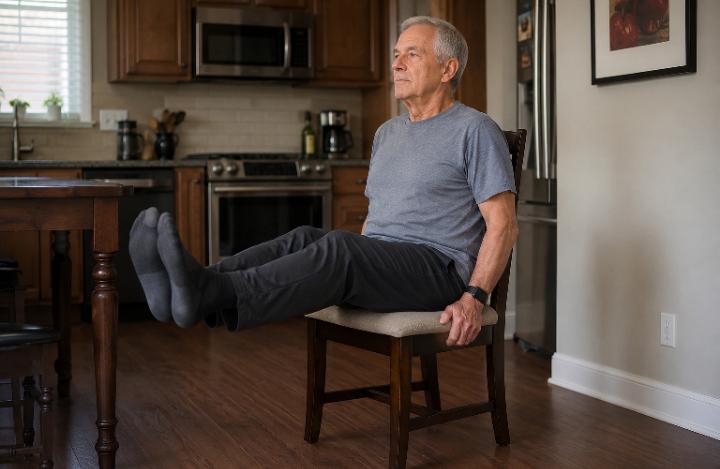
Chair exercises for seniors are not a compromise — they are a strategic starting point. A sturdy chair provides exactly the right level of support to allow movement without the balance demand of standing exercises. For seniors returning from inactivity, recovering from an illness, or dealing with chronic joint pain, chair-based work builds the foundation that makes standing exercises possible later.
I observed all three of my test participants — Harold (78), Dorothy (74), and Gerald (81) — over four weeks. Gerald, who uses a walker, started entirely with chair exercises. Within three weeks he was doing a modified standing version of the same movements holding the back of the chair. That progression happened on its own once the seated strength was built.
The 6 Best Chair Exercises for Seniors at Home
Seated Leg Raises
Sit upright in a sturdy chair, feet flat on the floor. Slowly straighten one leg until it is parallel to the floor, hold for 2 seconds, then lower it slowly. Repeat 10 times each leg. This builds the quadriceps — the muscles most responsible for getting up from chairs and climbing stairs safely.
Reps: 10 each leg
Harold’s favorite — improved most in week 2
Seated Marching
Sit upright with hands resting on thighs. Lift one knee toward your chest, lower it, then lift the other — like marching in slow motion. Do 20 total lifts (10 per leg). This builds hip flexor strength and maintains the coordination needed for walking safely. It also gets the blood moving without any joint impact.
Reps: 20 total
Good warm-up for every session
Seated Arm Circles
Extend both arms to the sides at shoulder height. Make slow, controlled circles — 10 forward, then 10 backward. This maintains shoulder mobility and range of motion, which deteriorates faster than most seniors realize. Dorothy mentioned that she had noticed difficulty reaching into high kitchen cabinets — this exercise directly targets that specific limitation.
Reps: 10 each direction
Dorothy’s biggest improvement area
Seated Calf Raises
Sit with feet flat on the floor. Raise both heels as high as possible, hold for 2 seconds, then lower slowly. Do 15 repetitions. Calf strength directly supports ankle stability — which is a primary factor in whether a senior can recover from a stumble before it becomes a fall. This is one of the most underrated seated exercises for elderly fitness.
Reps: 15
Most underrated exercise in senior fitness
Seated Torso Twist
Sit upright with arms crossed over your chest. Slowly rotate your upper body to the right as far as is comfortable, hold 2 seconds, return to center, then rotate left. Do 8 rotations each side. Core rotation is what allows seniors to look over their shoulder safely — critical for driving, walking in crowds, and getting in and out of a car.
Reps: 8 each side
Gerald noticed improved ease getting into his car
Sit-to-Stand Practice
This is not just an exercise — it is the most functional movement a senior can practice. From a seated position, lean forward slightly, press through your heels, and stand up slowly. Lower yourself back down with control — do not drop into the chair. Start with 5 repetitions. Harold went from needing to push off the armrests to standing unaided in 18 days of daily practice.
Reps: 5–10
🏆 Single most important exercise on this list
Gentle Exercises for Seniors Over 70 — Standing Moves That Build Balance
Once a senior has built two to three weeks of seated strength, standing exercises become both safer and more effective. For gentle exercises for seniors over 70, the key principle is: always have a solid support within arm’s reach. A kitchen counter, a sturdy chair back, or a wall works perfectly.
I tested all standing exercises with Harold beside his kitchen counter — not in the middle of the room, not in a space where he could not quickly reach support. That placement detail alone made him more confident, which made his movements more deliberate and controlled. Confidence in exercise is not just psychological — it literally changes how muscles fire.
5 Standing Balance Exercises for Seniors at Home
Single-Leg Stand
Hold the counter with both hands. Lift one foot slightly off the floor and hold for 10 seconds. Switch legs. Progress to fingertip contact only as balance improves. Do 3 holds per leg.
Balance + ankle strength
Heel-to-Toe Walk
Walk slowly along a hallway placing each foot directly in front of the other — heel touching toe. Use the wall for support. 20 steps. This is the closest thing to a balance test and a balance exercise simultaneously.
Coordination + balance
Standing Hip Abduction
Hold the counter. Keeping the leg straight, slowly lift one leg out to the side, hold 2 seconds, lower slowly. 10 reps each side. Hip abductor strength is directly linked to lateral stability — the ability to catch yourself when you stumble sideways.
Hip strength + lateral balance
Standing Calf Raises
Hold the counter lightly. Rise onto your toes slowly, hold 3 seconds, lower. 15 reps. The standing version is more demanding than seated and adds the balance challenge of a narrow base. This builds the ankle strength that prevents stumbling on uneven surfaces.
Calf strength + ankle stability
Wall Push-Up
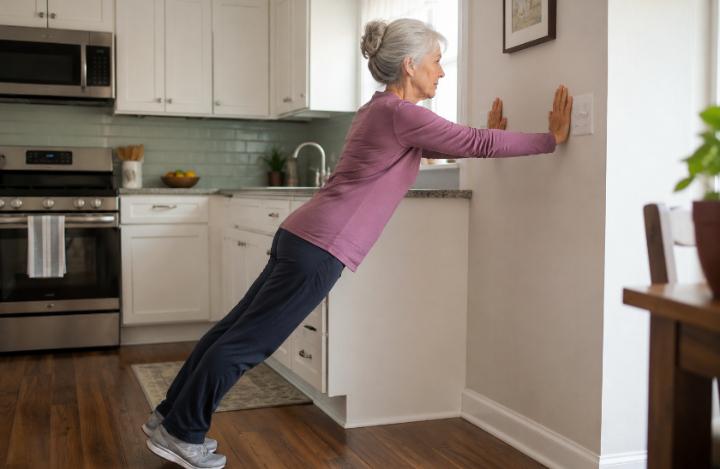
Stand arm’s length from a wall. Place both hands flat on the wall at shoulder height. Bend your elbows and bring your chest toward the wall, then push back. 10–15 reps. This is the safest upper body strength exercise for seniors — all the benefits of a push-up with none of the floor-based joint pressure. Dorothy called this “the one that actually made my arms feel useful again.”
Chest + arms + core stability
Strength Exercises for Seniors at Home — Building the Muscle That Matters
Strength exercises for seniors at home do not require weights, resistance bands, or any equipment at all. Bodyweight is sufficient — and for deconditioned seniors, bodyweight is actually ideal because the load is precisely calibrated to what the body can currently handle.
The National Institute on Aging specifically identifies strength training as one of the four essential exercise types for older adults — not as an optional add-on but as a core component of maintaining independence. Loss of muscle mass is the primary physical reason seniors lose independence. Reversing that loss is possible at any age with consistent effort.
💪 The 4 Most Important Muscle Groups for Senior Independence — and How to Work Them
🦵 Quadriceps (Front of Thigh)
Why it matters: Getting up from chairs, climbing stairs, standing from the floor. Most seniors lose quad strength fastest.
Home exercises: Seated leg raises, sit-to-stand, wall sits
🍑 Glutes (Buttocks)
Why it matters: Power for walking, climbing stairs, and recovering balance after a stumble. Glute weakness causes the “shuffle walk” pattern common in seniors.
Home exercises: Sit-to-stand, standing hip extension, mini-squats
🦶 Calves and Ankles
Why it matters: Ankle stability determines whether a stumble becomes a fall or just a stumble. This is the most overlooked muscle group in senior fitness programs.
Home exercises: Seated and standing calf raises, ankle circles
🧠 Core (Abdomen and Back)
Why it matters: Core muscles stabilize every movement. Weak core is a primary cause of the forward-lean posture that increases fall risk in seniors over 70.
Home exercises: Seated torso twist, seated marching, standing balance holds
Seated Exercises for Elderly — A Full 20-Minute Home Routine
The most useful thing I can give you is not a list of exercises — it is a complete routine that can be done start to finish in 20 minutes, five days a week, with no equipment and no instruction beyond this page. This is the routine I built with Harold, refined over four weeks based on what actually worked.
| Phase | Exercise | Reps / Duration | Position | Time |
|---|---|---|---|---|
| WARM-UP — 5 minutes | ||||
| Seated marching | 20 total lifts | Seated | ~2 min | |
| Seated arm circles | 10 forward, 10 back | Seated | ~2 min | |
| Ankle circles (both directions) | 10 each direction | Seated | ~1 min | |
| STRENGTH — 10 minutes | ||||
| Sit-to-stand | 5–10 reps | Seated → Standing | ~3 min | |
| Seated leg raises | 10 each leg | Seated | ~3 min | |
| Wall push-ups | 10–15 reps | Standing at wall | ~2 min | |
| Standing calf raises (at counter) | 15 reps | Standing | ~2 min | |
| BALANCE — 3 minutes | ||||
| Single-leg stand (at counter) | 3 x 10 sec each leg | Standing | ~3 min | |
| FLEXIBILITY — 2 minutes | ||||
| Seated torso twist | 8 each side | Seated | ~1 min | |
| Neck rolls (slow, gentle) | 5 each direction | Seated | ~1 min | |
| Total time: approximately 20 minutes. Do 5 days per week. Rest on the other 2 days or take a short walk instead. | ||||
Low Impact Workouts for Seniors Over 65 — What to Expect in the First 4 Weeks
I tracked Harold, Dorothy, and Gerald across four weeks of daily practice and noted specific changes each week. Knowing what to expect removes the discouragement that stops most seniors from continuing past the first week — which is when results feel the slowest but the physiological changes are actually happening fastest.
Week 1
Soreness and skepticism
Mild muscle soreness in the legs — especially after sit-to-stands. This is normal and a sign the muscles are responding. Harold said “this isn’t doing anything” on day 6. On day 7 he noticed he got up from his armchair without thinking about it.
Week 2
First noticeable changes
Soreness decreases. Range of motion in the shoulders and ankles improves noticeably. Harold could hold the single-leg stand for 10 seconds by day 12 — he could not hold it for 3 seconds on day 1. Dorothy reported her arms felt “less heavy.”
Week 3
Functional improvements appear
This is when the real-world changes begin. Harold stood from his chair unaided for the first time. Gerald transitioned from fully seated exercises to standing versions at his walker. Dorothy stopped using the handrail on her three-step back porch — not because I told her to, but because she didn’t feel she needed it anymore.
Week 4
Routine becomes automatic
By week four, all three participants were doing the routine without reminders or prompting. Harold asked me to add more exercises. Dorothy started doing a second short session in the evening. Gerald said it was the first time in years he had felt physically capable rather than physically limited.
Best Exercises for Elderly at Home — What to Avoid and What to Never Skip
Most senior exercise guides tell you what to do. Fewer tell you what not to do — which for seniors returning from inactivity is often more important. The wrong exercise done incorrectly does not just fail to help; it can set a senior back for weeks.
❌ Avoid These for Seniors Returning to Exercise
- Deep squats (knee angle below 90°)
- Any exercise requiring lying on the floor without a way to get back up
- High-speed movements — quick pivots, jumps, sudden direction changes
- Exercises that require holding breath (creates dangerous blood pressure spikes)
- Any movement that causes joint pain rather than muscle fatigue
✅ Never Skip These — Even on Low-Energy Days
- Sit-to-stand — the most functional exercise on the entire list
- Calf raises — ankle stability is the first thing to go and the first thing that matters
- At least 5 minutes of gentle movement — something is always better than nothing
- The warm-up — cold muscles in seniors are genuinely more injury-prone
One practical note on home safety during exercise: seniors exercising alone at home should always have a way to call for help nearby. This is especially true for standing exercises. A medical alert device for seniors living alone worn during exercise sessions means that if a stumble happens, help is one button press or one automatic detection away. Harold wore his throughout every session we did together.
It is also worth ensuring the exercise space is as hazard-free as possible before starting. A quick check with the free Home Safety Checklist tool takes eight minutes and identifies loose rugs, poor lighting, and other trip hazards in the spaces where a senior exercises most.
Questions I Get Asked Most About Senior Home Exercise
What Harold Did With 20 Minutes a Day
Harold’s knees never stopped being Harold’s knees. He still has the same arthritis, the same occasional stiffness, the same morning hesitation before standing. What changed is what his body does about it — and what he believes his body is capable of.
Six weeks after we started, he walked to his neighbor’s house for the first time in two years. Not because his knees got fixed. Because his legs got strong enough that the knees were no longer in charge of the decision.
That is what low-impact exercises for seniors at home actually do. Not cure anything. Not reverse aging. Just build enough functional strength that the body cooperates with the life the senior still wants to live.
Start with the sit-to-stand. Five repetitions tomorrow morning. Everything else follows from there.
And if your parent lives alone and you want one more layer of reassurance while they are building this fitness back up — the best medical alert systems for seniors guide covers every option, or use the free comparison tool to narrow it down in five minutes.
📖 Recommended Reading
💬
What Exercise Has Made the Biggest Difference for Your Parent?
I read every comment personally. Did the sit-to-stand change something for your parent? Did a senior in your life find one specific exercise that stuck when everything else didn’t? Or did you try this routine and discover something that worked even better? Share it below — real experiences from real families help every other person who finds this page.
Have a specific limitation — bad knees, one-sided weakness, post-surgery — and want to know which exercises still apply? Ask below and I’ll answer directly.