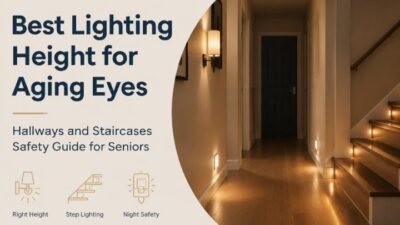

How to Prevent Nighttime Falls Between the Bedroom and Bathroom
My grandmother used to say the walk to her bathroom at night felt longer than the same walk in daylight, even though it was obviously the exact same distance. I didn’t really understand what she meant until I tried it myself once, lights off, half asleep, just to see. It’s a strange thing to explain to someone who hasn’t tried it. The hallway doesn’t get physically longer. It just feels like it, and I think that feeling is probably part of why so many falls happen on a walk people have made a thousand times before without any trouble at all.
This is one of those risks that doesn’t look dangerous from the outside. During the day, that same path from bed to bathroom looks completely fine, maybe even boring. At two in the morning, with a groggy brain and dim eyes, it turns into something else entirely.
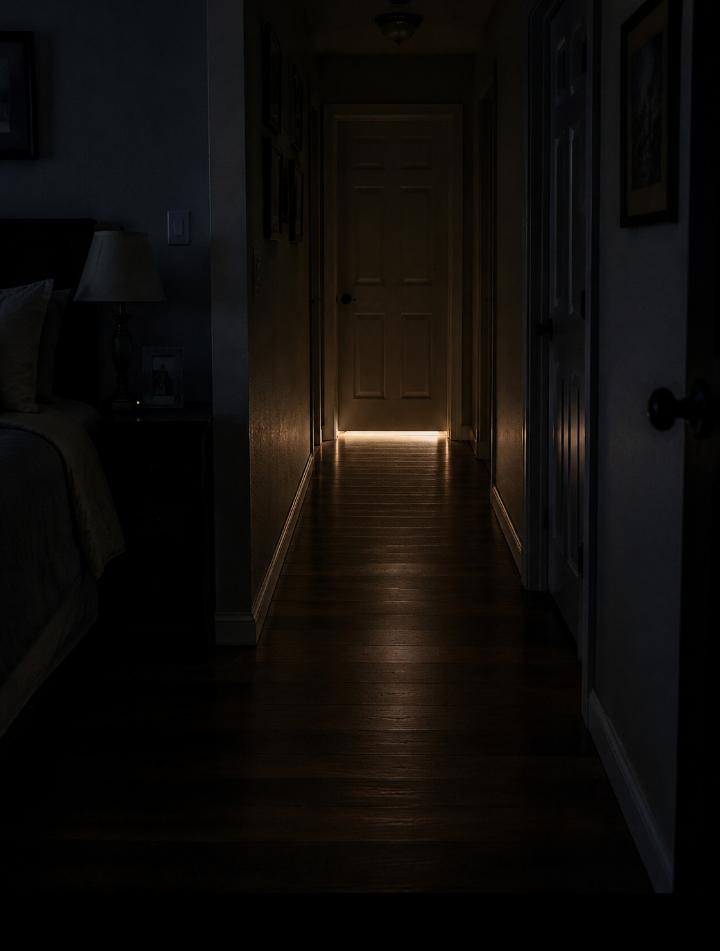
Why this specific trip is riskier than it looks
There seem to be a few things stacking on top of each other during a nighttime bathroom trip, and it might help to look at them individually rather than as one vague category of “nighttime risk.”
Waking from sleep leaves most people groggy for a stretch, sometimes longer than they’d guess, and that grogginess affects balance and spatial awareness more than people expect. On top of that, a lot of medications, blood pressure pills especially, seem to peak in effect overnight, which can add dizziness on top of the grogginess already happening. Then there’s urgency, since the reason for getting up in the first place is often a need that feels immediate, which pushes people to move faster than their body is really ready for. And finally, there’s just the dark itself, which removes the visual cues that balance depends on more than most people realize.
None of these individually sounds dramatic. Put together, in the same ten seconds, they explain a lot about why this specific walk causes so many injuries. The CDC’s own falls data puts it plainly too, noting that more than one out of four older adults falls each year, and falling once roughly doubles the chance of falling again. One source I came across put a more specific number on the nighttime piece: nighttime bathroom trips are responsible for over 6 percent of injury related emergency room visits among adults 65 and older, which is a bigger share than I expected when I first read it.
Lighting, probably the single biggest lever here
This one gets mentioned in nearly everything written about nighttime falls, and for good reason, though I think the details matter more than just “add a light somewhere.”
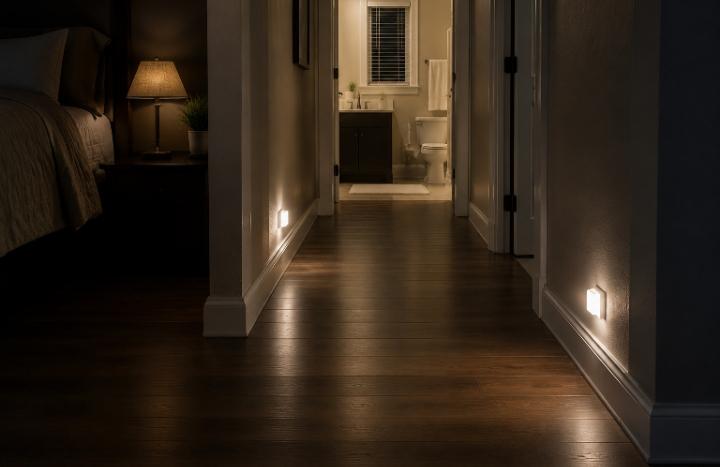
Turning on an overhead light sounds like the obvious answer, but in practice it rarely happens, since fumbling for a switch in the dark is its own small obstacle, and a bright overhead light can be disorienting enough on its own that some people avoid it entirely and just walk in the dark instead. What tends to work better is eliminating darkness before standing up at all, which usually means motion sensor lights along the path, so light appears automatically the moment someone sits up or steps onto the floor.
- A motion sensor light near the floor beside the bed, so it activates the second feet touch down
- A second one somewhere along the hallway or path to the bathroom, especially if the walk includes a turn or a doorway
- A third inside the bathroom itself, ideally soft enough not to fully wake someone up, since a harsh bright light at 2am can make it harder to fall back asleep afterward
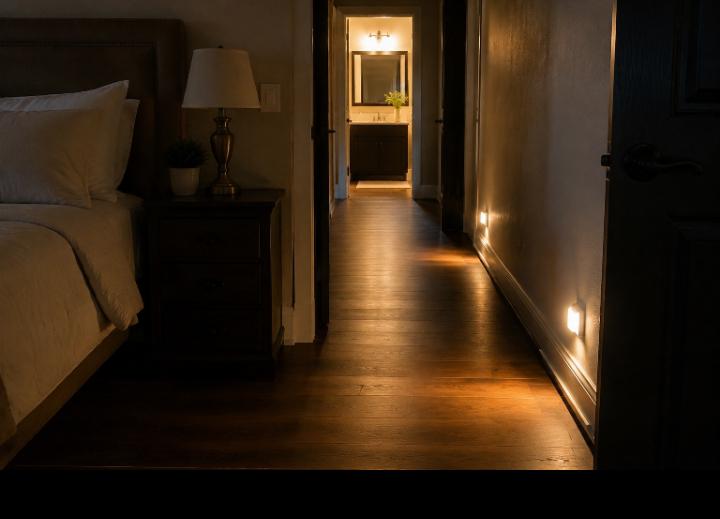
There’s a fuller breakdown of home lighting and general safety changes that goes into more depth on this than I can cover here, worth reading alongside this one if lighting is the main concern.
Bed height, which gets overlooked more than it should
This detail surprised me a little the first time I read about it, since it seems almost too simple to matter. But bed height, meaning how high the mattress sits off the floor, changes how stable that first moment of standing up actually is.
Ideally, feet should touch the floor flat while sitting on the edge of the bed, with knees roughly level with the hips, not higher and not lower. A bed that’s too high means feet dangle before finding the floor, which can throw off the first step. A bed that’s too low means getting up requires more leg strength and a bigger shift in balance, which matters more for someone who’s already a bit unsteady.
If the current bed doesn’t sit at the right height, bed risers or a different mattress base might help, and it’s a fairly cheap fix compared to most home safety changes discussed elsewhere.
Why Getting Up Slowly Matters at Night
This might sound like an odd thing to compare, but the pace someone gets up at seems to matter almost as much as anything else on this list.
| Approach | What Happens | Risk Level |
|---|---|---|
| Jumping straight up and moving quickly | Body moves faster than the balance system can adjust to, especially right after waking | Higher |
| Sitting on the bed edge for a moment first | Gives the body a few seconds to adjust before standing fully | Lower |
| Standing still for a moment before walking | Lets vision and balance catch up to the new position before movement begins | Lower still |
This is a habit more than a purchase, and it’s probably one of the hardest things to actually change, since urgency tends to override patience at two in the morning no matter how many times someone’s told to slow down. It might help to frame it less as a rule and more as something worth practicing consciously, maybe even during the day, so it becomes more automatic at night when the brain isn’t fully cooperating anyway.
Clearing the actual path, which sounds obvious but rarely gets checked properly
Shoes left out. A phone charging cord crossing the floor. A pet bed shifted slightly from where it usually sits. None of these look dangerous in daylight, and that’s really the problem, since the same walkthrough that catches these in daylight often misses them because daylight makes everything look manageable.
It might help to do the walkthrough at the actual time it matters, meaning at night, lights off, the way your parent would really experience it. This isn’t a one time check either. Cords get moved. Furniture shifts slightly over time. Rugs bunch up after enough foot traffic. It’s worth repeating this walkthrough every so often rather than treating it as something done once and forgotten. If the flooring itself along that path is part of the problem, whether it’s slick tile or an old rug that’s never sat quite flat, a comparison of non-slip flooring and mat options might be worth a look too, since the surface underfoot matters just as much as what’s sitting on top of it.
What about a bedside commode, since it comes up a lot
This is one of those suggestions that sounds a little uncomfortable to bring up, and I understand why some families avoid the conversation entirely. But a bedside commode, essentially removing the walk altogether for the middle of the night specifically, is one of the more effective fixes simply because it eliminates the trip rather than trying to make the trip safer.
I’d frame this gently rather than as a decline in independence. It’s really just removing the single riskiest moment of the day, while leaving daytime bathroom use completely unaffected. Some families use it only overnight, keeping the regular bathroom for every other time, which tends to feel like less of an adjustment than it sounds at first.
Grab bars along the actual path, not just inside the bathroom
Most advice about grab bars focuses entirely on the bathroom itself, near the toilet or in the shower, which makes sense since that’s where a lot of falls happen. But the hallway or path leading there matters too, especially if there’s any distance at all between bedroom and bathroom.
A simple wall mounted rail along a longer hallway, similar to what you’d see in some care facilities, gives something to hold onto for the entire walk rather than just the final destination. There’s a detailed guide on grab bar placement and options worth reading if bathroom specific support is still needed on top of hallway support, since the two aren’t really substitutes for each other.
Medication timing, which is worth a conversation with a doctor
This part isn’t something I’d try to solve without a doctor involved, but it’s worth mentioning since it comes up in almost every source on this topic. Certain medications, particularly ones affecting blood pressure or sleep, seem to have their strongest effect overnight, which can add dizziness or grogginess right at the exact moment someone needs to get up and walk somewhere unfamiliar in the dark.
If nighttime dizziness feels like a bigger issue than daytime dizziness, it might be worth asking a doctor directly whether timing of a specific medication could be adjusted, rather than assuming nothing can be done about it.
A quick comparison of fixes, roughly ordered by effort
| Fix | Effort Level | Rough Cost |
|---|---|---|
| Motion sensor lights along the path | Low, no tools needed | $10–$30 |
| Clearing cords, shoes, clutter | Low, just attention | Free |
| Adjusting bed height | Medium, may need risers | $20–$60 |
| Hallway grab rail | Medium, needs installation | $40–$150 |
| Bedside commode | Low physically, but a bigger conversation | $30–$100 |
What if a fall happens anyway, since it’s honest to plan for that too
Even with every fix in place, it’s fair to say the risk doesn’t drop to zero, and pretending otherwise probably isn’t helpful. The phone is usually sitting on a nightstand in the bedroom, which does very little good if the fall happens in the bathroom or somewhere along the hallway.
A medical alert device worn on the body, rather than a phone left behind in another room, closes that gap. This matters especially for a fall that happens at night, alone, when the delay between falling and getting help tends to be longer than during the day, simply because no one else is awake to notice. A system with automatic fall detection removes the need to press a button at all, which matters if someone’s disoriented right after a fall and not thinking clearly enough to act quickly.
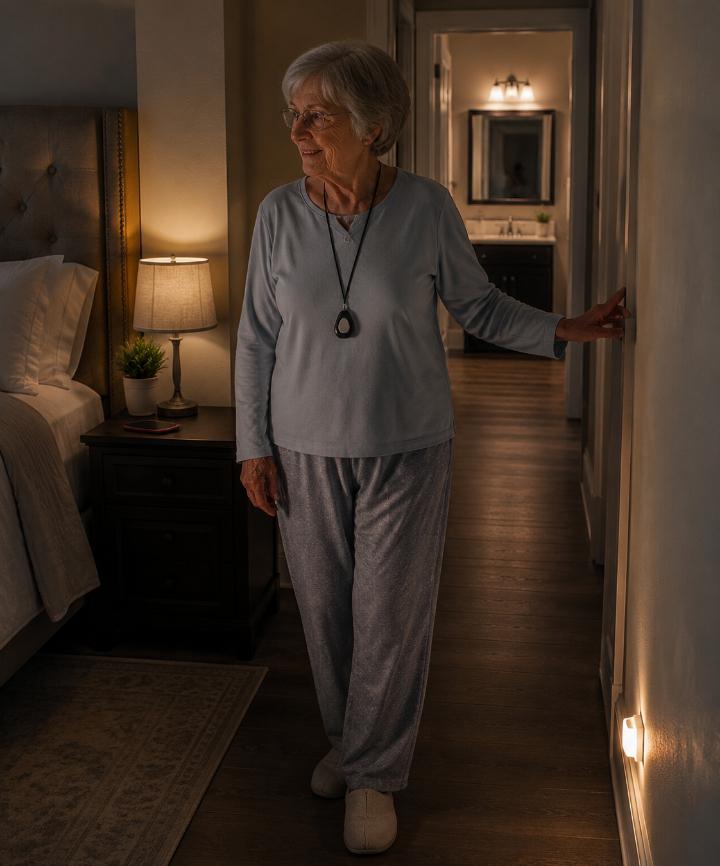
It might be worth comparing a watch versus a pendant style device, since what someone will actually wear to bed each night matters more than which one looks better on a comparison chart. A system with automatic fall detection built in removes the need to press a button at all, which matters if someone’s disoriented right after a fall. For anyone living entirely alone, this becomes even more important, and there’s a dedicated guide on medical alert systems for seniors who live alone worth reading alongside this one. A full review of medical alert systems and a side by side comparison tool can help narrow down the right fit without wading through marketing pages from every brand individually.
Questions people tend to ask about this
Is it normal to need the bathroom multiple times a night at this age?
Fairly common, yes, though if it’s a new change or happening much more often than before, it’s probably worth mentioning to a doctor, since it could point to something worth checking rather than just normal aging.
Should the bathroom door be left open at night?
This might help in some households, since it removes one more obstacle in the dark, though it depends on personal comfort and whether anyone else shares the space. Worth discussing rather than assuming one way is correct.
What if my parent refuses a bedside commode out of embarrassment?
This comes up a lot, and pushing too hard usually backfires. It might help to frame it as something temporary, or something used only on particularly rough nights, rather than a permanent change, which tends to feel less like giving something up.
Does this matter if my parent hasn’t fallen yet?
Probably still worth doing, honestly, since the goal is preventing the first fall, not just responding after one’s already happened. A near miss, someone catching themselves on a wall or a piece of furniture, is usually a clearer warning sign than people treat it as. Waiting for a fall before making any changes tends to mean the first real signal a family gets is also the most serious one, which isn’t really the position anyone wants to be in.
A short story about my grandmother’s hallway, and how it actually changed
I mentioned earlier that she used to say the walk felt longer at night. What eventually helped wasn’t one big fix, it was a handful of small things stacked together. Motion lights along the path, mentioned in an earlier post about her rented apartment. A slightly lower bed after we noticed her feet dangling a bit when she sat on the edge. A wall rail installed partway down the hallway, since the distance to her bathroom was longer than most apartments have.
None of it happened at once. It was more of a slow process, noticing one thing, fixing it, then noticing the next. I think that’s probably the more realistic version of how this actually works for most families, rather than one weekend overhaul that solves everything permanently.
Looking back, I think what actually made the difference wasn’t any single item on the list. It was that we kept checking. We’d fix one thing, feel good about it for a month or two, and then something else would surface, a bulb burning out, a rug shifting slightly, a new medication that seemed to make her a bit dizzier at night than before. Treating it as an ongoing thing to pay attention to, rather than a project with a clear finish line, seemed to matter more than getting any individual fix perfect the first time.
A word on rugs specifically, since they come up more than you’d think
Rugs get mentioned a lot in general home safety advice, usually with a blanket suggestion to just remove them entirely. I’d push back on that a little, since a rug isn’t automatically dangerous, it’s an unsecured rug that causes trouble. A rug with a rubber backing, taped down at the edges, or held in place with a non-slip pad underneath tends to behave completely differently than one that’s just been laid loosely on a hard floor.
If your parent has a rug they genuinely like, maybe one with sentimental value or just a favorite from years of use, it might not need to disappear entirely. It probably needs to be secured properly, checked periodically for curling edges, and kept clear of the direct path between bed and bathroom specifically, even if it stays somewhere else in the room.
Bringing this up without it feeling like an accusation
This might be the hardest part of the whole topic, honestly, harder than any of the physical fixes. Bringing up nighttime bathroom safety with a parent can feel loaded, like you’re really saying something bigger about their overall independence, even if that’s not the intention at all.
It might help to lead with something specific and small rather than a general concern. Mentioning a particular cord, a particular rug, or a particular dark spot in the hallway tends to land better than a broad statement like “I’m worried about you at night,” which can feel overwhelming or even a little insulting depending on how it’s phrased. Specific, small, and framed around comfort rather than decline seems to work better across most of the conversations I’ve heard about on this topic.
It’s also worth listening for what your parent brings up on their own, even in passing. A mention of feeling unsteady getting up, or avoiding a nighttime trip entirely, is usually worth following up on gently rather than letting it pass by unremarked.
Cognitive fog at night, and why it’s different from being tired
This part probably deserves its own section, since it’s a little different from ordinary tiredness. Waking up in the middle of a sleep cycle, rather than at the natural end of one, seems to leave people in a kind of fog that’s not quite the same as regular sleepiness. Spatial awareness drops. Reaction time slows. Even someone who’s steady and sharp during the day can be genuinely disoriented for those first thirty seconds or so after waking at 2am.
I think this matters because it explains why so many falls happen to people who otherwise walk perfectly fine the rest of the day. It’s not really a sign of declining ability in general. It’s more that this specific window, right after waking from deep sleep, is just a harder moment for almost anyone, and it gets harder with age simply because the margin for error shrinks.
It might help to think of this less as something to fix and more as something to plan around. You probably can’t eliminate the grogginess itself. But you can reduce how much that grogginess actually matters, by making sure the lighting, the path, and the bed height don’t require sharp thinking to navigate safely.
A note on caregivers who sleep in a different room or a different house entirely
If you don’t live with your parent, which is the case for a lot of families, the nighttime window is probably the hardest part of the day to feel confident about, simply because it’s the part you’re least likely to witness directly.
A simple intercom system, or even just a phone kept on the nightstand with a direct line to a family member, can help close some of that gap, though it depends on your parent actually being able to reach it if something’s already gone wrong, which isn’t always a safe assumption. This is really where a wearable medical alert device tends to matter more than a phone sitting in another room, since it stays on the body rather than needing to be reached after a fall has already happened.
It might also help to have a plan for what happens if a fall does occur and your parent can’t get to the bathroom door or bedroom door to let anyone in, which sounds like a small detail but has genuinely complicated emergency response in some situations I’ve heard about. Knowing where a spare key is kept, or having a way to unlock a door from outside, is worth thinking through before it’s needed rather than during an actual emergency.
A 10-Minute Nighttime Bathroom Safety Check
Nighttime Bedroom-to-Bathroom Safety Checklist
Where this leaves you
This walk probably won’t ever feel completely risk free, and I don’t think chasing a perfect fix is really the point. What seems to matter more is stacking enough small changes, lighting, bed height, a cleared path, maybe a rail or a commode, that the walk gets a little safer each time something gets adjusted.
If you’re not sure how ready the rest of the home is for this kind of thing, an aging in place readiness quiz might help you see the bigger picture, since the bedroom to bathroom walk is really just one part of a much wider set of routines worth looking at closely, rather than only after something’s already gone wrong.
I don’t think anyone gets this completely right on the first try, and that’s probably fine. The walk between bed and bathroom will likely never feel exactly like it did decades ago, and chasing that feeling probably isn’t the actual goal anyway. The real goal, at least the way I see it, is making sure that one ordinary trip in the middle of the night stays ordinary, rather than becoming the thing a whole family ends up worrying about at three in the morning after a phone call nobody wanted to get.