
Singapore Senior Home Modification Guide: What To Fix First And Why
My friend called me last month, worried about her dad’s flat in Yishun. She didn’t know where to start, and honestly, neither did I when my own aunt went through this.
So this is me writing the thing I wish someone had handed me back then. No brochure language, just what actually matters, in the order it actually matters.
I’m not a contractor, and I’m not from HDB. I’m just someone who’s actually done this twice now, once for family, once helping a friend, and I’m sharing exactly what I learned both times.
The Short Answer First, Since You’re Probably In A Hurry
A Singapore senior home modification guide, in one sentence, is a plan for changing a flat or house so an older person can move around it safely, without needing to move out of it.
That’s it. Grab bars, better flooring, ramps, wider doorways, safer kitchens, safer bedrooms. Some of it costs almost nothing. Some of it needs a proper contractor. This guide walks through both.
Who this is for: if you’re an adult child trying to help a parent, this is for you. If you’re a senior reading this yourself, deciding what to change in your own home, this is for you too. I wrote it for both, because in my experience, both sides of that conversation usually need the same information, just explained a little differently depending on who’s asking.
Why This Matters More Right Now Than It Did A Decade Ago
Singapore has one of the fastest ageing populations in the region, and government policy has clearly shifted toward keeping seniors at home rather than in institutional care wherever realistically possible.
EASE itself began back in 2012, and by March 2025, more than 379,000 households had already benefited from it, according to HDB’s own figures
. That’s not a small pilot, that’s a huge share of Singapore’s older HDB residents.
More recently, support extended to private property from April 2026, and Community Care Apartment eligibility dropped from age 65 to 55. A Singapore senior home modification guide written even a year ago would already be missing pieces of this picture.
I mention all of this not to bore you with policy history, but because it changes how you should approach the process. A scheme that’s been running and expanding for over a decade behaves differently than a brand new pilot. Contractors know it well, HDB staff know it well, and the whole process is far more predictable than most families assume going in for the first time.
Why I’m Writing This Like I’m Talking To A Friend, Not A Reader
I already wrote a full breakdown of Singapore’s ageing in place support and government schemes. This guide is different on purpose.
That one covers EASE and eligibility in depth. This Singapore senior home modification guide is about the actual physical changes themselves, what to prioritise, what they cost, and when a handyman just isn’t enough anymore.
I’m treating this the way I’d explain it to a friend over coffee, not the way a government pamphlet explains it. If something sounds too casual for a “guide,” that’s on purpose too, since the stiff, formal version of this content already exists elsewhere and hasn’t actually helped anyone I know make a faster decision.
Home Modification, Explained Without The Jargon
Home modification just means changing something physical in the home so it’s safer or easier to use. That’s the whole definition, nothing fancier hiding underneath it.
For seniors, that usually means fixing the things that cause falls, or the things that make daily tasks exhausting instead of routine. A grab bar. A ramp. A wider doorway. A brighter bulb.
A proper Singapore senior home modification guide doesn’t treat all of these as equally urgent though. Some changes stop an accident tonight. Others just make Tuesday afternoon a bit easier. Knowing the difference matters.
HDB Flat Or Private Property, Does The Approach Actually Change
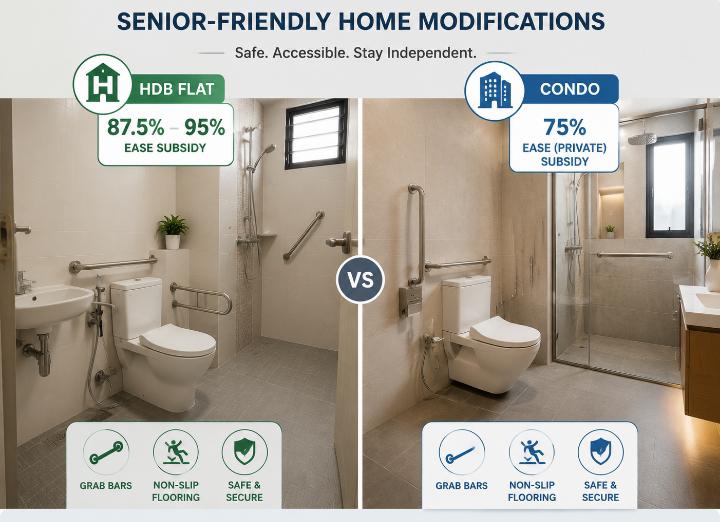
Yes, a bit, mostly around cost and who pays for what. HDB flats have access to EASE, a subsidy scheme covering grab bars, ramps, and slip resistant flooring, at rates from 87.5% up to 95% depending on flat type.
Private property, condos and landed homes, now has EASE (Private) too, since April 2026, covering roughly 75% of cost up to S$1,200 in vouchers, across seven fitting types instead of eleven.
Beyond the subsidy math, the physical modifications themselves don’t really change much between HDB and private homes. A grab bar works the same way in a condo bathroom as it does in a four room flat.
Subsidy Differences Across HDB Flat Types
Not every HDB flat gets the same subsidy rate under EASE, and this genuinely changes the maths behind any Singapore senior home modification guide plan for your family.
1 to 3 room flats generally sit at the higher end, around 95%, since HDB structured EASE with lower income households in mind. 4 and 5 room flats sit a little lower, often in the high 80s to low 90s. My aunt’s four room flat fell into this middle band.
Executive flats sit at the lower end of the scale, around 87.5%, still a large majority of cost covered, just proportionally less than the smallest flat types receive. Nobody pays full price under EASE, the differences are in degree, not in whether support exists.
The Modifications That Actually Matter Most
I’m going to rank these the way I’d genuinely rank them for a friend, not in some neutral “everything matters equally” way that helps nobody make a decision.
This ranking comes from watching two actual projects unfold, my aunt’s and my friend’s dad’s, not from a theoretical list someone wrote without ever standing in a real HDB bathroom at 11pm with a torch, checking the grip on a half installed grab bar.
Number One: Bathroom Grab Bars
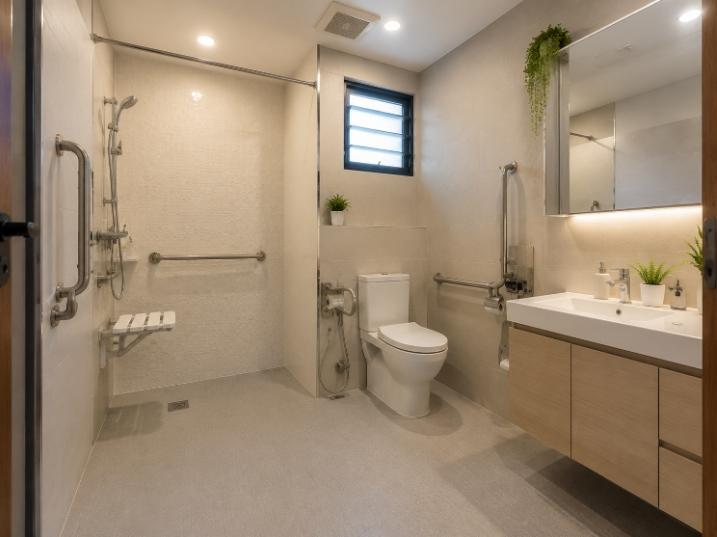
This is the single highest impact change in any Singapore senior home modification guide, full stop. Most falls happen in bathrooms, and a properly placed grab bar directly addresses that.
I’ve gone deep on this separately in a full review of the best grab bars, comparing grip, weight rating, and mounting styles, since not all bars are built the same.
Straight, Angled, Or Fold Down
Straight bars work well beside a toilet. Angled bars suit a shower corner better, giving a hand two directions to grip depending on the movement. Fold down bars work for tighter bathrooms, tucking away when not needed.
My aunt’s bathroom ended up with a straight bar beside the toilet and an angled one inside the shower, based on what the installer suggested after actually watching how she moved through the space.
Number Two: Slip Resistant Flooring
Second on the list, and it pairs directly with the grab bars above. A grab bar helps someone catch themselves. Non slip flooring helps stop the slip from happening at all.
You can run your own numbers through this non slip flooring cost calculator before deciding on material, since prices swing a lot depending on bathroom size.
Choosing Between Treatment And Full Retiling
A slip resistant treatment applied to existing tiles is cheaper and faster than retiling the whole bathroom, and it’s often enough on its own. Full retiling makes more sense only if the tiles are already worn, cracked, or genuinely due for replacement anyway.
I went with treatment for my aunt’s bathroom, since her tiles were otherwise in good condition, and it made the whole project faster and considerably cheaper than a full retile would have been.
Number Three: Ramps And Step Removal
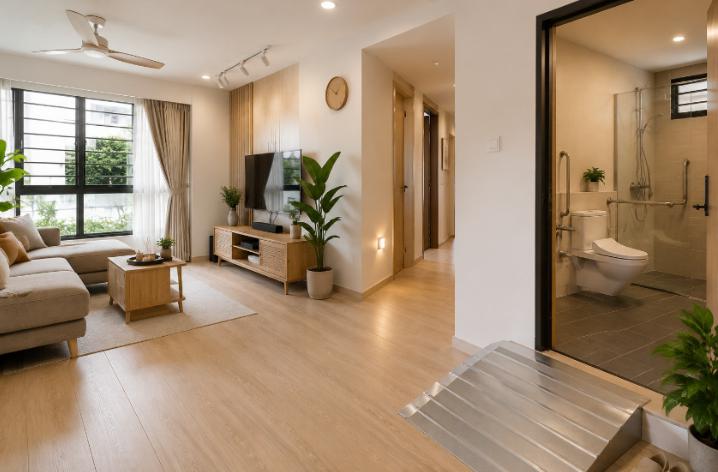
For anyone using a wheelchair or a frame, small steps at entrances or between rooms become real barriers. Ramps solve this, and pricing varies depending on length and material, which you can check with this wheelchair ramp cost calculator.
Aluminum Versus Concrete Ramps
Aluminum ramps install faster and cost less upfront, and they work well for smaller height differences at a single step. Concrete ramps suit larger height changes better, and last longer outdoors, but take real construction time and cost considerably more.
Most HDB flats only need a small aluminum ramp at a single low step, which is exactly the kind of item EASE typically covers without much fuss, and it’s usually the fastest single item on this whole list to get installed once approved.
Number Four: Doorway Widening
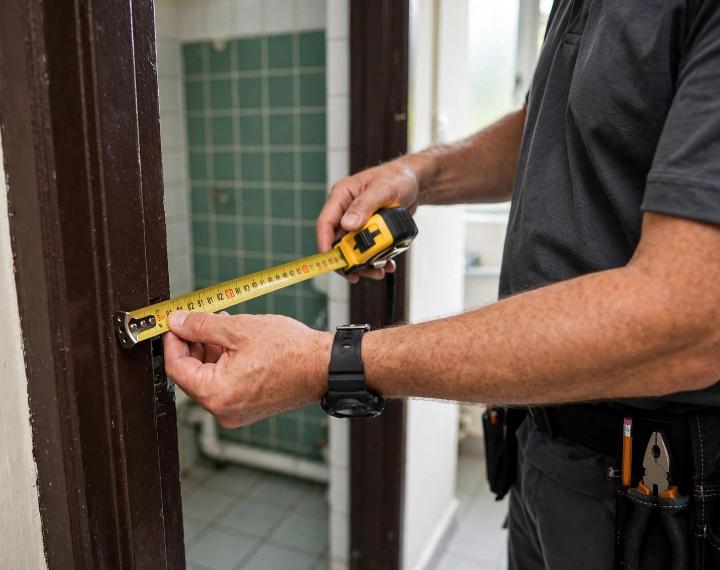
Standard HDB toilet doorways aren’t built with wheelchairs in mind, and widening one is real construction work, not a weekend fix. Price it separately using this door widening cost calculator before committing to a full bathroom project.
What Doorway Widening Actually Involves
This usually means removing the existing door frame, adjusting the surrounding wall section, and fitting a new, wider frame and door. It’s noisy, dusty work that takes a few days, not hours, so plan around it rather than squeezing it into a single weekend.
It’s also worth checking whether a sliding door, rather than a swing door, makes more sense for the new opening, since sliding doors can save valuable floor space in a tight bathroom, which matters a lot in smaller HDB flat types where every inch of the bathroom is already tightly planned.
Number Five: Lighting Throughout The Flat
Cheapest item on this whole list, and often the most ignored. A dim hallway or bathroom hides exactly the hazards the other four items are trying to fix. Fix lighting alongside everything else, not as an afterthought.
Number Six: Shower Seats And Toilet Risers
Small items, big daily difference. A foldable shower seat means standing under running water isn’t a balancing act anymore. A raised toilet seat, often under S$50, takes real strain off knees and hips every single use.
If a bathtub is involved instead of a shower, our guide on non slip mats and flooring options covers a cheaper first step before any bigger renovation decision.
What To Look For In A Shower Seat
Weight rating matters more than style. A foldable seat rated for a proper weight range, with rubber feet that grip the flooring underneath, is worth paying slightly more for over a flimsy plastic version that wobbles under real use.
I’d also check the seat height adjusts, since a fixed height that doesn’t match the shower or the person’s own height defeats a lot of the comfort benefit it’s meant to provide.
Number Seven: Stair Lifts, For Landed Properties Only
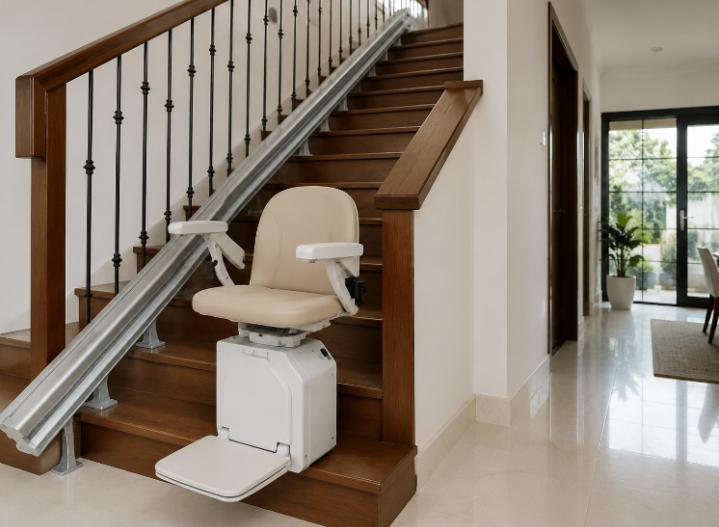
HDB flats are single level, so this doesn’t apply there. For landed homes with multiple floors, a stair lift removes one of the biggest daily risks entirely, though it’s a real investment.
What A Full Renovation Actually Costs In Singapore Dollars
I put this table together after comparing quotes from a few contractors, and cross checking against published EASE subsidy figures.
| Modification | HDB With EASE Subsidy | Private Property With EASE (Private) | Full Private Market Rate |
|---|---|---|---|
| Grab bars, set of 8 | Around S$130.80 | 75% of cost covered by voucher | S$400 to S$900 |
| Non slip flooring treatment | Heavily subsidised, small co-pay | 75% covered up to voucher limit | S$800 to S$2,500 |
| Ramp installation | Included, small co-pay | Included within 7 eligible items | S$500 to S$1,500 |
| Doorway widening | Not always included, ask HDB directly | Not always included, ask directly | S$600 to S$1,800 |
| Full bathroom renovation, senior focused | EASE items only, rest private cost | EASE items only, rest private cost | S$4,000 to S$12,000 |
| Stair lift, landed property | Not applicable, HDB flats are single level | Not typically covered | S$5,000 to S$15,000 |
Run your own numbers through this home modification cost calculator before signing anything, especially if you’re combining subsidised items with private renovation work.
What This Actually Saves, Compared To Recovering From A Fall
A full grab bar and flooring project, even paid entirely privately, usually costs less than a single hospital stay after a hip fracture, and far less than the recovery time that follows one.
I’m not saying this to scare anyone. I’m saying it because when a family hesitates over a few hundred dollars in flooring work, it helps to remember what the alternative actually costs, in money and in months of recovery.
What A Flat That’s Never Modified Actually Looks Like Years Later
I’ve seen this pattern more than once. A senior slowly narrows their own life to avoid risk, skipping the shower, avoiding certain rooms, asking less of their own body simply because the home hasn’t kept up with how they’ve changed.
That’s not independence, even though it can look like it from the outside. Real independence, the kind a Singapore senior home modification guide is actually trying to protect, means using the whole flat confidently, not just the safest corner of it.
Paying For What EASE Doesn’t Cover
Even with subsidies, a full bathroom renovation or doorway widening job still costs real money out of pocket. Here’s what families I’ve spoken with actually did about that gap.
Some pooled funds between siblings, splitting the private cost evenly instead of one person carrying it alone. Others used a renovation loan through their bank, spreading the cost over months instead of paying upfront.
A few simply phased the work, doing grab bars and flooring this quarter, doorway widening next quarter, once budget allowed. There’s no single right answer, just whatever keeps the actual safety work from getting delayed by cost alone.
A Rough Timeline From Start To Finish
For EASE items, families I’ve spoken with usually see three to eight weeks total, from application to finished installation. Ours landed around five weeks. Actual installation, once approved, often takes under a day.
For private renovation work outside EASE, timelines stretch longer, often four to ten weeks depending on scope, contractor availability, and whether any structural work like doorway widening is involved.
What A Physiotherapist Told Me That Changed My Whole Approach
Partway through my aunt’s project, I asked her physiotherapist a simple question. What’s the biggest thing families miss when modifying a flat for an older parent.
Her answer wasn’t about equipment at all. She said families fix the room where the last accident happened, then stop looking, when decline usually shows up gradually across several rooms at once, not one dramatic failure point.
That’s exactly why this Singapore senior home modification guide covers kitchens and bedrooms alongside bathrooms, instead of treating the bathroom as the whole story.
EASE In A Nutshell, With A Link If You Want The Full Picture
EASE, or Enhancement for Active Seniors, is HDB’s main subsidy scheme, and it’s the single biggest reason a Singapore senior home modification guide looks so different from similar guides in other countries.
Seniors 65 and older generally qualify automatically. Those aged 60 to 64 need a Functional Assessment Report first, confirming they need help with at least one daily living activity, done by a registered doctor or approved assessor.
I’ve written a full breakdown of eligibility, application routes, and exact subsidy percentages in my ageing in place in Singapore guide, so I won’t repeat all of it here. This guide is about the modifications themselves, not the paperwork.
Handyman, General Contractor, Or Specialist, Who Do You Actually Need
This trips people up more than anything else in this Singapore senior home modification guide, so let me break it down plainly.
When A Handyman Is Genuinely Enough
Swapping cabinet handles. Adding a motion sensor night light. Moving items to a lower shelf. Small, contained, low risk jobs that don’t touch plumbing or structural elements.
When You Need An EASE Appointed Contractor
Grab bars, ramps, and slip resistant flooring under the actual EASE scheme go through HDB’s appointed contractors, not a random handyman off an app, since the subsidy is tied to that specific arrangement.
When You Need A Licensed Renovation Contractor
Doorway widening, full bathroom remodels, anything touching plumbing, electrical wiring, or load bearing walls. This is real construction, and it needs proper licensing, not enthusiasm.
How I Actually Compared Three Contractors
For my aunt’s private renovation work, the parts outside EASE, I got three quotes before deciding anything. The spread surprised me more than expected.
The cheapest quote used generic flooring with no slip rating documented anywhere. The middle quote included a written slip rating certificate as standard. The most expensive bundled in cosmetic work we didn’t actually need.
We picked the middle one. Not the cheapest, not the priciest, the one that actually documented the safety details that mattered, instead of just describing the work in vague, reassuring language that sounds good on the phone but means nothing once the work is actually done.
What Happens If You Skip Professional Help Entirely
A grab bar mounted into drywall instead of a stud can pull loose exactly when someone leans on it hardest, during a fall, which is the worst possible moment for it to fail.
A DIY doorway widening job that isn’t done to code can create structural issues that cost more to fix later than a proper contractor would have charged from the start. Cutting corners here isn’t really saving money, it’s postponing a bigger bill.
My Aunt’s Flat Versus My Friend’s Dad’s Flat, Two Different Starting Points
My aunt’s four room HDB flat in Bedok needed bathroom work first, grab bars and flooring, since that’s where she’d already had a fall.
My friend’s dad’s flat in Yishun was different. He hadn’t fallen yet, but he was using a walking frame more each month, and the real problem was a narrow bathroom doorway and no ramp at the front step.
Same Singapore senior home modification guide principles applied to both, grab bars, flooring, ramps, but the priority order was completely different depending on what each person actually needed that week.
A Third Scenario, A Private Condo In Novena
A colleague’s mother lives in a private condo, not an HDB flat, and this case ran differently again. She qualified under EASE (Private), the newer scheme, and got a voucher covering roughly 75% of her grab bar and flooring costs.
Her biggest issue wasn’t the bathroom at all though, it was a raised threshold at her balcony door that her walking frame kept catching on. That’s not something any guide online mentions often, but it mattered more to her daily routine than anything in the bathroom.
Three different flats, three different starting points, and the same underlying lesson every time. A Singapore senior home modification guide only works when someone actually walks the specific flat first, instead of applying a generic list blindly.
The Actual Numbers Behind Each Scenario
My aunt’s bathroom work, eight grab bars plus flooring treatment under EASE, came to roughly S$130 out of pocket for the subsidised portion, plus about S$600 privately for a bathroom lighting upgrade EASE didn’t cover.
My friend’s dad’s ramp and doorway widening in Yishun cost more overall, since doorway widening isn’t always bundled into EASE. His family paid around S$900 privately for the doorway work, alongside a smaller EASE subsidised ramp installation.
My colleague’s mother’s condo project, under EASE (Private), came to about S$1,600 total for grab bars and flooring, with the S$1,200 voucher covering the bulk of it, leaving roughly S$400 out of pocket for her family.
If You’re The Parent Reading This, Not The Adult Child
A lot of this content assumes you’re a son or daughter trying to help. But some of you reading this are the senior yourself, deciding what to change in your own home.
You don’t need anyone’s permission to want a grab bar. You don’t need to wait until you fall to ask for one. If a bathroom feels risky to you, that feeling is data, not weakness.
I’ve heard from seniors who felt embarrassed asking their kids to help with this. Please don’t be. Asking for a safer bathroom is closer to asking for better glasses than admitting defeat.
When Your Adult Children Suggest Changes And It Stings A Little
My aunt’s first reaction to grab bars wasn’t gratitude, it was mild offense. It felt like an announcement that she was old and fragile, not a practical fix.
What actually helped was reframing it as convenience, not decline. A grab bar isn’t only for someone frail, it’s for anyone tired after a long day who wants something steady to hold. That framing matters more than people expect.
A Note For Families Talking About This For The First Time
If this conversation hasn’t happened yet in your family, start small. Ask about one room, not the whole flat. A single grab bar conversation is a lot less overwhelming than announcing a full renovation plan out of nowhere.
How I Actually Brought This Up With My Aunt
I didn’t start with “you need grab bars.” I started with “I want to fix the bathroom lighting, it’s too dim for me too when I visit.” That framing made the whole conversation about the flat, not about her.
Once the lighting conversation felt normal, the grab bar conversation followed naturally a week later. By the time I mentioned flooring, she brought it up herself before I did. Small steps worked far better than one big pitch.
Kitchen Changes That Rarely Make Anyone’s List
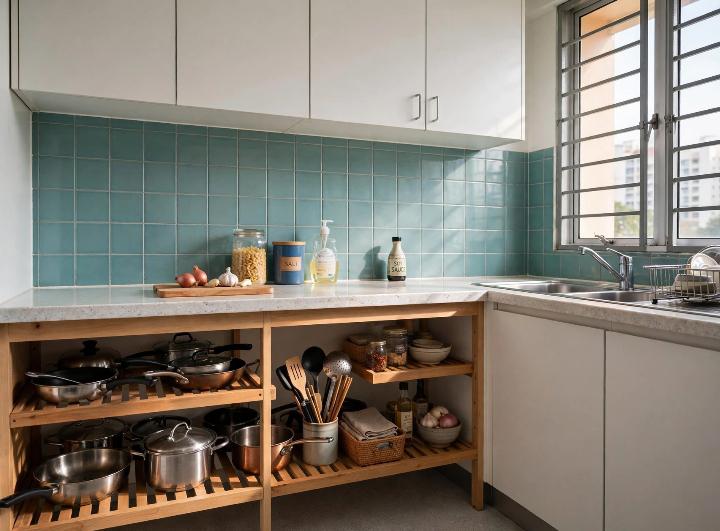
Bathrooms get all the attention in most guides, but kitchens quietly cause just as many problems, mostly through reaching, bending, and stove related risks.
Cabinet Handles
Twist knobs become painful with arthritis or general grip weakness. Pull bar handles cost very little, often under S$5 each, and remove that daily friction entirely.
Shelf Height
Everyday items on a top shelf mean climbing or stretching constantly, which is one of the more common, quietly ignored causes of falls at home.
It matters more than it sounds. A stretch to a high shelf, done on a stool, is one of the more common ways seniors fall at home, and it has nothing to do with any subsidy scheme at all.
Stove And Oven Habits
An auto shutoff feature, or a simple timer habit, matters more as memory naturally slows with age. This isn’t about capability, it’s about reducing the cost of an honest, ordinary mistake.
Kitchen Flooring
Kitchens get wet too, from spills, mopping, condensation near the sink. The same slip resistant thinking that applies to bathrooms should extend here, even though EASE itself doesn’t typically cover kitchen flooring specifically.
Bedroom Changes Worth Doing At The Same Time
Most falls at night happen for a boring reason. Someone wakes needing the bathroom, the room is dark, and their body hasn’t fully woken up yet.
Bed height matters more than people think. Too low, standing becomes hard work every time. Too high, getting down creates its own risk. A motion sensor night light along the path to the bathroom fixes the rest cheaply.
Finding The Right Bed Height
There’s a rough sweet spot, usually where knees sit close to a right angle while seated on the edge of the bed. Too far from that, and standing up becomes a small daily struggle nobody names out loud.
Night Lighting Between Bed And Bathroom
This is one of the cheapest fixes in this entire Singapore senior home modification guide. A motion sensor night light along the regular path costs very little and removes one of the biggest risk factors for night time falls specifically.
Wheelchair And Frame Access Through The Whole Flat
Grab bars and flooring get the spotlight, but getting around the entire flat matters just as much for anyone using a wheelchair or frame.
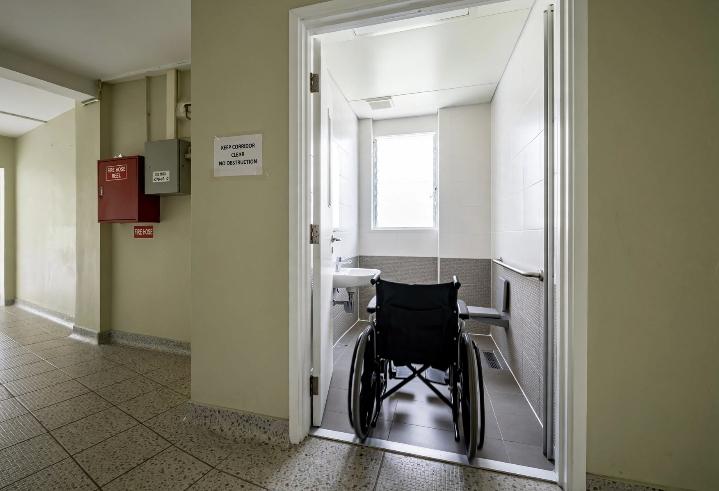
Common corridors and lifts matter too, and people forget this constantly. A perfectly modified flat still isn’t fully accessible if the block’s lift doesn’t stop on every floor.
Checking The Path Before The Front Door
Walk the actual route from the flat to the lift, and from the lift to the ground floor exit. Uneven paving, a raised threshold at the common corridor, a lift that stops one floor away during peak hours, all of these matter just as much as anything inside the flat itself.
I didn’t think about this until my friend mentioned her dad’s block has a lift that occasionally skips floors during maintenance windows. That’s not something any renovation fixes, but it’s worth knowing and planning around regardless.
Numbers worth remembering: HDB subsidy under EASE runs 87.5% to 95% depending on flat type. Private property under EASE (Private) gets 75% covered, capped at S$1,200 in vouchers. A basic grab bar and flooring project under EASE often costs under S$150 out of pocket for HDB residents.
If Memory Issues Are Part Of The Picture
A Singapore senior home modification guide looks a little different when dementia or memory decline is involved, not just physical mobility concerns.
Colour contrast matters more here. A toilet seat that clearly stands out against the floor and walls helps someone with memory decline locate it faster, reducing confusion related accidents rather than physical ones.
Consistent layout matters too. Moving furniture around, even to make things “safer,” can genuinely confuse someone relying on spatial memory to navigate their own home. Small, careful changes work better than one big rearrangement.
Labelling And Simple Visual Cues
Simple labels on cabinets, or a clear picture on the bathroom door, sound almost too basic to mention, but they genuinely help someone whose memory is starting to slip navigate their own home with less frustration.
If this applies to your family, it’s worth asking HDB specifically about dementia friendly design guidance during your EASE application, since the standard grab bar and flooring package doesn’t automatically include these considerations unless you raise them directly.
Signs It’s Time To Actually Start This, Not Just Think About It
- Holding onto furniture or walls while walking through rooms that used to be walked through freely.
- Avoiding the bathroom at certain times of day, or drinking less water to avoid needing it at night.
- New bruises with no clear explanation, or explanations that don’t quite add up.
- Reluctance to bend down or reach up, where they used to do both without thinking.
- Complaints that a specific room feels “annoying” or “too much effort,” which is often code for something physically harder than it should be.
None of these alone is an emergency. Together, they’re exactly the pattern worth acting on before an actual fall forces the decision instead.
Fall Prevention Beyond The Obvious Fixtures
Loose rugs, cables across walkways, socks on tile floors, these all matter as much as any renovation, and cost nothing to fix.
I’ve compared fall detection devices in this review of the best medical alert systems, useful alongside physical modifications, not instead of them.
Why A Wearable Still Matters Even With A Modified Flat
Grab bars and non slip flooring reduce the chance of a fall. They don’t eliminate it entirely. A wearable with fall detection covers the gap for the moments when even the best modifications aren’t enough on their own.
This matters most for someone living alone, or for the hours during the day when nobody else happens to be home, which for a lot of families is most hours, most days.
Watch Or Pendant, A Question I Get Constantly
A watch feels less clinical, which matters for someone who doesn’t want to feel treated as fragile. A pendant is often more reliable for fall detection though. I compared both properly in this watch versus pendant comparison.
For Someone Living Completely Alone
If a parent lives alone without daily check-ins, the stakes on this decision rise. Our guide on medical alert systems for seniors who live alone looks specifically at that situation.
Pets, Clutter, And Small Everyday Obstacles
A small dog underfoot, a laundry basket in a doorway, newspapers stacked by the sofa. None of these look dangerous individually, but they add up the same way a wet bathroom floor does, just slower and easier to overlook.
Neighbours And Community, The Support That Isn’t A Renovation
Not every safety layer comes from physical changes. A neighbour who checks in casually, a void deck community group, a nearby active ageing centre, these matter in ways no renovation budget covers.
My aunt’s block has an informal group of older residents checking on each other without anyone officially organising it. It’s arguably done as much for her daily safety as the grab bars have.
Footwear At Home, An Easy One To Forget
Socks on tile floors are more dangerous than most people realise. A cheap pair of grippy indoor slippers does more for fall prevention than people expect from something so ordinary and easy to overlook.
Doorway Width, The Detail Everyone Skips
Standard HDB toilet doorways aren’t built with wheelchairs in mind, and widening one is a real, physical construction job, not a quick fix. It’s worth pricing separately from the rest of any bathroom project.
Smart Sensors Beyond Physical Fixtures
Some families add simple door sensors or motion sensors in hallways, separate from any physical modification entirely. These flag unusual patterns, a bathroom door that hasn’t opened by mid morning, a hallway with no movement for hours longer than usual.
It’s not meant to replace grab bars or ramps, it’s meant to catch the specific gap where someone might not be able to call for help at all, whether from a fall, a medical episode, or simply feeling unwell.
Our roundup of tech gadgets that make life easier for seniors covers a few of these options alongside the physical modifications this guide focuses on.
Renting In Singapore, Does This Guide Still Apply
Registered tenants of HDB rental flats are included under EASE eligibility, alongside owners, which surprises a lot of people the first time they read it. Private rentals sit differently though, since landlord permission for physical changes becomes the real hurdle, not the subsidy itself.
For that specific situation, our guide on making a rental apartment safer without renovations covers non permanent changes that don’t need a landlord’s sign off at all.
Seven Mistakes I’ve Watched Families Make
Some of these I only recognised after making them myself, and a few I watched other families make while I was still figuring out my own aunt’s project. None of them are embarrassing, they’re just easy to miss when you’re doing this for the first time.
- Fixing only the bathroom. Kitchens and bedrooms cause falls too, often cheaply fixable.
- Choosing a handyman for EASE work. Subsidised items go through HDB appointed contractors, not general apps.
- Ignoring lighting entirely. Every other fix works better with proper lighting alongside it.
- Assuming private property gets nothing. EASE (Private) exists now, worth checking.
- Skipping quotes comparison. Three quotes revealed real differences in materials and warranty terms for my aunt’s project.
- Not budgeting private costs separately. A full remodel still costs real money beyond any subsidy.
- Waiting for a fall first. Applying and planning early beats reacting after an accident.
- Assuming one visit fixes everything long term. Mobility changes over time, and the flat needs revisiting every few months.
- Ignoring the emotional side of the conversation. Presenting changes as decline instead of convenience makes seniors resist help that would genuinely benefit them.
I’ve made at least three of these mistakes myself, mostly the ones about budgeting and about only fixing the bathroom. Nobody gets this perfectly right the first time, and that’s fine, as long as the second attempt actually happens.
Choosing What To Fix First With A Genuinely Tight Budget
If money is the real constraint, here’s the order I’d actually recommend, based on both my aunt’s project and my friend’s dad’s project.
First, apply for EASE regardless of budget, since the subsidised items cost very little out of pocket for HDB residents. Second, fix bathroom lighting, since it’s cheap and makes every other change more effective. Third, swap kitchen cabinet handles, since it’s a few dollars per handle and removes daily friction immediately.
Everything else, doorway widening, full remodels, stair lifts, can wait until the budget allows, as long as the highest risk items are already addressed first.
A Simple Room By Room Checklist
- Bathroom: grab bar near toilet and shower, slip resistant flooring, good lighting.
- Kitchen: pull bar handles, waist height storage for daily items, working stove timer habit.
- Bedroom: comfortable bed height, motion sensor night light toward the bathroom.
- Hallway: clear of clutter, cables, and loose rugs, evenly lit.
- Entrance: ramp where steps exist, doorway wide enough for a frame or wheelchair.
Our home safety checklist tool expands this into twenty specific points, paired with the full home safety checklist article if you want reasoning behind each one.
Walking Through The Bathroom With Fresh Eyes
Test the floor when wet, barefoot, carefully, to feel if it’s actually slip resistant, not just labelled that way. Check the grab bar height against the actual person using it, not a generic standard height.
Walking Through The Kitchen With Fresh Eyes
Open every cabinet the senior uses daily. If any of them require a stretch, a stool, or real effort, that’s a fix worth prioritising, even though it has nothing to do with EASE or any subsidy scheme.
Walking Through The Bedroom And Hallway With Fresh Eyes
Sit on the edge of the bed and stand up the way an older adult would, slowly, without momentum. If that feels awkward for you, it’s likely genuinely difficult for someone with less strength or balance than you have.
Walk the path from bed to bathroom at night, lights off, phone flashlight only as backup. If you’d hesitate, so would they, and that hesitation is exactly what causes night time falls.
What I’d Tell A Friend Choosing Between DIY And Hiring Someone
DIY works for cheap, low risk items. Cabinet handles, a night light, moving shelf items around. It doesn’t work for grab bars, since incorrect placement or weak mounting genuinely defeats the whole purpose.
If your budget is tight, I’d spend it on professional grab bar installation first, and DIY the kitchen and bedroom fixes yourself. That order gets the highest safety return for the lowest total cost.
Questions Worth Asking Any Contractor Before Signing
- Have you installed grab bars rated for full body weight, not decorative ones.
- Can you show me the slip rating documented for the flooring you’re proposing.
- What’s the actual timeline, in writing, from deposit to completion.
- Will the work disrupt water or electricity access during the project.
- Do you offer any warranty on installation, separate from the product warranty itself.
I asked all five of these before work started on my aunt’s flat, and two of the answers changed which contractor we ultimately chose, saving us from a decision we’d likely have regretted a few months into using the finished bathroom.
What Installation Day Actually Looks Like
Nobody explained this part to us clearly beforehand, so here’s what actually happened for my aunt’s project. A representative visited first, checking where grab bars made physical sense, confirming the bathroom layout before any installation date got set.
That visit took under an hour. She didn’t need to do anything except answer questions about how she moves around her own bathroom, which sink she uses, which side she steps out of the shower from.
The actual installation crew came separately, weeks later, and finished everything in roughly six hours. We were told to expect a full day, so finishing early was a pleasant surprise, though I wouldn’t assume every case moves that fast, since crew availability and the specific fittings involved both affect how long the actual work takes on the day itself.
A Note On Warranty And Aftercare
HDB appointed contractors under EASE typically provide a warranty period against installation defects, usually around a year. It’s worth asking exactly what that covers before work begins, since not every fault after installation counts as a defect under warranty terms.
For private market work outside EASE, warranty terms vary a lot by contractor, and I’d get it in writing every single time, not just as a verbal assurance during the quote.
Singapore Versus What I’ve Written About The US
I’ve covered home modification grants in Texas, Florida, California, and New York, and Singapore’s approach is simpler by comparison, one national scheme with clear percentages, instead of scattered state programmes.
| Factor | Singapore | Typical US State Programme |
|---|---|---|
| Structure | One national scheme, HDB run | Varies widely by state |
| Subsidy level | 87.5% to 95% HDB, 75% private | Varies, sometimes flat grant amounts |
| Items covered | Defined list, grab bars, ramps, flooring | Depends on programme |
Quick Glossary Since These Terms Show Up Everywhere
A few acronyms come up constantly in any Singapore senior home modification guide, so here’s the plain English version of each.
- EASE: Enhancement for Active Seniors, HDB’s main subsidy scheme for home modifications.
- EASE (Private): The 2026 extension of EASE to condos, landed homes, and other private property.
- HIP: Home Improvement Programme, HDB’s wider estate upgrading project EASE items can be bundled into.
- ADL: Activities of Daily Living, the basic self care tasks used for eligibility assessment.
- AIC: Agency for Integrated Care, publishes plain language guidance on schemes like EASE.
If You’re Reading This From The US While Helping Family In Singapore
Some readers here are based in the US, helping fund a Singapore senior home modification project for a parent overseas while managing their own retirement finances too.
If you’re timing retirement income around this kind of family spending, our Social Security break even calculator is worth running, since it can shift when drawing benefits makes more sense.
Worth knowing clearly, Medicare and Medicaid are US programmes and don’t extend to a parent living in Singapore. This Singapore senior home modification guide runs entirely on Singapore’s own schemes, not anything American.
Small Comforts That Aren’t About Safety At All
Not everything about caring for an ageing parent needs to be grab bars and cost tables. Some of it is just making daily life feel a little less clinical.
Our list of gift ideas for elderly parents and grandparents and our roundup of subscription boxes seniors actually enjoy both come from the same instinct as this whole guide, noticing what makes daily life better, not just safer.
I mention this because it’s easy to let an entire home modification project feel purely clinical, purely about risk and subsidy percentages. A flat that’s safe but joyless isn’t really the goal here, comfort and safety can sit together in the same home, and honestly, they should, since a home is meant to feel like one, not like a facility someone happens to still be living inside of.
Staying Fit Enough That The Modifications Actually Matter Less Over Time
Home modifications reduce risk. Strength and balance reduce it further. Our guide on low impact exercises seniors can do at home pairs naturally with everything covered here.
Nutrition plays its own quiet role too. Fatigue and dizziness from poor eating habits contribute to falls just as much as a wet floor does. Our piece on easy nutritious meal ideas for seniors living alone is worth a look if that’s a gap in the routine.
Why This Isn’t Just A Nice Extra
A stronger grip means a grab bar does its job better in a real emergency. Better balance means fewer near misses in rooms that haven’t been modified yet. None of this replaces the physical changes in this guide, it just makes every single one of them work harder.
I’ve noticed this directly with my aunt. The grab bars matter, but so does the fact that her physiotherapist has her doing simple balance exercises twice a week, which has made her noticeably steadier even in rooms we haven’t touched yet, proof that a Singapore senior home modification guide works best paired with the person’s own physical progress, not as a replacement for it.
Revisiting The Flat Every Few Months, Not Just Once
A Singapore senior home modification guide isn’t a one time checklist you tick off and forget. Grip on a grab bar wears down over years. Flooring treatment degrades slightly with regular cleaning chemicals. Bulbs dim gradually enough that nobody notices until it’s genuinely too dark.
I now walk through my aunt’s flat every few months with the same checklist I used the first time. It takes fifteen minutes, and it’s caught two small issues already, a slightly loosened grab bar and a dimmed hallway bulb.
How I Know It’s Actually Working
I don’t measure success by how the bathroom looks. I measure it by whether my aunt still uses her whole flat confidently, the shower, the kitchen, the hallway at night, without hesitation or avoidance.
That’s the real test of any Singapore senior home modification guide, not how new the fittings look, but whether the person living there actually moves through their own home the way they used to, or better.
Questions I Get Asked About This Constantly
These are the questions that come up almost every single time I talk to a friend or family member about a Singapore senior home modification guide project, so I’m answering them here directly.
What should I fix first with a limited budget?
Bathroom grab bars and flooring, in that order. They address the room where most falls happen.
Can I install grab bars myself?
You can, but incorrect placement or weak mounting makes them nearly useless. Professional installation is worth the small extra cost.
Does a Singapore senior home modification guide apply the same way to rentals?
Registered HDB rental tenants are included under EASE. Private rentals need landlord approval for permanent changes first.
How long does a full modification project take?
EASE items usually take three to eight weeks from application to installation. Private renovation work can take longer depending on scope.
Should I get more than one contractor quote?
Yes, always. Three quotes revealed real differences in materials, documentation, and warranty terms during my aunt’s own project, and the middle quote ended up being the right choice, not the cheapest one.
What’s the very first thing I should do this week?
Walk the flat with fresh eyes, room by room, and write down what actually feels unsteady. That single walkthrough tells you more than any generic checklist ever could.
Is a full bathroom remodel worth it over just grab bars and flooring?
Only if the bathroom layout itself is the problem, narrow doorway, awkward shower step. Otherwise, grab bars and flooring alone often solve most of the actual risk.
Does this Singapore senior home modification guide apply to executive flats too?
Yes. Executive flats sit at the lower end of the HDB subsidy scale, around 87.5%, but the same modifications and priorities apply regardless of flat size.
What if my parent’s needs change after the modifications are done?
Usually just a small adjustment is needed, a second grab bar or a repositioned one, rather than a full second renovation from scratch.
Can I do the whole flat at once, or should I phase it?
Phasing works well if budget is tight. Bathroom first, since that’s highest risk, then kitchen and bedroom over the following months.
Do these modifications reduce home value or make a flat harder to sell later?
Not meaningfully. Grab bars and slip resistant flooring are practical, removable, or easily painted over features, and most buyers don’t view them negatively.
Managing This When You’re Not Physically In Singapore
Not every adult child helping with this actually lives in Singapore day to day. I coordinate a lot of this from overseas myself, and it’s genuinely doable, just slower without eyes on the flat directly.
Video calls during site visits helped a lot. I asked the contractor to walk me through the bathroom on a call before booking anything, instead of approving work based on a secondhand description.
A local family member or trusted neighbour still matters though, someone physically present on installation day, since most contractors need someone on site, not just reachable by phone.
Coordinating Paperwork From Another Time Zone
EASE applications and Functional Assessment Reports often need signatures or in-person steps that are hard to manage purely remotely. I’ve found it easiest to nominate one local family member as the main point of contact, and stay looped in through updates rather than trying to run the process myself from overseas.
It’s a small adjustment, but it avoids the confusion of HDB or a contractor needing to reach two different family members for the same decision at different times.
The First Thirty Days After Any Modification Work
Finished installation isn’t actually the finish line. The first month is when you find out if anything was measured or placed slightly wrong.
I checked in with my aunt daily for the first week after her grab bars went in, then every few days after, specifically asking about the new fixtures, not just general wellbeing questions.
One grab bar needed a minor adjustment, it sat slightly too far from where she naturally reached, and the contractor fixed it under warranty at no extra charge. That kind of detail only shows up once someone’s actually using the space daily.
A Word On Filial Expectations In Singapore Households
Family caregiving carries real cultural weight in Singapore, and that shapes how these conversations go more than any cost table does.
Suggesting home modifications can feel, to some seniors, like a signal that their children think they can’t manage anymore. Framing it as something done for your own peace of mind, not because they can’t cope, tends to land better.
This matters just as much between siblings sometimes. If more than one adult child is involved in a parent’s care, agreeing on this Singapore senior home modification guide approach together, before bringing it to the parent, avoids the awkwardness of the senior feeling caught between conflicting opinions.
Before And After, What Actually Changed For My Aunt
Before any of this, she avoided her own bathroom after dark. She’d hold onto the sink edge like it owed her something. She stopped drinking water in the evening just to avoid needing the toilet at night.
After the grab bars, the flooring treatment, and a proper night light in the hallway, she stopped doing all of that. She still lives in the same flat, alone, and that was the entire point of this Singapore senior home modification guide for our family, not moving her, just making her home safe enough to stay in.
What I’d Tell Myself A Year Ago, Before Any Of This Started
I’d tell myself to stop treating this like an emergency project and start treating it like ordinary home maintenance, the same way you’d fix a leaking tap without waiting for the ceiling to cave in first.
I’d also tell myself that asking for help figuring out a Singapore senior home modification guide isn’t a sign of not caring enough already. It took me longer than it should have to just pick up the phone and ask direct questions, instead of guessing from secondhand advice.
And I’d tell myself the paperwork, while slower than I wanted, was never the hard part. The hard part was the conversation with my aunt about why any of this mattered to her, not just to me.
What Actually Changed For My Friend’s Dad, Not Just My Aunt
I’ve talked a lot about my aunt in this guide, but my friend’s dad’s story matters just as much, and it looked different in a few important ways.
Before the ramp and doorway widening, he’d started avoiding trips outside the flat entirely, since the front step with his walking frame felt like too much effort most days. That’s not a bathroom problem, it’s a whole different kind of quiet decline.
After the ramp went in, he started going down to the void deck again most afternoons, something he’d quietly stopped doing months earlier without anyone really noticing until my friend asked him directly why he’d stopped.
That’s the part of a Singapore senior home modification guide that doesn’t show up in any cost table. It’s not just about avoiding a fall, it’s about someone getting their actual daily life back, the parts of it they’d quietly given up on without telling anyone.
Where To Start This Week
Walk through the flat tonight, bathroom first, then kitchen, then bedroom. Note what feels unsteady, not just what looks old. A Singapore senior home modification guide only works when it starts with an honest look at the actual flat, not a generic list.
Look at the whole home, not just the room where something already went wrong. Kitchens, bedrooms, hallways, even the common corridor outside the front door, all of it plays a part in whether these changes actually work long term, not just on paper.
Start with whichever room feels most urgent to you right now, not necessarily the one everyone else would guess. You know the flat, and the person living in it, better than any generic guide ever could, including this one, and that knowledge is worth more than any checklist.
My aunt is doing fine now. My friend’s dad is too, ramp installed, doorway widened, walking frame moving through his flat without catching on anything anymore. Neither of them needed to move out of the home they already knew.
If you’ve already started this process, or you’re stuck deciding what to fix first, tell me in the comments. I read every one, and I’ll answer honestly, not with a sales pitch.
This whole Singapore senior home modification guide started as a phone call from a worried friend, and it turned into something I genuinely wish had existed when I was standing in my aunt’s bathroom that first week, unsure what to even ask a contractor. If it saves you even one of those confused weeks, that’s exactly what it was written for.
Continue Reading
- Stair Lift Cost Calculator
- Walk In Shower Cost Calculator
- Best Home Modifications For Ageing In Place
- Ageing In Place Readiness Quiz
- Bathroom Modification Cost Calculator
Sources & References
- HDB, Enhancement for Active Seniors (EASE), official programme page
- Agency for Integrated Care (AIC), EASE eligibility breakdown
I’d always check these two pages directly before applying for anything, since eligibility details and subsidy figures can shift, and a page like this one, however carefully researched, is never a substitute for the official source at the moment you actually need it.