

Walk-In Tub or Walk-In Shower for Bad Knees? What Works Best, Including After a Knee Replacement
For bad knees, a walk-in shower with a built-in seat is usually the simpler daily choice.
A walk-in tub is the better pick if soaking matters and you have the space, the budget, and patience for fill and drain times.
Both options help bad knees more than a standard tub, because neither asks your knees to lift over a high wall or lower to the floor.
The features that help knees most are the same in both: no big step, a seat at a comfortable height, a handheld shower, and grab bars.
After a knee replacement, the rules change for a while. Surgeons generally allow showers sooner than baths, and some ask you not to soak the incision at all for weeks.
Always follow your surgeon’s instructions, and use this guide for the bathroom planning.
Below I compare the two options motion by motion, add a recovery timeline, and give examples, costs to check, and questions to ask before you buy.
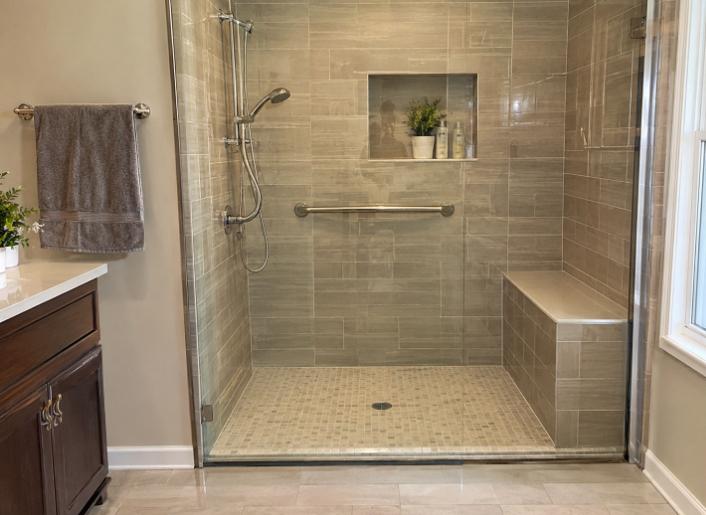
Quick Decision Guide
| If this sounds like you… | Start by looking at… | Why |
|---|---|---|
| You want the simplest, fastest daily wash | A walk-in or low-threshold shower with a seat | No fill or drain wait, no deep seat to get out of |
| You love a long soak and have the space | A walk-in tub with a good seat and a door you can reach | Soaking is the whole point of a tub |
| You are recovering from knee surgery right now | A shower, a tub bench, and your surgeon’s clearance for soaking | Showering usually comes first, and soaking comes later |
| You use a wheelchair or walker for part of the day | A roll-in shower, or a transfer-friendly tub | Transfer room matters more than anything |
| You have a tight budget | A transfer bench, handheld shower, and grab bars on your current tub | Low-cost changes remove the biggest hazards |
| You rent | Removable options, and a written request to the landlord | Permanent changes may need permission |
The one rule for everyone
No fixture fixes a knee problem. A walk-in shower or tub only removes obstacles.
If knee pain, swelling, or instability is changing, tell a doctor or physical therapist, and let them guide how and when you bathe.
What Bad Knees Actually Struggle With in a Bathroom
It helps to name the movements, because each fixture helps with a different one. Bathrooms ask knees to do five hard things, often while wet.
| Movement | Standard tub | Walk-in shower | Walk-in tub |
|---|---|---|---|
| Stepping over a wall or curb | High lift on one leg, then the other | Little or no step | Low step through a door |
| Lowering to a seat | Sitting on a low tub floor is very hard | A bench at a comfortable height | A built-in seat, height varies by model |
| Standing back up | Hard from the tub floor | Easier from a bench with a grab bar | Easier from a seat, but you stand in a tub |
| Kneeling or squatting | Often needed for washing feet or cleaning | Not needed with a handheld shower and long-handled tools | Not needed if the seat and reach are good |
| Balance on a wet floor | Slick tub floor | Textured floor and bench help | Textured floor, and you sit most of the time |
Notice that the tub column has an extra challenge: you are still lowering into and standing out of a deeper space. The shower column avoids most of that. The tub wins only on soaking.
Stepping is the hardest part for many people
A standard tub wall is often more than a foot high. Lifting a stiff or painful knee that high, on a wet surface, is a lot to ask.
That is why most families start by asking about the step.
A walk-in tub swaps the wall for a side door, so the step is much lower. A walk-in shower can remove the step altogether, with a flat or nearly flat floor.
Bending matters more than most people expect
Sitting in a walk-in tub asks the knees to bend, often to about a right angle, and to stay there while the tub fills and drains. For some people that is fine.
For others, especially early in recovery, it is the main drawback.
A shower seat lets you sit with the legs out and the feet flat, which can be easier on stiff knees. If bending is your main limit, try sitting in a demo tub before buying.
Bathing After a Knee Replacement: A Cautious Timeline
Every surgeon has different rules, and every hospital hands out its own sheet. The pattern I see across published guides is similar, though: showers come first, soaking comes later, and safety gear helps throughout.
Please read this part carefully
This guide is not medical advice, and the timing below is not a prescription. Your surgeon sets the rules for your wound and your joint. If your sheet says something different, follow your sheet.
| Stage | What published guides tend to say | Bathroom takeaway |
|---|---|---|
| Before surgery | The AAOS suggests setting up safety bars or handrails in the shower or tub, and arranging help. HSS suggests doing this before surgery if possible | Install grab bars and a non-slip surface early |
| First days | Guides vary: some allow showering within days if the wound is dry and covered, and one HSS guide says no shower or bath until staples or sutures are out, about 10 to 14 days | Ask your surgeon which rule applies to you |
| While the incision heals | Showers are usually allowed once cleared, and many guides say not to soak the incision in a tub. One university hospital says not to soak for 6 weeks | A walk-in tub soak waits for your surgeon’s OK |
| After clearance | Surgeons allow soaking when the incision has healed. Practice with a physical therapist first | Test the tub seat and entry with help the first time |
| Long term | Many people want an easier, lower-step bathroom for good | Plan for the knee you have in five years, not just this month |
Here are my sources for those points.
HSS publishes a guide on caring for the surgical site after knee replacement, and another on getting in and out of the tub with a tub bench.
The University of Iowa Hospitals and Clinics answers frequently asked questions about joint replacement, including soaking.
Mayo Clinic’s overview also suggests making a living space on one floor and installing safety bars in the shower or bath during recovery. See the Mayo Clinic knee replacement page.
What a tub bench does during recovery
A tub bench sits across the tub wall, so you sit outside and swing your legs in. HSS suggests using one until your knee mobility returns, and practicing with a home physical therapist first.
For a partial knee replacement, one HSS guide also says not to bend the knee more than 90 degrees for the first week. Your plan may differ, so ask your surgeon or therapist.
Richmond, Virginia, November 2025
Picture Carol, 69, who scheduled a knee replacement and then looked at her bathroom with fresh eyes. The tub wall was tall, and the floor was glossy tile.
Her daughter Beth read the AAOS checklist and installed two grab bars and a transfer bench before surgery. They added a non-slip mat inside the tub.
Carol showered with help the first week her surgeon allowed it, and skipped soaking for weeks. “I’m glad the hard part was done before I got home,” she said.
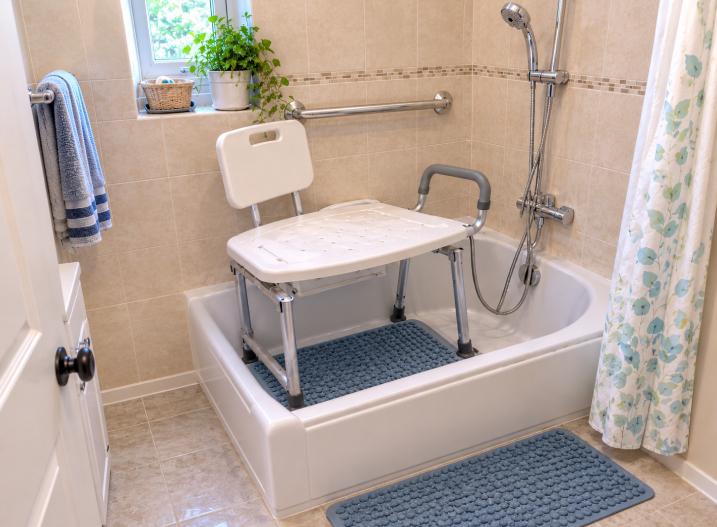
Walk-In Shower for Bad Knees: What to Look For
A good walk-in shower for bad knees is mostly about details. The same shower can be easy or miserable depending on a few inches.
- A low or no threshold. A roll-in style entry has no curb. The ADA allows a threshold of up to half an inch.
- A bench at a comfortable height. The ADA standards use a seat 17 to 19 inches high for transfer showers, a handy yardstick.
- A handheld shower on a slide bar. It lets you rinse legs and feet without bending.
- Grab bars at the entry, by the bench, and near the controls.
- A textured floor with enough slope to drain.
- Enough room. The ADA lists 36 by 36 inches inside for a transfer shower and at least 30 by 60 inches for a roll-in.
Those numbers come from the Access Board’s guidance on bathing facilities. See ADA chapter 6. Homes do not have to follow the ADA, but its numbers are a trusted yardstick.
To see a rough price, try the Senivly walk-in shower cost calculator. It gives a range before you talk to a contractor.
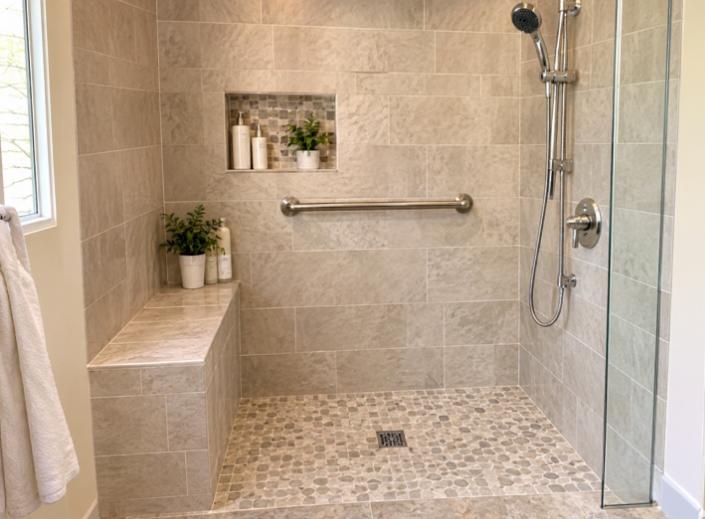
Walk-In Tub for Bad Knees: What to Look For
A walk-in tub can be a very good fit if you love a soak, and if the details match your knees. These are the details I would check first.
- Step-in height. Ask the maker for the exact height you step over at the door. Do not guess from photos.
- Seat height and depth. You want to be able to sit and stand without a big push.
- Leg room. Check how much space there is for your knees and feet while seated.
- Door type. An outswing door can leave more room to approach. An inswing door can crowd the seat.
- Fill and drain time. You wait in the tub for both, so ask for the numbers.
- Grab bars and non-slip surfaces inside the tub.
- Controls you can reach while seated.
I covered fill and drain times in my guide to walk-in tub water heater size, which also explains why a bigger heater may be needed. Check your heater before you order.
For wheelchair-friendly options, my guides to wheelchair accessible walk-in tubs for elderly parents and getting a parent into the bathtub cover doors, seat widths, and transfers.
To compare more options, read my guide on walk-in tub vs walk-in shower for seniors. It looks at the decision from the family’s side.
Test before you buy
If you can, sit in a demo tub with your knees bent for ten minutes. Then stand up, and notice how it feels. Ten minutes in a showroom can save a lot of regret.
Fort Wayne, Indiana, March 2026
Picture Frank, 72, who loves a hot soak and had a bad right knee for years. He drove an hour to a showroom and sat in a walk-in tub for fifteen minutes.
His knees bent more than he liked, and standing up took two tries. A different model had a higher seat and a bit more leg room, and he stood up in one go.
He bought that one. “The showroom saved me from the wrong tub,” Frank said, and he told the salesperson so.
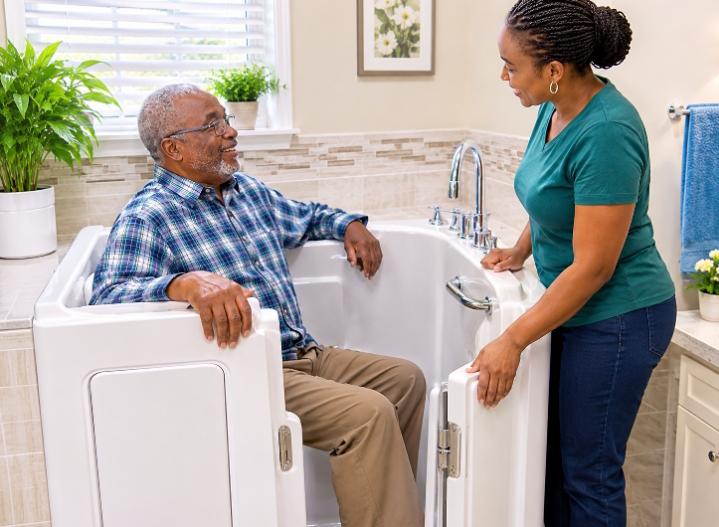
Side-by-Side: Which Is Easier on the Knees?
| Question | Walk-in shower | Walk-in tub |
|---|---|---|
| Step or lift at entry | Little or none | Low, but not zero |
| Bent knees while bathing | Easy to keep legs out | Often bent to sit |
| Soaking | Not possible | Yes, after clearance |
| Waiting during the bath | None | Fill and drain time |
| Space needed | Often about 36 by 36 to 30 by 60 inches or more | Usually more, plus door swing |
| Hot water needs | Moderate | Often larger |
| Helps during early recovery | Yes, with a bench and clearance for showering | Only after soaking is allowed |
| Cost | Often lower | Often higher |
| Transfers from a chair or walker | Excellent with a roll-in layout | Good with a transfer-style tub |
I use words, not scores, here on purpose. Nobody has tested these on your knees. The right answer is the one that fits your body and your routine.
Cheaper and Temporary Options That Help Knees Today
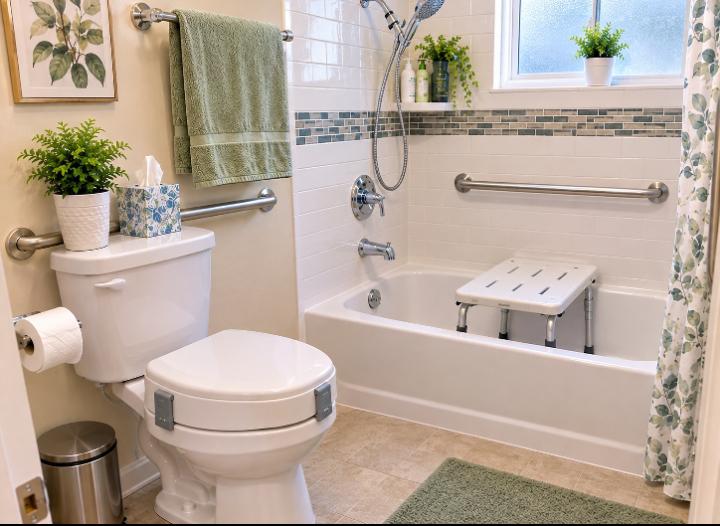
You do not have to decide on a full remodel this week. Several low-cost items help bad knees right away, and they are useful even if you do remodel later.
| Item | What it helps with | Good to know |
|---|---|---|
| Tub transfer bench | Sitting outside the tub and swinging legs in | HSS suggests using one until knee mobility returns |
| Shower chair or bench | Sitting while washing | Must not wobble; test with a helper nearby |
| Handheld shower | Rinsing legs and feet without bending | Usually easy to install |
| Grab bars into studs | Steadying hands for stepping and standing | Suction bars are not meant for body weight |
| Raised toilet seat or frame | Less bending to sit and stand | Matches the 17 to 19 inch seat range |
| Long-handled sponge and tools | Washing feet without bending or kneeling | Cheap and useful |
| Non-slip strips or mat | Grip in the tub or shower | Choose products made for wet areas |
| Hand towels at seat height | No reaching or twisting | Keep them within arm’s reach |
My review of the best grab bars for seniors explains what to look for. Plan the wall blocking and finishes, and install into studs.
If money is tight, these changes are where I would start. They solve the biggest hazards for a fraction of a remodel.
Charleston, South Carolina, June 2026
Picture Denise, 66, whose husband Sam, 70, had a total knee replacement scheduled. They could not afford a new shower, and they rented.
Denise asked the landlord in writing for permission to add grab bars and a handheld shower. The landlord agreed and asked her to leave the bathroom clean at move-out.
They added a rented tub bench, a handheld shower, and a raised toilet seat. Sam managed his first showers with Denise nearby. “It’s not a spa,” he said. “It’s safe.”
Costs, Installation, and Insurance: What to Check
Prices swing by city, by contractor, and by what is behind the wall, so I will not guess at numbers. Use calculators for ranges, then get written quotes.
- Start with the walk-in shower cost calculator and the walk-in tub cost calculator.
- Add the rest of the project with the bathroom modification cost calculator.
- Think about the whole home with the home modification cost calculator.
- Ask each company what is included: removal, plumbing, electrical, permits, and a warranty.
Wondering what install day looks like? I explain the process in the walk-in tub installation guide. It covers timing, plumbing, and what can add cost.
Original Medicare generally does not pay for walk-in tubs or showers, because they are home modifications.
I explain the rules, and where help may come from, in does Medicare or Medicaid cover walk-in tubs in 2026.
Ask early about help
Some Medicare Advantage plans, state programs, and VA benefits may help with home modifications. Rules differ by plan and state, and approval is never guaranteed. Ask before you buy, not after.
Ella’s Bubbles: A Tub Option If Soaking Matters
If you decide a tub is right, one option to compare is the Ella’s Bubbles transfer range.
It has five sizes, from a 26 by 52 inch tub with a 19 inch seat to a 36 by 55 inch tub with a 29 inch seat.
I do not have published step-in height, seat height, or leg room figures for these models, and I will not guess. For knees, those are the numbers to ask for.
- What is the step-in height at the door?
- What is the seat height from the tub floor?
- How much leg room is there while seated?
- How fast does the tub fill and drain?
- What water heater size do you recommend for this model?
- Can I sit in a demo model or see a detailed video?
I may earn a commission if you buy through my Ella’s Bubbles link, at no extra cost to you.
See Ella’s Bubbles Wheelchair Transfer Tubs →
Whichever route you choose, get at least two quotes, and ask each company the same questions in writing.
Bathroom Details That Spare Your Knees
A few small design choices reduce bending, kneeling, and twisting. They are cheap compared with the big fixtures, and they work in a shower, a tub, or a standard bathroom.
- Toilet height: A seat around 17 to 19 inches high is easier than a low one.
- Storage: Keep daily items between knee and shoulder height, with nothing on the floor.
- Lighting: Good light shows wet spots and edges, so you place your feet well.
- Floor: Choose matte, textured surfaces and keep them dry.
- Towels and robe: Hang them within reach of the seat.
- Cleaning: Use a long-handled brush, so nobody kneels to scrub.
For flooring and mats, see the non-slip guide in the reading list below.
Hot Water, Wet Floors, and Calling for Help
The Consumer Product Safety Commission recommends setting water heaters to 120°F, since hotter water can burn skin quickly. Older adults are at higher risk. Read the CPSC scald alert.
Falls are a risk in every bathroom. The CDC’s STEADI program has free resources for older adults and families who want to look at fall risk. See the CDC STEADI page.
- Check the water temperature before you step or sit in.
- Keep a phone or call button within reach of the tub or shower.
- Agree on a check-in with a family member.
- Do not rush out after a long soak. Stand slowly and pause.
If your parent lives alone, a wearable alert can add peace of mind. My guide to medical alert watches with fall detection covers options that work in wet rooms.
A Day in the Bathroom With Bad Knees
It helps to walk through the routine once, step by step. I use this sequence when I think through any bathroom for someone with bad knees. Your therapist may adjust it.
- Set up first. Put towels, soap, and a robe within reach of the seat, and check the water temperature with a hand or thermometer.
- Approach slowly. Hold a grab bar, not a towel bar or the sink. Pause before you step.
- Sit before you wash. Whether it is a bench or a tub seat, sit down fully, then turn on the water.
- Wash seated. Use a handheld shower and a long-handled sponge for legs and feet, so you never bend or kneel.
- Dry and cool down. Pat dry while seated if you can, and let your body settle before standing.
- Stand with a pause. Push up from the seat with a grab bar, then stand still for a few seconds before walking.
- Dress seated. A chair in the bathroom makes socks and pants much easier.
Notice that nearly every step uses a seat, a bar, or a long handle. Those three items do most of the work for knees.
A 20-Minute Home Test Before You Spend Money
You can learn a lot about your needs without buying anything. A kitchen chair, a tape measure, and twenty minutes will tell you more than a brochure.
- Find a sturdy chair and measure its seat height. Sit on it, and notice whether standing feels easy or hard.
- Try a lower seat, like a low stool, and notice the difference. This shows how much seat height matters to your knees.
- Sit with your knees bent as they would be in a tub, and stay there for five minutes. Notice any stiffness or pain.
- Practice standing up with a counter or a sturdy table to hold, which stands in for a grab bar.
- Write down what felt easy and what felt hard.
If a 17 to 19 inch seat feels right, tell the shower or tub company that number. If staying bent was the problem, you may prefer a shower seat with the legs out.
Caregiver Notes: Helping Someone With Bad Knees Bathe
If you help a parent or spouse, a few habits make bath time safer and kinder. They matter just as much as the fixtures.
- Ask how they want to be helped, instead of guessing.
- Stand where you can steady them without pulling on a leg or an arm.
- Never lift under the knee or hold a painful joint.
- Use the bench, handheld shower, and long-handled tools so your back stays safe too.
- Respect privacy, with a towel and a closed door when you can.
- Agree on a signal, so they can say “stop” or “slow down.”
A physical therapist can show safe ways to guide a transfer. Ten minutes of coaching often prevents a strained back or a stumble.
St. Louis, Missouri, September 2025
Picture Linda, 58, who helped her mother Joan, 79, bathe after a knee flare-up. Linda used to grab Joan’s arm and pull.
A therapist showed her how to stand beside Joan, let Joan do the pushing, and use the grab bar for balance. It felt strange at first, and then it felt natural.
Joan said, “You stopped yanking me.” Linda laughed. “I’m learning.”
Plan for the Knee You Will Have in Five Years
Knees change, and so do needs. A bathroom that suits you today may need more room tomorrow. I like to plan for what comes next without overbuilding.
| Today | In a few years | What to plan now |
|---|---|---|
| Cane or no aid | Walker | Wider door and a clear approach |
| Walker | Wheelchair part of the day | A roll-in or transfer-friendly shower or tub, and turning space |
| Short, easy showers | More fatigue and balance trouble | A bench, grab bars, and a call button |
| Occasional soaks | Soaking only with help | A seat that fits, and a plan for a helper |
None of this means expecting the worst. It means choosing a bathroom that can bend with you, which usually costs less than redoing it in two years.
Questions to Ask Your Surgeon or Therapist
- When can I shower, and how should I cover the incision?
- When can I soak in a tub, and what should I watch for?
- How far can I bend my knee in the first weeks?
- Should I use a tub bench or a shower chair, and for how long?
- What height is best for my seat and toilet?
- Is it safe to use hot water, and for how long?
- Who should help me the first few times?
- What signs should make me call you?
Write the answers down and keep them with the bathroom plan. They are the real rules for your recovery, and they beat any article, including this one.
Duluth, Minnesota, January 2026
Picture Walt, 74, who took a list of questions to his follow-up visit. He asked about soaking, and the surgeon said to wait several more weeks.
Walt was annoyed, since he had already shopped for a walk-in tub. His wife suggested he use the waiting time to sit in demo models and compare shower options.
By the time he got the all-clear, he knew exactly what he wanted. “The waiting turned into research,” he said, and he stopped complaining about the doctor.
Seven Mistakes to Avoid
- Assuming a tub is allowed right after surgery. Ask your surgeon about soaking.
- Buying by photo. Sit in a demo, or ask for exact step-in and seat heights.
- Forgetting the water heater. A big tub needs lots of hot water.
- Skipping grab bars. They matter in every option.
- Using suction bars for support. They are not meant for body weight.
- Rushing the decision during recovery. Temporary fixes can buy time.
- Leaving out the person who bathes. Their knees and habits decide the answer.
A Checklist to Take to the Showroom or Contractor
- ☐I know whether my surgeon allows soaking, and from when.
- ☐I have measured the bathroom and the doorway.
- ☐I know the step-in height and seat height for each option.
- ☐I have sat in a demo, or seen a detailed video.
- ☐I know the fill and drain times for any tub.
- ☐I have checked my water heater size and temperature.
- ☐I have asked about warranty, install, and service in writing.
- ☐I have two or more written quotes.
- ☐Grab bars will go into studs or solid blocking.
- ☐A phone or call button will be within reach.
Quick Questions
Is a walk-in tub or shower better for bad knees?
For daily use, a walk-in shower with a seat is often simpler, since it has little or no step and no waiting. A walk-in tub suits people who love soaking and have the space.
Both beat a standard tub.
Can I take a bath after a knee replacement?
Not until your surgeon says so. Many guides say not to soak the incision in a tub until it has healed, and one university hospital says not to soak for 6 weeks.
Showers usually come first. Follow your surgeon’s rules.
When can I shower after knee replacement?
Guides vary. Some say within a few days if the wound is dry and covered, and one HSS guide says not until staples or sutures are out, about 10 to 14 days.
Your surgeon’s office will give you exact instructions.
How high should a shower seat be for bad knees?
The ADA standards use 17 to 19 inches for transfer shower seats, which many people find comfortable. A therapist can fine-tune the height for your legs. Make sure the seat is firmly mounted.
Is a tub transfer bench worth it?
Often yes, especially during recovery. HSS suggests using one until your knee mobility returns, and practicing with a therapist first. It is much cheaper than a remodel and can be removed later.
Do walk-in tubs hurt your knees?
They can, if the seat is low or the knees must stay bent for a long time. Ask for seat height and leg room figures, and sit in a demo before buying.
What bathroom changes help knee arthritis?
A low step, a shower seat, a handheld shower, grab bars, a raised toilet seat, and long-handled cleaning tools all reduce bending, kneeling, and twisting. A therapist can tailor the plan.
Does Medicare cover a walk-in shower or tub for knee problems?
Original Medicare generally does not, because these are home modifications. Some Medicare Advantage plans, state programs, or VA benefits may help. Check before you buy.
How long should I use a shower chair after knee replacement?
It depends on your recovery and your surgeon or therapist. Many people use one for weeks, and some keep it long term. Ask your care team when it is safe to stop.
Should I renovate before or after knee surgery?
Install simple items, like grab bars and a bench, before surgery if possible, as AAOS and HSS suggest. Save big remodels for after you know how your recovery and needs are going.
A Last Thought
A good bathroom for bad knees does not ask your knees to do heroics. It removes the step, offers a seat, and gives your hands something steady to hold.
Start with the cheap, removable fixes this month. Then use your recovery, and your real habits, to decide between a shower and a tub.
And if you are still on the fence, sit in a few. Your knees will tell you more in ten minutes than any brochure will.
Get new Senivly guides in your inbox
I write practical guides on senior home safety and aging in place. Join the newsletter below.
Your turn: Did a tub bench, shower seat, or a new shower make bathing easier for you or a parent? Tell me in the comments.
Continue Reading
- Best non-slip mats and flooring options for senior homes in 2026
- Bathroom grab bar placement for seniors with shoulder arthritis
- Low-impact exercises seniors can do at home
- Best home modifications for aging in place in 2026
- Home safety checklist: 20 ways to make your home safer
This guide is general information, not medical advice. Follow your surgeon’s and therapist’s instructions about showering, soaking, and movement after surgery, and consult a licensed contractor before changing plumbing or walls.